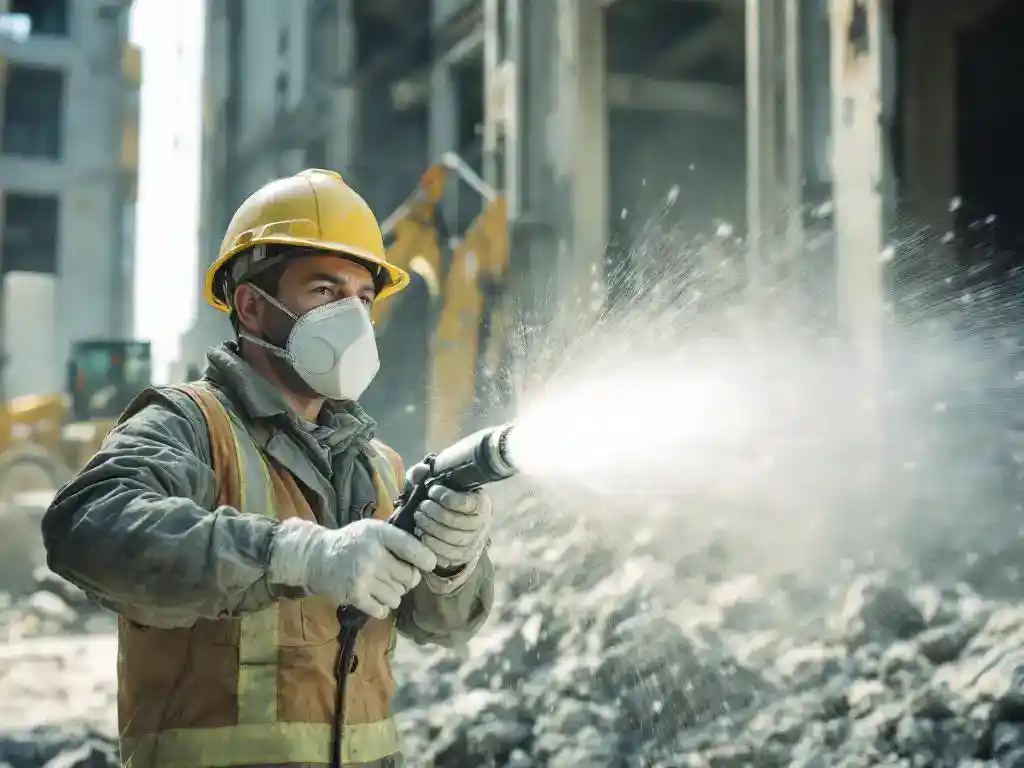
Preventing stored material from being blown away requires a combination of physical protection and dust control techniques. Crust formation, moistening and windbreaks are the most effective methods, with the choice depending on your material type, storage duration and budget. Each material has different properties that determine how susceptible it is to wind, and the right approach can reduce material loss by up to 90 per cent.
Why does stored material actually blow away?
Material is blown away when the wind force exceeds the weight and the binding force of the particles. This occurs mainly with fine materials with a low moisture content, such as coal, biomass, ores and recycled materials. Wind speeds of 5 metres per second or more are already sufficient to cause fine dust to be blown up.
Particle size plays a significant role. Materials smaller than 0.1 millimetres are most susceptible to wind dispersal. Moisture content acts as a natural binder between particles; dry materials are therefore blown away much more quickly than damp ones. The shape of your stockpile also makes a difference: tall, pointed piles create more turbulence than low, rounded mounds.
Weather conditions exacerbate the problem. Dry, hot days with strong winds cause the most disruption. Temperature differences can also cause air currents that blow material into the air. Various industrial sectors have to deal with this on a daily basis.
What methods are available to protect materials from being blown away?
There are five main methods for protecting stored materials: physical covering, moistening, crust formation, windbreaks and covered storage. Each method has its own scope of application and effectiveness.
Physical covering with tarpaulins or nets offers immediate protection, but is labour-intensive and unsuitable for materials that are moved regularly. Wetting with water works temporarily, but consumes a lot of water and must be repeated continuously.
Crust formation creates a protective layer on the material that remains effective over the long term. Windbreaks reduce wind speed around storage areas, but require permanent structures. Covered storage offers complete protection, but requires significant investment.
| Method | Effectiveness | Suitable for | Duration of protection |
|---|---|---|---|
| Crusting | 90%+ | All materials | Weeks to months |
| Humidification | 60-80% | Absorbent material | Hours to days |
| Windbreaks | 50-70% | Permanent storage | Years |
| Scope | 95%+ | Small quantities | To be removed |
How do you choose the right solution for your situation?
The best method depends on your type of material, storage duration, location and budget. Start by analysing your specific situation: what kind of material are you storing, how long will it be stored for, and what are the local weather conditions?
For short-term storage (a few days), moistening is often sufficient. For long-term storage (weeks to months), crust formation works best. Permanent storage locations may benefit from windbreaks or covered storage.
Please also bear in mind the regulatory framework. Increasingly stringent environmental legislation demands effective reduction of dust emissions. Fines for dust nuisance can run into tens of thousands of euros. You should therefore opt for proven dust control solutions that meet all requirements.
Material-specific factors are important. Biomass and recycled materials have different properties to ores or coal. Always test on a small scale first before proceeding to full-scale implementation.
What are the costs of the various protection methods?
Costs vary significantly depending on the method and situation. Wetting costs 2–5 euros per tonne of material, but must be repeated regularly. Crust formation costs 3–8 euros per tonne, but offers long-term protection.
Windbreaks require an investment of 200–500 euros per linear metre, but can be used for many years. Covered storage costs 1,000–3,000 euros per square metre, but eliminates the problem entirely.
Do not forget the cost of doing nothing. Material loss can amount to 5–15 per cent of your stock. With thousands of tonnes of material, this amounts to substantial sums. In addition, you risk fines starting at 10,000 euros for breaches of the regulations on dust emissions.
Operational costs such as water, electricity and labour must also be taken into account. Automated systems have higher acquisition costs but lower operational costs than manual methods.
How we help prevent staff from leaving
We develop biodegradable additives and systems that reduce material loss due to wind blow-off by more than 90 per cent. Our approach is simple: we analyse your specific situation and materials in our own laboratory and recommend the best solution.
Our key solutions for storage problems:
- Crust formation: EcoCrust S and Freko-Crust create a protective layer that remains effective for weeks to months.
- Humidification systems: The Freko-Humidifier is up to 10 times more effective than plain water due to a reduction in surface tension.
- Misting: Misting systems that create a protective mist screen around your storage facility.
- Bespoke installations: Fully automated systems that provide 24/7 protection without the need for manual operation.
All products are 100% safe for people and the environment, and we reduce water consumption by 70–80% compared with traditional methods. We always start with a trial at your premises using your own equipment, so you can be sure the solution works.
Would you like to know which solution best suits your situation? Read more about our approach or contact us directly for a no-obligation analysis of your storage problem.