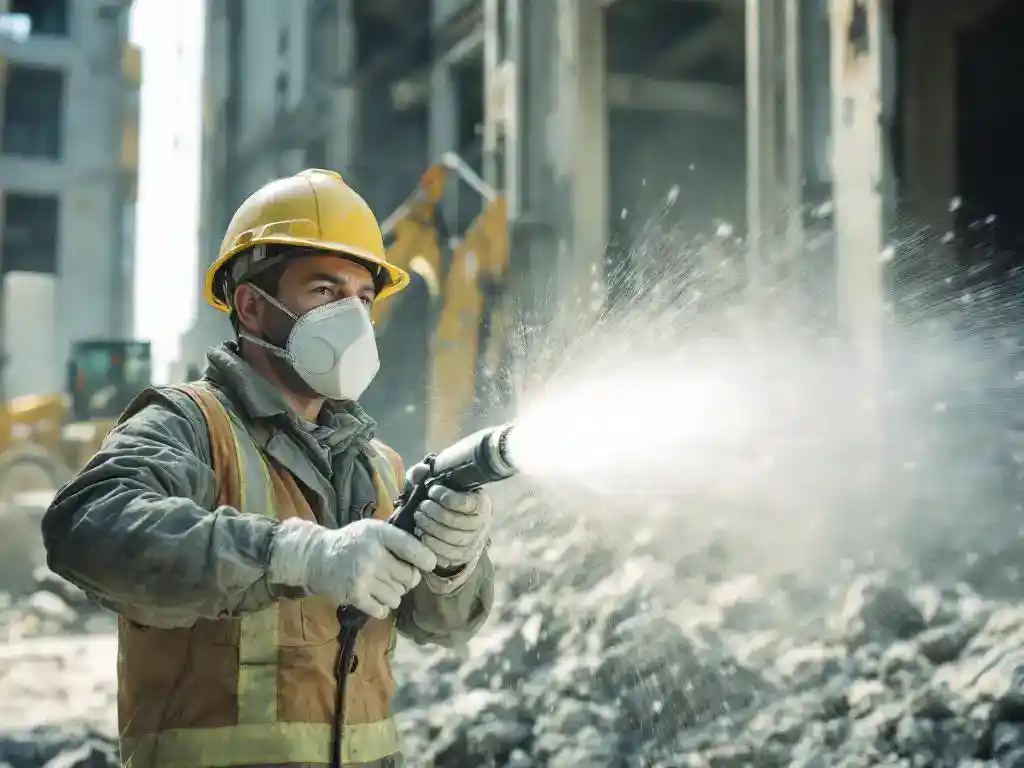
Foam suppression is an industrial dust control method in which foam is sprayed directly onto dust sources to bind dust particles and prevent their dispersion. The foam works by trapping dust particles before they can become airborne, which is more effective than traditional water spraying. Foam suppression is primarily used in processes that generate a lot of dust, such as sorting lines, crushers and conveyor belts. This method uses less water than traditional techniques and offers longer-lasting protection against dust emissions.
What exactly is foaming and how does it work against dust?
Foam generation for dust control works by injecting a special biodegradable solution under high pressure via spray bars and nozzles. The foam produced forms a protective layer that immediately binds dust particles before they can rise and spread through the air.
The mechanism is actually quite simple: when dust particles come into contact with the foam, they are trapped within the foam structure. This prevents them from being blown away or stirred up by the movement of materials. The foam retains the dust particles until it dissolves naturally, after which the trapped particles remain in place.
What distinguishes foam formation from other methods, such as water spraying, is its longer-lasting effect. Whereas water evaporates or runs off quickly, foam remains active on the material for longer. This ensures continuous dust suppression, even when the material is in motion. Furthermore, foam generation uses considerably less water than traditional spraying.
When is foaming the best choice for your dust problem?
Foam formation is ideal when dealing with active dust sources where material is being moved, crushed or sorted. It works extremely well in processes involving continuous movement and where other methods, such as crust formation, are impractical.
The technology is particularly suitable for dust control solutions on sorting lines in recycling plants, crushers in quarries and conveyor belts in ports. Foam formation is also highly effective during loading and unloading operations where material falls from a height.
You should opt for ‘foam formation’ when:
- the material is constantly evolving
- water consumption is a significant cost item
- you require long-term dust suppression
- other methods yield insufficient results in dynamic processes
Companies in various industrial sectors, such as mining, recycling and energy production, utilise foaming because it works effectively under their specific operational conditions.
What are the advantages of foam compared to other dust control methods?
The greatest advantage of foam application is the drastically lower water consumption: up to 70–80 per cent less water than traditional spraying, whilst effectiveness actually increases. This translates into significant cost savings and a more sustainable use of natural resources.
| Method | Water consumption | Duration | Suitable for |
|---|---|---|---|
| Water spraying | High | In short | Static storage |
| Foam formation | Low (70–80 per cent less) | Long | Dynamic processes |
| Crusting | Intermediate | Very long | Long-term storage |
| Misting | Intermediate | Ongoing requirement | Large surfaces |
Foam also provides better coverage of uneven surfaces and works effectively in windy conditions, where water is quickly blown away. The biodegradable formulation ensures that no harmful by-products are produced, which is important for environmental compliance.
Another advantage is flexibility: foam systems are easy to automate and can be precisely calibrated to the specific dust production of your process.
Which materials and processes are suitable for foam treatment?
Foam treatment works well with dry, dust-sensitive materials such as coal, ores, biomass, recycled materials and construction waste. It is particularly effective with materials that produce a lot of fine dust during transport and handling.
Suitable processes are:
- Crushing and screening processes in which material is reduced in size
- Conveyor belts with overflow points
- Sorting lines in recycling companies
- Loading and unloading operations involving ships and lorries
- Storage areas where materials are moved
A few practical considerations are important for the implementation. The material must not be too damp, as the foam will then adhere less effectively. There must also be sufficient space for the installation of spray bars and nozzles at strategic positions.
Foaming is less suitable for very fine powders that become airborne even with minimal air movement, or for processes in which the material is heated directly, as the foam then evaporates too quickly.
How we help with foam formation for dust control
We offer complete foam solutions for industrial dust control, from analysis to implementation and ongoing supply. Our Freko-Foam is a biodegradable foaming agent that is injected under high pressure and effectively binds dust particles at active dust sources.
Our approach comprises:
- Site survey to determine the best locations for spray bars
- Bespoke installations capable of fully automated operation
- Proprietary additives developed in our laboratory for optimal performance
- Opportunities to test with your own materials before investing
- 24/7 support and continuous supply of biodegradable additives
Would you like to know whether foaming is suitable for your dust problem? We’d be happy to help you with a practical on-site test.
Please contact our dust control experts for a no-obligation consultation or arrange a site visit straight away to discuss the options.
Related Articles
- Dust control at transhipment points: which method should you choose?
- What are the disadvantages of covering dust with tarpaulins or cloths?
- How can dust nuisance be prevented when storing ores and coal in port areas?
- What happens during an inspection for dust nuisance carried out by the environmental agency?
- What are the six best methods for dust control in 2026?