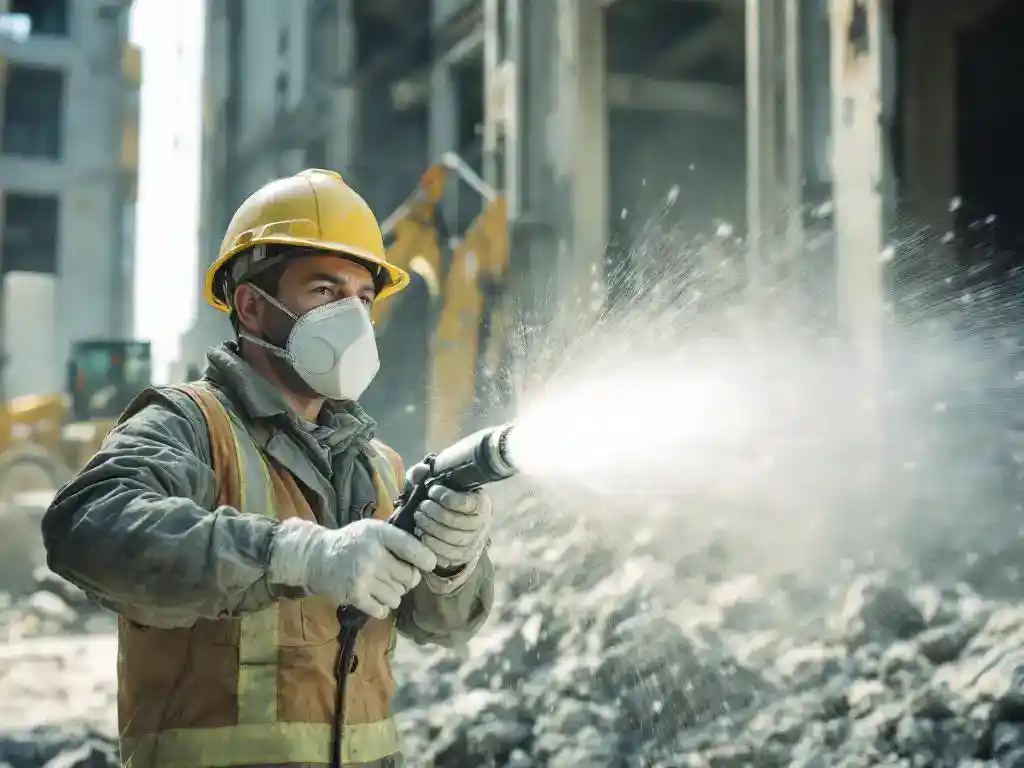
Atomisation is the right choice for dust control when dust is released into the air around a dust source and there is a need for a mist curtain that binds those airborne dust particles before they spread further. It works best with materials that produce fine, light dust particles which become airborne quickly, such as during the loading and unloading of dry bulk materials, waste processing or in crushers. Whether misting is the best approach for your situation depends on the material, the environment and the desired result. This article answers the most frequently asked questions about misting as a dust control technique.
How does atomisation work as a dust control technique?
Atomisation works by creating a fine mist of water droplets around the dust source. These droplets bind the airborne dust particles, after which they fall to the ground together, effectively settling the dust. The system operates in the vicinity of the source, not on the material itself.
The droplet size is the determining factor here. Atomisation systems produce droplets that are so small that they remain in the air for a long time and cover a wide area. The finer the droplets, the better they adhere to the smallest dust particles. By reducing the surface tension of water with an additive such as Freko-Humidifier, droplets become up to ten times more effective at binding dust. This makes atomisation particularly suitable for situations where dust has already been stirred up and is at risk of spreading rapidly.
The installation typically consists of a ring or line of nozzles around the dust source, fed by a pump that atomises water under pressure. The system can be fully automated and tailored to the activity: active whilst a ship is being unloaded, and inactive when the installation is at a standstill.
For which materials and sectors is atomisation suitable?
Atomisation is most effective with dry, light materials that become airborne quickly when disturbed or exposed to wind. Examples include coal, biomass, fly ash, ores and recycled materials. In sectors such as dry bulk handling, power stations, mining and waste processing, these are the most common applications.
Specifically, the most suitable applications are:
- Loading and unloading of dry bulk carriers and lorries — dust is released with every tip or shovelful
- Waste processing plants — sorting lines and crushers continuously generate clouds of dust
- Storage areas and stockpiles — wind causes dust to be blown from the surface
- Conveyor belts — overflow points are known sources of dust
- Biomass and coal-fired power stations — fine material during supply and storage
For a complete overview of industries where atomisation is used, see our industrial sectors page.
What is the difference between atomisation, crust formation and foam treatment?
The key difference lies in the timing and location of the treatment. Atomisation acts in the air around the dust source and binds dust that has already been stirred up. Crusting acts on the material itself and forms a protective layer that prevents dust from becoming airborne. Foam treatment binds dust particles directly at the source – such as on a conveyor belt or in a crusher – before the dust has a chance to disperse.
A comparison in broad terms:
- Atomisation: a mist screen around the source, effective even when dust has already been stirred up
- Crust formation: a protective layer on the surface of the material, suitable for stockpiles and storage sites
- Foam treatment: direct binding at the source of the material, ideal for sorting machines, crushers and conveyor belts
The choice between these techniques depends on where the dust is released, what the material looks like and what the environment permits. In many situations, two techniques are combined to achieve a more comprehensive result. See the overview of dust control solutions for more information on each technique.
When exactly does atomisation not work well?
Spraying is less effective when the material is already wet or heavy, when dust does not rise but remains on the surface, or when the environment is sensitive to additional moisture. In such cases, crust formation or foam offers a better solution.
Specific situations in which atomisation falls short:
- Materials with a high moisture content — adding extra water contributes little and may damage the material
- Enclosed spaces with limited air circulation — mist spreads with difficulty and does not reach all dust particles
- Strong winds or open locations — the mist is blown away before it can bind with dust
- Materials that must not become damp — for some raw materials or products, moisture is undesirable
- Dust already lying on the surface of a stockpile — atomisation does not affect this; crust formation is therefore more effective
It is therefore important to analyse the source material and the content thoroughly before selecting a technique.
What factors determine whether atomisation is profitable?
Mist spraying is cost-effective when the investment in installation and water consumption outweighs the costs of dust-related nuisance: fines, health risks, downtime and complaints from local residents. The payback period depends heavily on the scale of the problem and the frequency of use.
The key factors determining profitability:
- Frequency of data generation — the more often the system is active, the faster the investment pays off
- Water consumption — with additives such as Freko-Humidifier, water consumption is significantly reduced, which lowers operational costs
- Automation — an automated system prevents waste and reduces labour costs
- Avoided costs — fines for non-compliance with environmental legislation, loss of production due to dust nuisance and absenteeism
- Scale of the installation — larger installations require a higher initial investment, but also deliver a greater impact per euro
How do you combine atomisation with additives to achieve better results?
Adding an additive to the misting water significantly increases the system’s effectiveness. The additive reduces the surface tension of the water, causing the droplets to become smaller and adhere more effectively to fine dust particles. This results in better adhesion and reduced water consumption.
In practice, this works as follows: the additive is dosed into the water system of the atomisation installation. The concentration is low, but the effect on droplet size and adhesion is significant. Freko-Humidifier has been specifically developed for this purpose and is fully biodegradable and safe for people and the environment.
The combination of atomisation with an additive is particularly valuable in:
- Materials containing very fine dust particles that are difficult to bind with water alone
- Locations where water consumption needs to be reduced
- Situations where a higher concentration of dust requires a more powerful system
Adding an additive is a simple adjustment that does not require any major changes to the existing installation.
How we assist with misting as a dust control solution
At Wuvio, we analyse every dust problem on site before recommending a solution. Atomisation is one of the techniques in our portfolio, but we always choose the approach that best suits the material, the environment and the process.
- Analysis and advice: we identify the sources of dust and determine which technique is most effective
- Lab testing with our own materials: we use our own laboratory to test the effectiveness of additives on the specific material
- Bespoke installation: misting systems that are fully tailored to the location and the process
- Freko-Humidifier: our additive that makes atomisation up to ten times more effective and reduces water consumption
- Ongoing supply: biodegradable additives supplied as and when required, without the need for large stocks
Would you like to know whether atomisation is the right choice for your situation? Read more about us and our approach, or get in touch for a no-obligation chat.