To draw up a dust control programme for a recycling site, you must first identify the dust hotspots (where, when and under what circumstances dust is generated), then carrying out a risk assessment, formulating measurable targets and linking the control methods to the specific materials and processes on site. Dust control is not a stand-alone measure, but an integral part of business operations: it relates to emissions, air quality, compliance with permits and the continuity of the business. The questions below will guide you step by step through the process of developing such a programme.
Which material sources are specific to a recycling site?
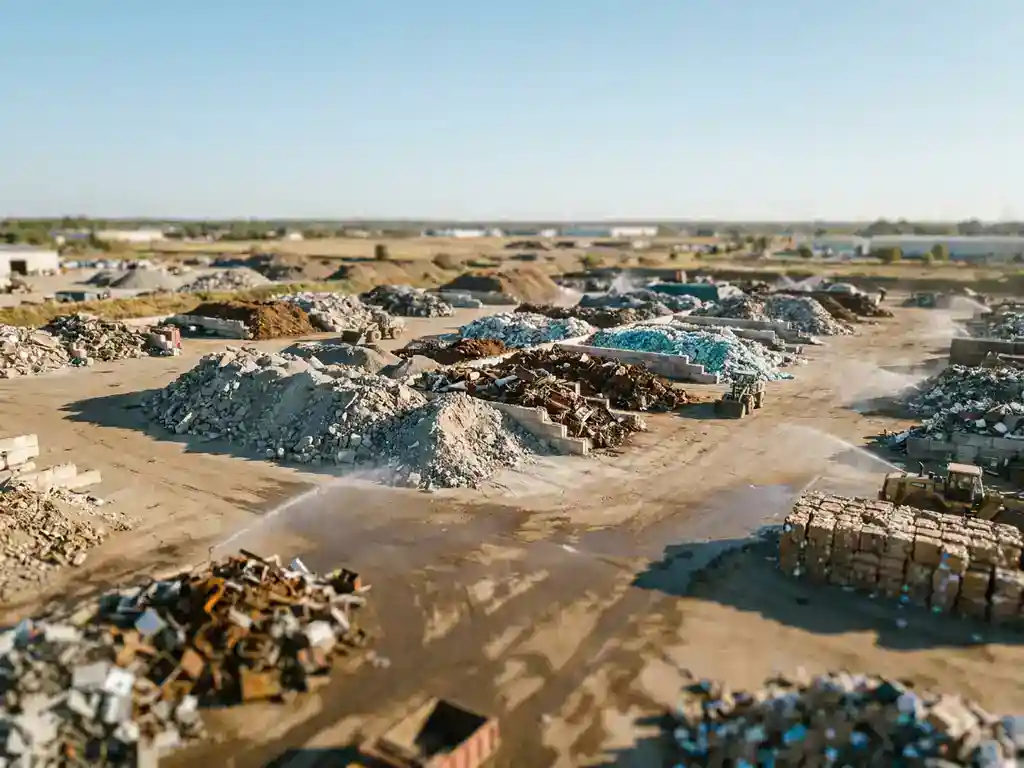
At a recycling site, the sources of particulate matter are diverse and depend on the material flows being processed. The main sources are transfer points, sorting lines, crushers, shredders, conveyor belts and the outdoor storage of dry material. Particulate matter is released whenever dry material is moved, but also when wind blows across uncovered storage areas.
Specifically for recycling, materials include construction and demolition waste, paper and cardboard waste, plastics, metal dust and mixed waste streams. These materials vary greatly in moisture content, particle size and dust behaviour. Dry construction and demolition waste often contains silica-containing dust, which poses additional health risks. Paper and cardboard processing generates light, fine dust that can spread over long distances. Metal processing produces fine dust containing potentially toxic components.
In addition to the materials themselves, the processes also play a role. Crushers and shredders are significant sources of dust because they fragment material. Conveyor belts generate dust at transfer points. And during dry periods, vehicles travelling on unpaved sections of terrain can contribute significantly to total dust emissions.
Furthermore, dust emissions are rarely constant. They vary by season, wind direction and speed, material supply and time of day. It is therefore worthwhile to record, for each source, when and under what conditions emissions peak. Operators who work on site every day often possess the most valuable knowledge in this regard: they know which areas are the first to become dusty in dry weather or when a particular type of material is delivered. A comprehensive overview of all sources and hotspots is the first step towards effective dust control.
What laws and regulations apply to dust emissions at recycling sites?
Recycling sites in the Netherlands are subject to the Environment Act and the associated environmental permit, which sets out limit values for dust emissions. In addition, the standards set out in the Activities Decree for particulate matter (PM10 and PM2.5) and the Working Conditions Act apply to the protection of employees against harmful dust in the workplace.
In practical terms, this means that recycling companies must demonstrate that dust emissions remain within permitted limits. The Dutch Air Emissions Directive (NeR) and its successor under the Environment Act set requirements for diffuse emissions, including dust from storage and transhipment activities. For companies subject to IPPC regulations, additional Best Available Techniques (BAT) obligations apply.
At European level, the Industrial Emissions Directive (IED) and the air quality directives are relevant. Towards 2030, the standards for particulate matter will be further tightened in line with the revised WHO guidelines, and BAT requirements and emission limit values for particulate matter will become stricter. Existing permits may therefore need to be amended. Fines for non-compliance can be substantial, and enforcement by environmental agencies is increasing.
Structural dust control therefore directly affects the licence to operate. Repeated breaches or complaints from local residents can lead to additional licensing requirements, restrictions on processing capacity or, in the worst-case scenario, the suspension of operations. A sound dust control programme is therefore not only an operational choice, but also a legal necessity and a prerequisite for business continuity.
How do you carry out a substance risk assessment at a recycling site?
A dust risk assessment at a recycling site is carried out by systematically identifying all sources of dust, measuring or estimating exposure levels, and assessing the risks to both staff and the surrounding environment. This forms the factual basis for the dust control programme.
The assessment consists of a number of specific steps:
- Hotspot analysis: Map out all processes and locations where dust is released and record when and under what circumstances this occurs, including seasonal variations, weather influences and peak periods in supply. Involve the operators in this process, as they are familiar with the hotspots from their day-to-day experience.
- Material assessment: Analyse the dust characteristics of the processed materials: particle size, moisture content, dust potential and any hazardous components such as silica or heavy metals.
- Emissions measurement: Measure particulate matter concentrations at relevant monitoring points, both at the source and at the site boundary. Use certified measurement methods in accordance with NEN standards for this purpose. For larger sites, additional techniques such as LiDAR can provide insight into the dispersion of dust plumes.
- Employee exposure assessment: Determine the personal exposure of employees working close to sources of substances, in accordance with the Health and Safety Regulations regarding limit values in the workplace.
- Risk prioritisation: Prioritise the sources of substances based on emission intensity, duration of exposure and health risk. This determines where the approach should be implemented first.
The outcome of this assessment is a clear picture of where the greatest risks lie and which sources deserve priority. Without this step, a substance management programme is an assumption rather than a well-founded approach.
Which pest control methods work best for recycled materials?
For recycled materials, foaming, atomisation and crust formation work best, depending on the location of the dust source and the type of material. There is no one-size-fits-all solution: effectiveness depends on the material’s moisture content, the process speed and the environmental conditions. As a result, the technique, dosage and equipment vary by location and may require a bespoke approach. Additives work best as part of a broader strategy, alongside source control measures such as containment, process adjustments and site management.
Foaming in crushers and sorting lines
For intensive dust sources such as crushers, shredders and sorting lines, foaming is a proven method. Foam binds dust particles directly at the source before they enter the air. It is injected under high pressure via spray bars and nozzles and is particularly effective with dry, friable material. A biodegradable foam additive such as Freko-Foam adds minimal moisture to the material, which is important when the process material must remain dry.
Uncertainty surrounding transhipment points and storage
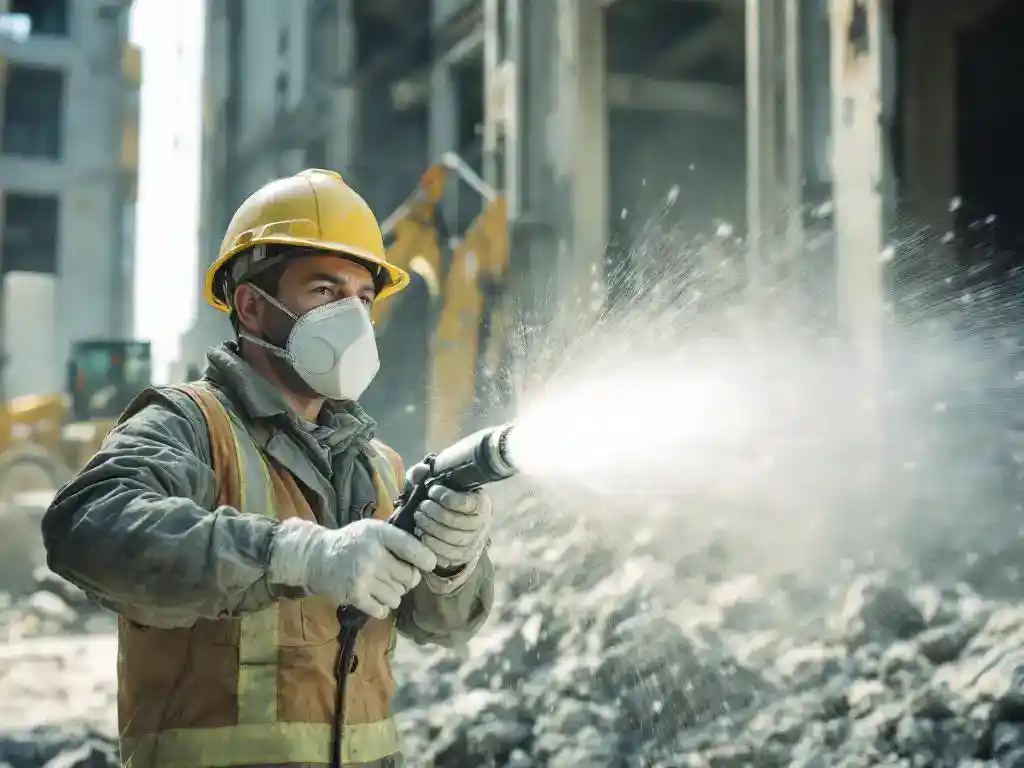
At transhipment points and outdoor storage areas, atomisation is a suitable method. An atomisation system creates a mist curtain of fine water droplets around the dust source, thereby trapping dust particles before they spread further. Effective dust control does not automatically mean using more water. With an additive such as Freko-Humidifier, which reduces the surface tension of water, the binding with dust particles is improved and water usage can actually become more efficient.
Crust formation on storage surfaces
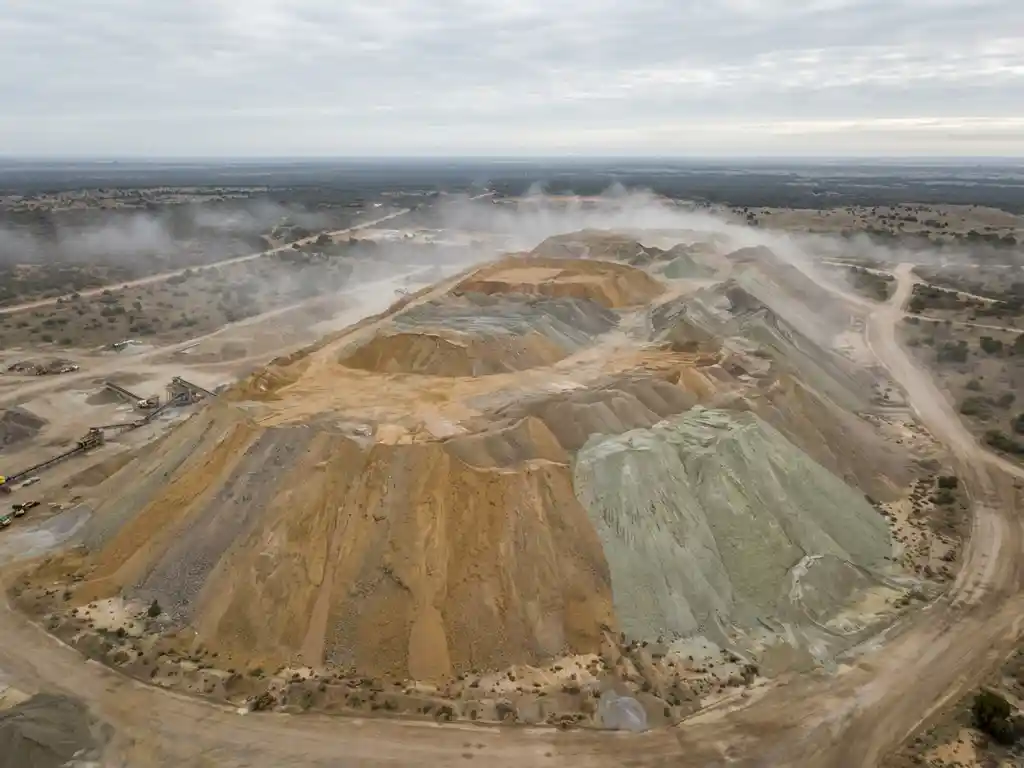
For dry storage areas and stockpiles of recycled material, crust formation is the most sustainable solution. A crust former applies a protective layer over the surface of the material, preventing the wind from dislodging dust particles. This is particularly effective for the seasonal storage of dry material that remains on site for extended periods.
See the overview of sectors and applications for further insight into which methods are used in comparable industrial environments.
How do you set measurable objectives and KPIs for dust control?
Measurable targets for dust control are set by taking current emission levels as a starting point and formulating concrete reduction targets that align with the permitted limit values, the outcomes of the risk assessment and the expected tightening of standards towards 2030. KPIs make progress visible and demonstrable to regulators, and provide the basis for validating results and optimising the approach.
Relevant KPIs for a recycling sector include:
- PM10 and PM2.5 concentrations at the site boundary, measured at fixed monitoring points and assessed against authorised limit values
- Personal exposure of employees, expressed as average daily concentration and assessed against the limit values set out in the Health and Safety Catalogue
- Number of complaints from local residents about dust nuisance per quarter
- Water consumption by dust control systems, as an indicator of efficiency and sustainability
- Frequency of maintenance and inspection of installations and nozzles
- Percentage of dust sources equipped with active dust control compared to the total number of identified sources
Set a target value and a measurement frequency for each KPI. Quarterly reports provide a good rhythm for making adjustments without becoming an administrative burden. Actively use the measurement data to optimise dosage, equipment and timing of application: measurement is not an end in itself, but the basis for making adjustments. Also link the KPIs to responsibilities: who measures, who reports and who makes decisions when targets are exceeded.
When is a substance management programme ready for implementation?
A dust control programme is ready for implementation once the dust sources and hotspots have been identified, the risk assessment has been completed, the appropriate methods have been selected, and the objectives and KPIs have been established. In addition, responsibilities must have been assigned and the necessary installations or resources must be available.
In practice, it is advisable to begin with a pilot phase focusing on the most critical sources of contamination. This makes it possible to test the chosen methods, dosages and equipment under real process conditions before the programme is fully rolled out. A pilot limits the initial investment and provides immediate evidence of effectiveness, which simplifies internal decision-making.
A programme is only ready for implementation once it has gained support on the shop floor. Staff who work with the installations on a daily basis must know how they function, what to look out for in the event of malfunctions, and how they contribute to meeting the objectives. Training and clear protocols are therefore an integral part of the preparation.
How we help set up dust control measures at recycling sites
Wuvio supports recycling companies in setting up and implementing a dust control programme. This begins with a thorough analysis of dust sources, hotspots and materials on site, carried out by our specialists. We then test the most suitable solutions in our own laboratory and on-site, ensuring that the approach is tailored to the actual process conditions.
What we offer:
- Site assessment and substance risk assessment by experienced specialists
- Laboratory testing using our own materials to determine the correct additives and methods
- Bespoke systems for foam generation, atomisation and crust formation
- Biodegradable additives, safe for people and the environment
- Ongoing delivery and technical support following implementation
- Support with compliance with emissions regulations and licensing requirements
It is always possible to start small: begin with a test on the most critical source of contamination and scale up when the results justify it. You can read more about our approach on our website, or contact us directly for a no-obligation discussion about the situation at your site.
Related Articles
- What is dust control in the mining industry?
- Which dust binders are suitable for dust control in ports?
- What are the first three steps to take in the event of an acute dust nuisance on an outdoor site?
- What is source-oriented dust control and when should you apply it?
- What effect does particulate matter have on your body?