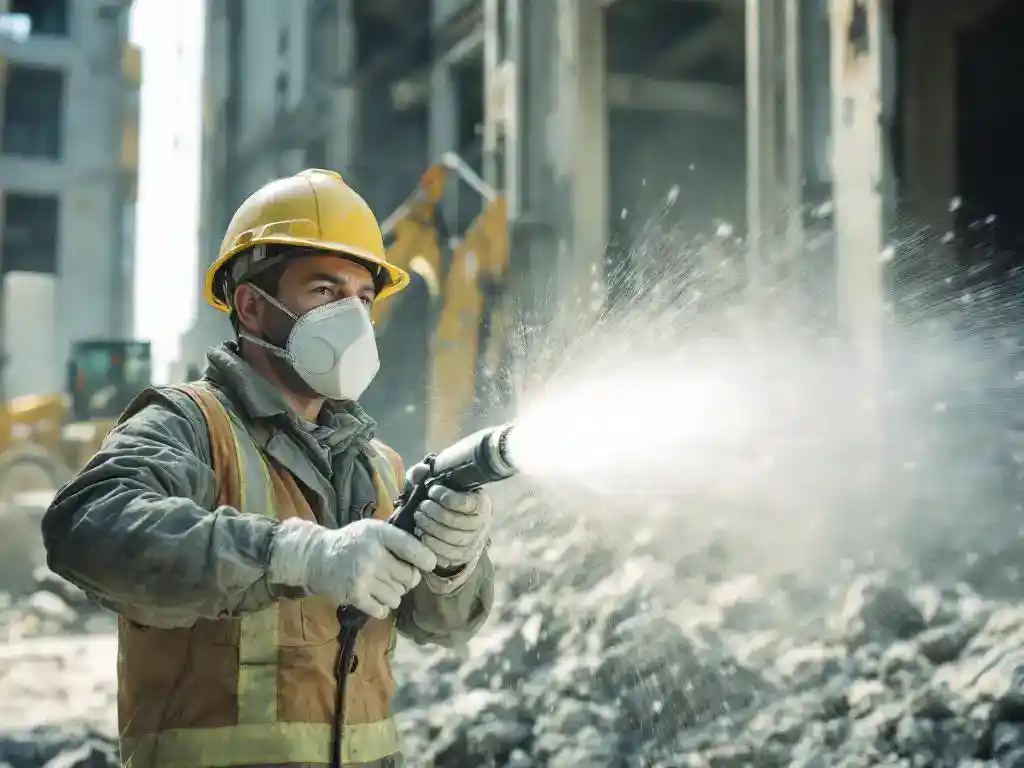
When it comes to dust control in dry mining environments, seven solutions have been proven effective: crust formation on stockpiles, foam formation at crushers and conveyor belts, atomisation at transhipment points, road dust control on unpaved roads, extraction in enclosed installations, covering stockpiles and the use of hygroscopic additives. Which approach works best depends on the type of material, the location of the dust source and the climatic conditions. Dust control is not an isolated measure, but part of broader operational management: it relates to emissions, air quality, regulatory compliance and business continuity. The questions below provide a specific answer for each situation.
Why is dust in dry mining environments so difficult to control?
Dust in dry mining environments is difficult to control because the dust sources are numerous, scattered and continuously active. Crushers, conveyor belts, loading and unloading points, unpaved access roads and open stockpiles constantly produce dust particles. In dry conditions, the natural binding effect normally provided by moisture is absent, meaning that even a light breeze can disperse fine dust over long distances.
Furthermore, mining materials vary greatly from one another. Ores, coal, limestone grit and sand each behave differently when subjected to mechanical processing. The particle size distribution, moisture content and chemical composition determine how quickly and how much dust is released. A method that works well with lime may prove inadequate for coal dust. This renders a generic approach unsuitable and calls for a solution tailored to the specific material and process.
Furthermore, traditional methods such as simply spraying water in dry environments are only effective for a short time. The water evaporates quickly, after which dust formation resumes immediately. Using more water is therefore not automatically the solution: without the right additives, the effect wears off within a short time and water consumption rises without any improvement in dust suppression. Additives can prolong dust suppression and make water use more efficient.
Start by mapping out the substance hotspots
Effective dust control does not begin with the choice of a product, but with an understanding of the sources of dust. Therefore, first identify the hotspots: where does the dust originate, when does it occur and under what circumstances? Consider peak times during crushing, loading and unloading, dry periods, strong winds and busy transport routes. Operators and foremen know the areas where dust is most prevalent and are therefore a valuable source of practical knowledge for this assessment.
A straightforward approach consists of three steps:
- Identify all sources of dust at the site, by process and by material.
- Assess for each source when and under what weather and operational conditions particulate matter formation peaks.
- Rank the sources according to their contribution to total emissions and tackle the biggest hotspots first.
What health risks do mining dust pose?
Mining dust poses serious health risks, particularly due to prolonged exposure to respirable particulate matter. Particles smaller than 10 micrometres (PM10) and, in particular, particles smaller than 2.5 micrometres (PM2.5) penetrate deep into the lungs and are not, or hardly, eliminated by the body. This leads to chronic conditions such as silicosis, pneumoconiosis and an increased risk of lung cancer.
Silicosis is an occupational disease caused by inhaling crystalline silicon dioxide, which is present in quartz. This mineral is found in virtually all common mining materials. The disease is irreversible and can also occur following relatively short periods of exposure to high concentrations. Employees working with crushers, drilling machines or on dust-laden access roads are at the greatest risk.
In addition to lung conditions, high dust concentrations can also irritate the eyes, skin and respiratory tract, impair concentration and increase the risk of workplace accidents by restricting visibility. Dust control is therefore directly linked to safety in the workplace.
What are the legal standards for dust emissions in the mining industry?
The legal standards for dust emissions in the mining sector vary by country, but in Europe the Industrial Emissions Directive (IED, 2010/75/EU) provides the overarching framework. Within this framework, national standards have been established for maximum exposure limits in the workplace and for emissions to the outside air. In the Netherlands, the limit values set out in the Working Conditions Regulation and the requirements of the Environmental Management Activities Decree apply.
In the Netherlands, the limit value for respirable quartz dust is 0.075 mg/m³ as a time-weighted average over an eight-hour working day. Exceeding this limit not only poses health risks but also results in enforcement measures and substantial fines. Regulatory bodies such as the Dutch Labour Inspectorate (NLA) carry out spot checks and may halt production processes in the event of repeated breaches.
In addition to workplace standards, environmental emission standards also apply. Dust deposition on neighbouring plots and particulate matter concentrations in ambient air are governed by the Environmental Management Act and the European Air Quality Directive (2008/50/EC). Organisations active in the mining sector would be well advised to systematically monitor and document their dust emissions, so that, in the event of an inspection, they can immediately demonstrate that they are operating within the standards.
Stricter requirements towards 2030 and the licence to operate
The direction is clear: requirements regarding particulate matter are becoming stricter. European air quality standards are expected to be tightened by 2030, and the BAT (Best Available Techniques) requirements and emission limit values for particulate matter within industrial emission frameworks continue to evolve. Those who invest systematically in dust control now will prevent future tightening of regulations from leading to emergency measures or production restrictions.
Furthermore, dust control is closely linked to the ‘licence to operate’. Regulatory authorities and local residents assess a mining site partly on the basis of its dust pollution. Demonstrably and systematically controlled emissions strengthen trust and reduce the risk of complaints, enforcement action and licensing issues. Incidental measures taken in response to complaints are therefore insufficient; dust control should be an integral part of business operations.
How do you measure and validate whether dust control is effective?
You validate dust control by measuring emissions before and after the measure and comparing the results. Without measurement data, the effect of an approach remains an assumption. To measure particulate matter, continuous PM10 and PM2.5 monitors are often deployed along the site boundary and at the main hotspots. LiDAR measurements are a suitable complement for mapping dust plumes over larger areas, as they reveal where and to what extent dust is spreading.
Use the measurement results to further refine the approach: adjust the dosage of additives, the nozzle configuration and the spraying frequency based on what the data shows. This prevents both under- and over-dosing and keeps water consumption low. Furthermore, record the results so that you can demonstrate during inspections and licensing procedures that the measures are effective.
How does crust formation work as a dust control method in mining?
Crust formation works by creating a protective layer on the surface of a stockpile or bulk material, causing dust particles to remain bound and preventing them from being released by wind or movement. A crusting agent is applied via spraying systems and penetrates slightly into the surface, after which it hardens into a flexible layer that resists wind and rain.
In the mining sector, crust formation is particularly suitable for open stockpiles of ores, coal or crushed stone that remain on site for extended periods. The crust prevents mass loss due to wind erosion and reduces the need for frequent re-treatment. Water-based products containing natural fibres, such as EcoCrust S, reduce dust formation on stockpiles by more than 90 per cent and are fully biodegradable.
A key advantage over atomisation is that crust formation has a lasting effect. Atomisation works actively only whilst the system is running; crust formation also provides protection when no equipment is in operation. This makes it a cost-effective solution for static dust sources with a high dust risk.
When is foaming the better choice over atomisation?
Foaming is the better choice over atomisation when the dust source produces a high concentration of dry, fine particles at a specific point, such as a crusher, sorting plant or transfer point on a conveyor belt. Foam traps dust particles directly at the source before they enter the air, whilst misting captures dust particles in the air after they have already been released.
The difference lies in the method. Atomisation creates a mist curtain around the dust source and is effective for larger, open dust clouds. Foam is injected under pressure via spray bars and nozzles directly onto the material, thereby trapping the dust at the point of release. This makes foam formation more effective in cases of high dust concentrations in a confined area and with materials that dry quickly.
Furthermore, foam formation consumes considerably less water than atomisation. In arid mining environments where water consumption is a limiting factor, this offers a practical advantage. The biodegradable composition of foam additives also ensures that no hazardous residues are left behind on the material or in the soil.
Which dust control solution is suitable for which mining material?
The correct dust control solution depends on the properties of the material: particle size distribution, moisture sensitivity, chemical composition and the way in which the material is moved or stored. Not every material reacts in the same way to water, foam or crust formation, and the wrong choice leads to insufficient effectiveness or unnecessary costs.
The overview below provides practical guidance for each type of material:
- Iron ore and copper ore: Crust formation on stockpiles; foaming at crushers and conveyor belts. Ores are heavy and produce a great deal of fine dust during mechanical processing.
- Coal: Crust formation for long-term storage; atomisation at loading and unloading points. Coal dust is flammable, which requires extra caution when selecting additives.
- Limestone grit: Foaming in crushers; dust suppression on access roads within the mine site. Limestone generates a great deal of dust in dry conditions and under high mechanical stress.
- Sand and gravel: Spraying at transhipment points; dust control on unpaved roads. The coarse fraction generates less dust, but fine sand spreads quickly in the wind.
- Phosphate rock: Crust formation on stockpiles; foaming during processing. Phosphate dust is fine and may be harmful if inhaled.
A laboratory test using your own materials provides the most reliable basis for your choice. Substance behaviour varies depending on location, climate and processing method, and what is correct in theory must be confirmed in practice. Please also bear in mind that the correct technique, dosage and equipment may vary depending on the location, material and process, and therefore often require a bespoke approach. Additives work best as part of a broader dust control strategy, in combination with good process design, equipment maintenance and monitoring, rather than as a stand-alone solution.
How we help with dust control in the mining industry
We support mining companies in finding a dust control approach that is tailored to their specific materials, location and process conditions. This begins with an analysis of the dust sources and a laboratory test using the company’s own materials, ensuring that the solution is based on measurable results rather than assumptions.
- Lab test using our own materials for objective product selection
- Tailored advice per dust source: stockpiles, crushers, conveyor belts and access roads
- Biodegradable additives for crust formation, foaming and atomisation
- Installation and commissioning of sprinkler systems and nozzles
- Optimisation of dosing and equipment based on measurement data
- Ongoing supply of additives and technical support
- Operating in Europe and the Middle East, with local expertise in each region
Looking for an effective solution for industrial dust control? We’d be happy to help you find a suitable approach. Take a look at our dust control solutions or get in touch for personalised advice.
Related Articles
- How effective is foaming for dust control in the mining industry?
- How does dust suppression using foam additives work in a port?
- Which four weather conditions exacerbate dust nuisance the most?
- How does high-temperature dust pollution affect outdoor areas?
- How does dust control in biomass storage differ from that in other sectors?