Dust pollution on your business premises is more than just a visual problem. It poses health risks to staff, leads to complaints from local residents and can result in hefty fines due to stricter environmental legislation. Fortunately, there are effective ways to drastically reduce dust emissions. From optimised spraying techniques to innovative biodegradable additives – with the right approach, you can bring dust problems under control and create a safer working environment.
Why dust nuisance is a growing problem?
The pressure on industrial companies to control dust emissions is steadily increasing. Stricter environmental legislation means that what was once acceptable can now lead to fines and production disruptions. In addition, employers are increasingly being held liable for the health of their staff.
Dust cumulation in the workplace causes respiratory complaints and irritation and can lead to serious health problems in the long term. This results not only in higher sickness absence, but also in lower productivity and higher insurance premiums. Furthermore, complaints from local residents damage a company’s reputation and may lead to legal proceedings.
The consequences for your business operations are immediately apparent: disrupted processes, higher operational costs and constant concerns about compliance. It is therefore important not to view industrial dust control as a cost item, but as an investment in the continuity of your business.
1. Optimising water misting and spraying techniques
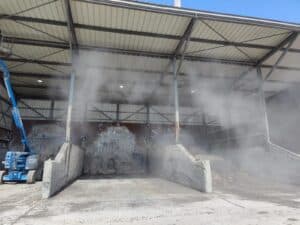
Traditional water spraying techniques are often the first step in dust control, but they can be applied much more effectively. It is not just about how much water you use, but above all about how and when you use it. The right spraying systems make the difference between effective dust suppression and a waste of water.
Timing is crucial when it comes to misting. Do not spray continuously, but anticipate times when dust formation will accure, such as during transhipment or transport. By positioning misting systems at the right points, you create a mist curtain around the dust source that binds particles before they became airborne.
Please note the limitations: in strong winds, atomisation is less effective, and in cold conditions, freezing can cause problems. Mud formation due to excessive water can also cause new problems, particularly with finer materials.
2. Applying crust formation for long-term protection

Crust formation offers an efficient solution for dust control in stockpiles and dry bulk goods. By applying a protective layer over the material, you prevent dust particles from being released. This method can reduce dust formation by more than 90% and – if desired – be designed so that the crust remains effective for a longer period.
Crust formers work very well with materials such as ores, coal, biomass, petcoke and ash. The crust former has a base consisting of natural fibres mixed with water and additives. Together, they form a flexible yet strong protective layer. This layer is resistant to harsh weather and breaks down slowly and naturally, without leaving behind any harmful residues.
The major advantage of crust formation is its long-term effectiveness. Whereas traditional methods require daily attention, a single treatment protects the storage for weeks or even months. This makes the crust former particularly suitable for large stockpiles, where continuous treatment is practically unfeasible.
3. Using foaming techniques in transport and transhipment
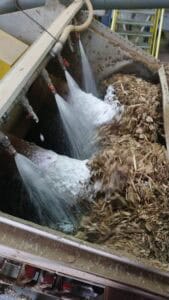
Foam formation is the ideal solution for dust generation during transport on conveyor belts and at drop points. The foam adheres to the dust particles, preventing them from becoming airborne. This makes it particularly effective on sorting lines, crushers and conveyor belts.
The foam is injected under high pressure via spray bars and nozzles, ensuring it is directed precisely where dust formation occurs. Dry foam works by the foam structure binding small dust particles to larger ones without any clogging.
This method is particularly valuable in transhipment operations as it does not disrupt the flow of materials. The foam dissolves naturally and leaves no residue that affects the quality of the product. Furthermore, it is biodegradable and harmless to aquatic environments.
4. Which biodegradable additives are suitable for your material?
Not every additive works for every material. The choice depends on factors such as particle size, moisture content, chemical composition and the specific conditions under which the material is processed. Biodegradable additives offer an environmentally friendly solution without the risks associated with traditional chemical dust control.
Biodegradability is important not only for compliance with environmentally friendly dust control, but also for the long term. Traditional chemical agents can accumulate in the soil and pollute the groundwater. Biodegradable alternatives break down completely into harmless components such as water and CO2.
5. Preventive measures and process optimisation
The best way to tackle dust is to prevent it from forming at source. This begins with analysing your work processes and identifying moments when large amounts of dust are released. Often, minor adjustments to timing, speed or working methods are sufficient to reduce dust nuisance.
Consider adjustments such as reducing drop heights during transhipment, installing windbreaks around critical zones or adjusting transport speeds. The sequence of operations can also have an impact: carry out dust-sensitive activities during periods of lower wind speeds.
Integration into existing business processes requires a holistic approach. Train your staff in dust-aware working practices, draw up clear procedures and ensure regular evaluation of their effectiveness. Dust control in industry is a team effort: everyone must understand why and how dust control works.
| Method | Best use | Duration | Water consumption per unit |
|---|---|---|---|
| Misting | Transhipment and transport | Short, during the activity | High |
| Crusting | Stockpiles and storage | Weeks to months | Low |
| Foam formation | Processing materials | Hours | Low |
| Other preventive measures | All situations | Permanent | None |
How Wuvio helps tackle dust nuisance at your business premises
We offer a comprehensive approach to industrial dust control, from analysis to implementation. With over 10 years’ experience and our own laboratory, we develop solutions that are perfectly tailored to your specific materials and processes. Our approach ensures that dust emissions are reduced by 90% and water consumption by 70–80%, whilst effectiveness actually increases.
Our services include:
- Free analysis of your dust problem and advice on the best dust control methods
- Laboratory test using your own materials to demonstrate effectiveness
- Effective systems for crust formation, foam formation and atomisation
- Ongoing supply of biodegradable additives
- 24/7 support and optimisation of your dust control
We work with companies in various industrial sectors such as ports, cement, steel production and power plants. All our products are fully biodegradable and safe for people and the environment.
Would you like to know how we can solve your dust problem? Read more about our expertise or contact us directly for a no-obligation consultation.