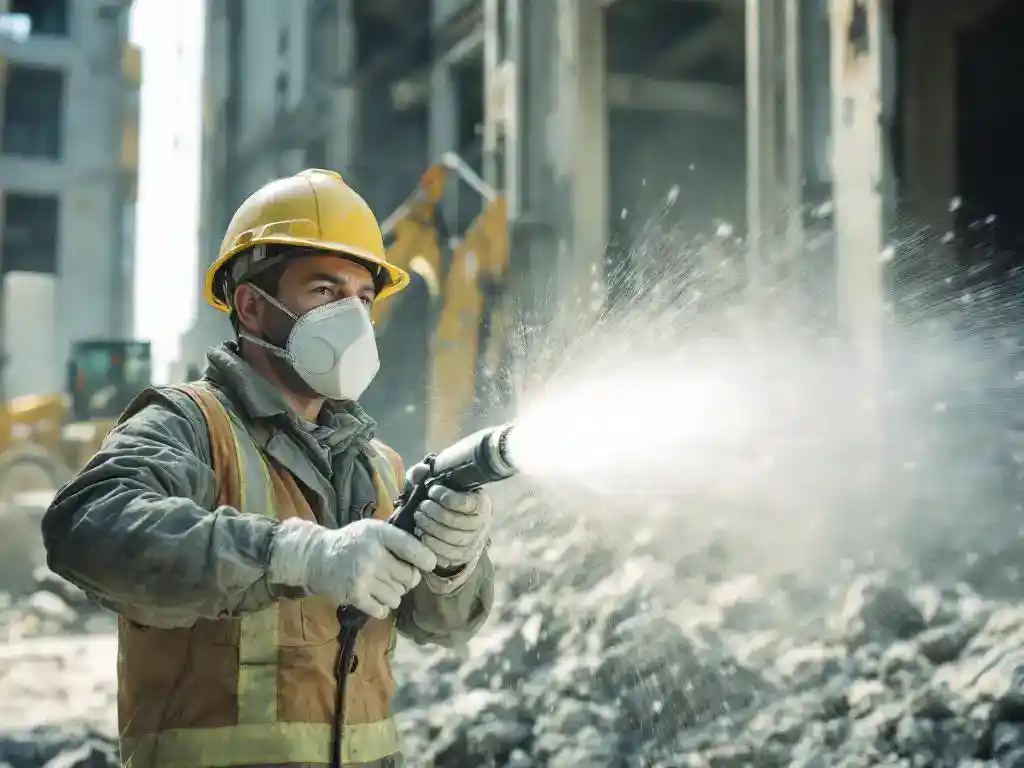
Foam formation is an effective technique for dust control in the mining industry, particularly at crushers, conveyor belts and transhipment points where dry, fine-particle-laden material is released. The technique binds dust particles directly at source, before they enter the air. Compared with traditional water spraying, foam suppression uses considerably less water whilst achieving higher suppression efficiency. Dust control is not a stand-alone measure, but an integral part of operational management: it affects emissions, air quality, compliance and the continuity of operations. The questions below provide a comprehensive overview of how the technology works, when to use it, and how to justify and optimise the approach.
How does foaming work as a dust suppression technique?
Foam formation works by injecting a mixture of water and a foaming additive onto the material under high pressure via spray bars and nozzles. The foam envelops individual dust particles and binds them together, preventing them from escaping into the air. As the foam covers the material, dust emissions are blocked directly at source rather than being captured in the air afterwards.
The mechanism differs fundamentally from that of spraying with plain water. Water naturally has high surface tension, which makes it difficult for it to retain small dust particles. A foam-forming additive significantly reduces this surface tension, enabling the foam to effectively envelop and bind even the smallest particles. The result is a compact, moist mass that releases hardly any dust at all.
The installation consists of a dosing unit, a pump and a network of pipes fitted with nozzles directed at the dust sources. The system can be fully automated and adjusts foam production to the current material flow.
Please bear in mind that the correct technique, dosage and equipment vary depending on the location, material and process. In practice, a standard set-up is rare: nozzle position, pressure and dosage ratio are tailored to the situation on site.
Where does the dust come from? First, map out the hotspots
Before choosing a technique, it is worth first determining where, when and under what circumstances the dust is generated. A thorough hotspot analysis prevents you from installing a system in the wrong place or choosing a solution that does not address the actual source.
Here’s how to approach it:
- Where: identify the points where dry material is processed, transferred or transported, such as crushers, screens, discharge points and transfers between conveyors.
- When: look for patterns over time, such as peak loads, fluctuating production, dry spells and weather conditions such as wind and humidity.
- Under what conditions: note the type of material, particle size, natural moisture content, drop height and belt speed, as these factors significantly influence dust formation.
- If in doubt: involve operators and maintenance staff. They often know the dust sources and hotspots better than any measurement could and are the first to spot anomalies.
Based on this assessment, you determine which technique is suitable for each hotspot: foam, atomisation, shielding, extraction or a combination.
Which types of substances in the mining industry are suitable for foam treatment?
Foaming works best with dry, fine-particle materials that generate a lot of dust during mechanical processing or transport. In the mining sector, this includes ores, coal, limestone dust, phosphate and similar dry bulk raw materials. Materials with a high fine-particle content and low natural moisture content benefit most from foam treatment.
Materials that are naturally damp or sticky do not respond as well to foam. In such cases, the additional bonding provided by the foam is less necessary, and a different technique may be more efficient. If there is any doubt about the suitability of a specific material, a laboratory test using the material in question is the most reliable way to determine the correct approach.
What is the difference between foaming and atomisation in dust control?
The key difference lies in where the technology intervenes. Foam formation acts directly on the material: the foam envelops dust particles at source before they are released. Atomisation works in the air surrounding the dust source: a mist curtain of fine water droplets captures dust particles after they have already been released.
Foam formation: binding at source
Foam is applied directly to the material, for example on a conveyor belt or at a crusher. The dust particles are bound before they have a chance to become airborne. This makes foam application particularly suitable for enclosed or semi-enclosed environments where the dust source is easily accessible.
Atomisation: dispersion in the air
Mist-spraying systems create a cloud of microscopic water droplets that bind dust particles already released into the air and draw them down to the ground. This approach works well at open transhipment points, when loading and unloading bulk carriers, or at locations where direct treatment of the material is not possible.
In the mining industry, both techniques are sometimes combined: foam at the crushers and conveyor belts, and atomisation at the larger open-air transfer points.
How much water does foam formation save compared to traditional spray water?
Foam formation uses up to 90 per cent less water than traditional spray water to achieve comparable or better dust suppression. This is because the foam additive significantly reduces the surface tension of water, enabling a small amount of liquid to envelop and bind a large surface area of dust particles.
Effective dust control therefore does not automatically mean using more water. More spray water does not necessarily mean less dust: a large proportion of the water does not bind the fine particles and mainly just makes the material wet and heavy. An additive ensures more efficient water use and better dust binding, precisely because the water adheres better to the particles that matter.
In the mining sector, water conservation is not merely a cost issue. At sites with limited water supply, in arid climates or in regions with strict water permits, reduced water consumption is an operational necessity. Furthermore, using less water prevents the material from becoming too damp, which can negatively affect the workability or weight of certain ores and raw materials.
The exact savings depend on the type of material, the dust load and the installation parameters, but the trend is consistent: foam achieves more with less water.
When is foaming the best choice for dust control in the mining industry?
Foam generation is the best choice when dust is released from a specific, well-defined source that is directly accessible to a system, such as a crusher, screening plant, conveyor belt or transfer point. The technology performs best with dry, fine-particle material in an environment where water conservation and direct suppression at source are priorities.
Situations in which ‘foam formation’ is particularly well-suited:
- High dust concentrations at mechanical processing points such as crushers and grinding plants
- Conveyor belts that transport dry, fine material over longer distances
- Locations with limited water supply or strict water licences
- Environments where the material must not become too damp
- Enclosed or semi-enclosed spaces where atomisation is less effective
Where the dust source is difficult to access, the material is already damp, or dust is being dispersed over a large open area, atomisation or a combination of techniques is often a better choice. Every dust problem requires an approach tailored to the specific material and process conditions.
Furthermore, foam suppression is rarely a stand-alone solution. It works best as part of a broader dust control strategy, alongside measures such as enclosing transfer points, limiting drop heights, proper maintenance of the plant, and process protocols for dry and windy periods.
Substance management, compliance and the licence to operate towards 2030
Structural dust control is no minor matter for mining companies. Dust emissions affect local air quality, compliance with permit conditions and, ultimately, the licence to operate: the support of local residents, regulators and other stakeholders required to continue operations. Complaints about dust nuisance, breaches of emission limits or enforcement proceedings can lead to production restrictions and shutdowns, thereby directly affecting business continuity.
Looking towards 2030, requirements are expected to become even more stringent. Consider stricter standards for particulate matter, higher expectations regarding the application of Best Available Techniques (BAT) and lower dust emission limits. Those who commit now to a structural, demonstrable approach will be in a stronger position when it comes to future permit applications and reviews. The exact requirements vary by country, region and permit, so always assess your approach against the conditions specific to your own location.
How do you measure and validate whether dust control is effective?
A substance management approach is only convincing if you can demonstrate the results. Measurement and validation not only substantiate the effectiveness to regulators and stakeholders, but also provide the data needed to further improve the approach.
- Baseline measurement: record the situation before the measure is implemented, so that you can compare the effect afterwards.
- Particulate matter measurements: continuous or periodic measurements of PM10 and PM2.5 at relevant points on and around the site provide insight into emissions and air quality.
- Visual techniques such as LiDAR: these allow you to visualise dust plumes and see how dust spreads, which helps in locating hotspots and assessing effectiveness.
- Process data: combine measurements with data on material flow, humidity, weather conditions and dosage to identify correlations.
You should then use the measurement data to adjust the dosage, nozzle position, pressure and equipment. In this way, dust control shifts from a one-off installation to a learning process, in which you find the best balance between dust suppression and water consumption for each hotspot.
Are foam additives for dust control safe for people and the environment?
High-quality foam additives for industrial dust control are fully biodegradable and are developed without hazardous chemicals. They are safe for staff who work with them on a daily basis and pose no risk to the aquatic environment, even if they run off into soil or surface water.
When selecting a foam additive, it is important to check whether the product is classified as non-hazardous to the aquatic environment and whether it complies with the applicable environmental legislation in the country in question. In the mining sector, where runoff into the surrounding environment poses a real risk, this is not a minor consideration but a fundamental requirement.
Safety for employees also means that the product does not emit harmful vapours and does not require special protective equipment during normal use. A transparent safety data sheet (SDS) is a minimum requirement in this regard. Biodegradable products free from hazardous substances have now become the standard in sectors with strict environmental standards, including the mining industry.
How we help with foam formation for dust control in the mining industry
We develop and supply Freko-Foam, a biodegradable foam additive specially developed for industrial dust control at sources such as crushers, sorting lines and conveyor belts. The product is injected under high pressure via bespoke systems fitted with spray bars and nozzles, fully tailored to the specific dust source and material.
What we offer:
- Lab testing with our own materials: before an installation is fitted, we test the foam additive on the specific material used in our own operations
- Bespoke installation: design, supply and installation of the complete system, including dosing unit, pump and nozzles
- Ongoing supply: continuous supply of Freko-Foam additive and post-installation support
- Fully biodegradable: safe for staff and the environment, with no hazardous chemicals
- Automation: systems can be fully automated and adapt to the current material flow
Looking for an effective solution for industrial dust control? We’d be happy to help you find a suitable approach. Take a look at our dust control solutions or get in touch for personalised advice.
Related Articles
- Which five indicators point to serious dust nuisance with dry bulk materials?
- How do you continuously monitor dust control on a large outdoor site?
- Can inhaling dust make you ill?
- What happens when you work in a dusty environment for years on end?
- What changes are coming to European environmental legislation on dust emissions in 2026?