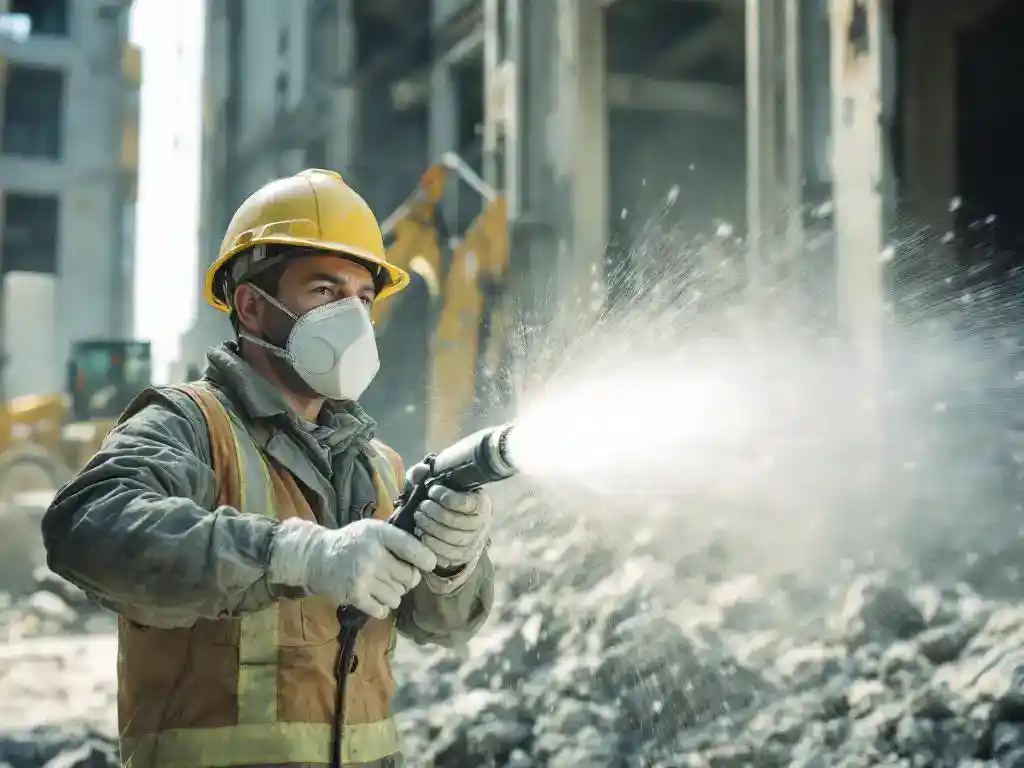
Dust control on industrial outdoor sites encompasses all measures and techniques that limit dust emissions in open areas, such as at storage sites, transhipment points, access roads and loading and unloading areas. The aim is to prevent the spread of dust particles into the surrounding environment, to protect the health of employees and to comply with applicable environmental legislation. In this article, we answer the most frequently asked questions about dust control on outdoor sites.
Which sources of substances are most commonly found on industrial outdoor sites?
In industrial outdoor areas , stockpiles, access roads, loading and unloading points, and conveyor belts are the most common sources of dust. Wind, vehicle traffic and mechanical processes cause fine particles to be released from the material and enter the air.
The risk of dust formation is greatest with dry bulk materials such as coal, ores, biomass or recycled granulates. The drier and finer the material, the more readily particles become dislodged by wind or movement. On sites where heavy machinery operates, such as ports, steelworks or recycling plants, unpaved roads are an additional source of airborne dust.
Transfer points deserve special attention. When material is dumped or moved, a free fall occurs, causing air to be entrained and dust clouds to be released. This applies to cranes and conveyor belts as well as to loading and unloading operations involving lorries or ships.
What methods are used for dust control in outdoor areas?
The most commonly used methods for dust control on industrial outdoor sites are crust formation, misting, foam applications and road dust control. Which method is most effective depends on the type of material, the location and the process conditions.
- Crust formation: a binding agent is applied to the surface of a stockpile or storage site, creating a protective layer that retains dust at source. Suitable for static storage sites.
- Atomisation: fine water droplets are dispersed around the dust source via a mist curtain. The droplets bind dust particles in the air before they spread further. Effective at transfer points and during loading and unloading activities.
- Foam applications: foam is applied under pressure to the material at dust sources such as crushers or sorting lines. The foam envelops the dust particles and prevents them from being released.
- Road dust control: additives are applied to roads and sites to keep the road surface slightly damp. Thanks to their hygroscopic action, the surface remains damp for longer, even without continuous watering.
See the overview of dust control solutions for a detailed comparison of the available techniques and applications.
Why is simply spraying water often not enough?
Simply spraying water is often insufficient because water evaporates quickly, the surface tension is too high to effectively bind fine dust particles, and the required amount of water is not feasible in practice without damaging the material or disrupting the moisture balance.
Fine dust particles have a low mass and high air resistance. Ordinary water droplets are too large and too heavy to capture these particles efficiently. A large proportion of the water either fails to reach the dust source or evaporates before it can have any effect. Furthermore, in the case of materials where the moisture content must be closely monitored, such as coal or biomass, excessive water is operationally undesirable.
Adding additives to the water significantly reduces surface tension. This creates smaller, finer droplets that better envelop and bind dust particles. The result is greater effectiveness with lower water consumption, which is both practical and more sustainable.
What laws and regulations apply to dust emissions on industrial outdoor sites?
In the Netherlands and the rest of Europe, industrial companies are obliged to limit dust emissions in accordance with the Environmental Management Act, the Activities Regulation and European directives on air quality. Exceeding the limit values for particulate matter (PM10 and PM2.5) may result in enforcement action, shutdowns or substantial fines.
Companies working with dry bulk materials, recycling or mining are generally subject to an environmental permit with specific emission requirements. These permits set limit values for dust concentrations at the site boundary and in the immediate vicinity. Regulatory bodies such as the Environmental Agency and the Dutch Labour Inspectorate actively enforce compliance.
In addition to national regulations, the European NEC Directive (National Emission Ceilings) also plays a role. This directive obliges Member States to structurally reduce emissions of particulate matter. Companies that fail to anticipate this in good time run the risk of having their licences tightened or revoked.
Regulations are becoming stricter, and limit values are expected to be further tightened in the coming years. Proactive investment in dust control is therefore not only a matter of compliance but also of business continuity. You may also wish to explore which sectors face specific emission requirements and dust-related issues.
What are the health risks associated with dust pollution in outdoor areas?
Dust pollution on industrial outdoor sites poses serious health risks, particularly due to prolonged exposure to particulate matter (PM2.5 and PM10). These particles penetrate deep into the respiratory tract and can cause lung diseases, cardiovascular diseases and chronic respiratory problems.
Employees who work daily in environments with high dust concentrations are at increased risk of occupational diseases such as silicosis (from quartz dust), pneumoconiosis (from coal dust) and chronic bronchitis. These conditions develop gradually over many years and are often irreversible.
In addition to the direct health risks to employees, dust pollution also has consequences for local residents and the wider living environment. Complaints about air quality from the local community are increasingly leading to requests for enforcement and legal proceedings. Employers have a statutory duty of care to minimise exposure to hazardous dust, as laid down in the Working Conditions Act and the associated limit values.
When is a biodegradable additive the right choice for dust control?
A biodegradable additive is the right choice when effective dust control needs to be combined with minimal impact on the environment, the material or the health of staff. This applies in particular to sites where water can seep into the ground, where materials are subsequently reused or processed, or where strict environmental requirements apply.
Traditional chemical pest control agents can leave harmful residues in soil and groundwater. In the case of materials such as biomass, recycled granules or ores that are further processed after storage, it is important that the agent used does not adversely affect the composition or quality of the material.
Biodegradable additives solve this problem. They are completely safe for people and the environment, leave no hazardous residues and are effective at low doses. Furthermore, they meet the increasingly stringent environmental requirements that governments and clients impose on additives used in industrial settings.
An additive is also practical when water consumption needs to be reduced. By lowering the surface tension of water, less liquid is required to achieve the same effect, which reduces both operational costs and environmental impact.
How we help with dust control on industrial outdoor sites
We offer a comprehensive approach to dust control in industrial outdoor areas, from initial analysis to the ongoing supply of biodegradable additives. Every dust problem is different, which is why we always begin with a thorough assessment of the material, the process and the location.
- Lab testing with your own materials: we test our products on your specific materials in our own laboratory, so that you know what to expect before you invest.
- Bespoke solution: based on the test results, we recommend the most suitable technique, whether that be crust formation, atomisation, foaming or road dust control.
- Installation and commissioning: we handle the complete installation of the necessary equipment, including spray bars, nozzles and automation.
- Ongoing supply: all additives are biodegradable and safe for people and the environment. We supply on an ongoing basis and contribute ideas when process changes are required.
- A fully managed service: from advice and testing to installation and aftercare, ensuring that dust control does not place an additional burden on your team.
Would you like to know how we approach this? Read more about our approach or contact us directly for a no-obligation discussion about your dust problem.
Related Articles
- Can dust nuisance in biomass storage cause spontaneous combustion?
- How does dust pollution from coal differ from that caused by biomass?
- Why is dust control in biomass generation seasonal?
- What measurement techniques are associated with effective substance management?
- What happens when you work in a dusty environment for years on end?