The four best methods for dust control at transhipment points in the mining industry are crust formation, foam suppression, atomisation and combined approaches in which multiple techniques work together. Which method works best depends on the type of material, the environmental conditions and the desired reduction in particulate matter (PM2.5). The first thing you need is an understanding of where, when and under what conditions the dust is generated. Below, we discuss each method in detail, including when to use which technique and how to make the right choice for your transhipment point.
Which dust-related problems are most common at transhipment points in the mining industry?
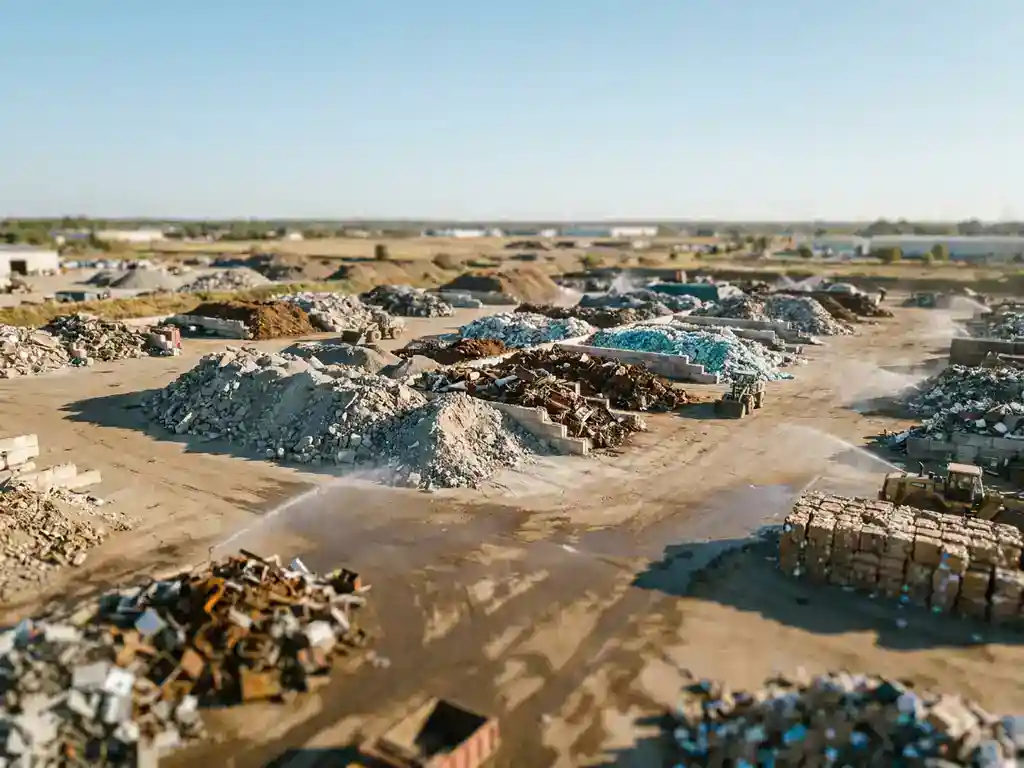
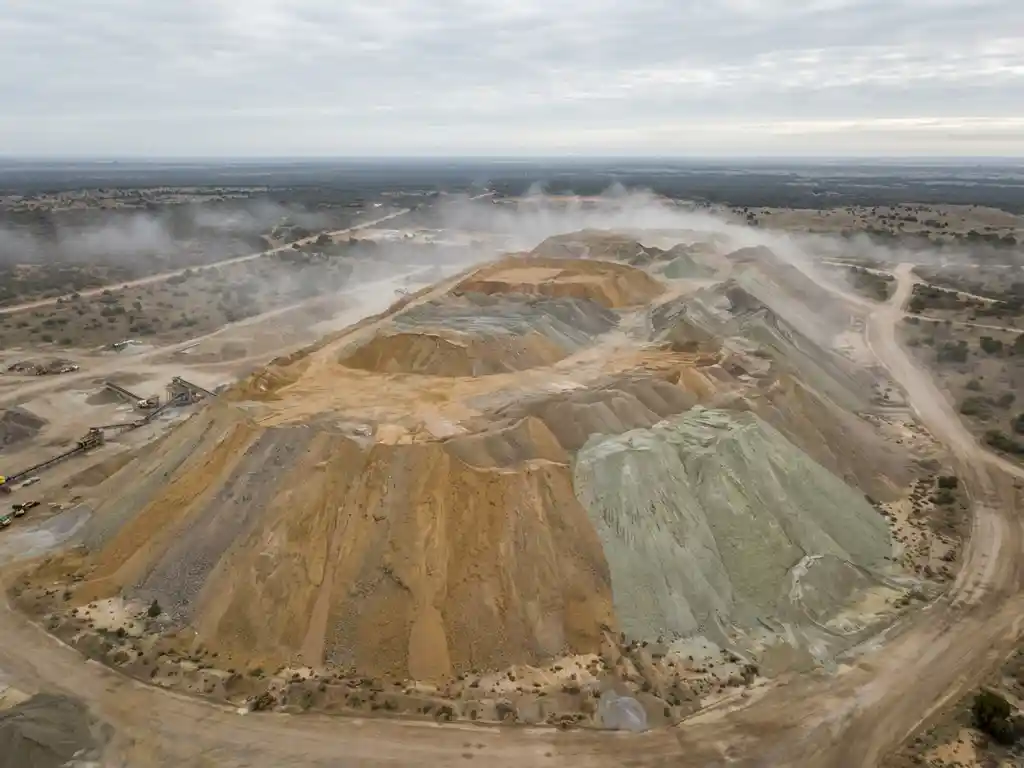
At transhipment points in the mining industry, the most common dust problems involve the release of fine dust during the dumping, transport and unloading of dry bulk materials such as ores, coal and minerals. The combination of dry material, high drop speeds and wind makes transhipment points one of the largest sources of dust at a mining site.
Specifically, this concerns dust clouds in:
- Dumping points on conveyor belts: with every transfer of material, dust is released due to the falling motion and air displacement
- Loading and unloading lorries and trains: large quantities of material in a short space of time
- Stockpiles and storage heaps: wind erodes the surface of dry bulk goods
- Crushers and screening plants: the reduction of material produces large quantities of fine dust
Particulate matter (PM2.5 and PM10) poses the greatest challenge in this regard. These particles remain suspended in the air for a long time, penetrate deep into employees’ respiratory tracts and, at wind-sensitive locations, can lead to complaints from local residents. Stricter environmental legislation makes adequate dust control at transhipment points not only a health requirement but also a legal obligation. It is therefore wise to start preparing now for 2030: stricter requirements for particulate matter, more stringent BAT (Best Available Techniques) requirements and lower emission limit values for dust are expected. Structural dust control is also a prerequisite for retaining your licence to operate and ensuring business continuity. Exceedances of limits and complaints from local residents can lead to enforcement action, production restrictions or the suspension of activities.
How do you identify the key areas of interest before choosing a method?
An effective approach begins with identifying the dust hotspots: where does the dust originate, when does it arise, and under what circumstances? Without this analysis, it is easy to choose a technique that does not address the actual source, resulting in unnecessary water consumption and disappointing results.
In practice, follow these steps:
- Identify the sources: dumping sites, embankment crossings, crushers, loading and unloading points, and stockpiles
- Determine the timing: continuously, during peak demand, in dry weather or, conversely, when certain wind directions prevail
- Note the conditions: wind speed, temperature, humidity, drop height and moisture content of the material
- Consult the operators: they often know the problematic areas and changing circumstances best
- Assess the baseline situation: using particulate matter measurements on and around the site, possibly supplemented by LiDAR to visualise dust clouds and their dispersion
This baseline measurement will serve as the foundation for later validation of whether the chosen measure is effective.
How does crust formation work as a dust control method for mining materials?
Crust formation works by applying a binding layer to the surface of dry material. A liquid additive is sprayed onto the stockpile or the material, after which it penetrates and cures into a protective crust that traps dust particles and prevents wind or movement from dislodging them.
For mining materials such as ores, coal or minerals, crust formation is particularly effective in static situations: storage heaps, temporary stockpiles and material that remains on site for some time. The crust reduces surface dust emissions by more than 90 per cent, without significantly increasing the material’s moisture content. The latter is important for materials where the moisture content affects processing quality or weight.
Crust formation is less suitable for material that is constantly in motion, such as active conveyor belts or discharge points. Other techniques are more effective in such cases.
When is foam suppression preferable to water mist systems at transfer points?
Foam suppression is preferable to water mist systems when the dust source is located at a fixed, defined site and when water consumption must be kept to a minimum. Foam binds dust particles directly at the source by enveloping them, whilst misting systems create a mist curtain in the surrounding area.
At transhipment points in the mining sector, foam suppression is the preferred choice in these situations:
- In crushers and sorting lines where large quantities of fine dust are released over a small surface area
- At conveyor belt transfer points where material falls from one belt onto another
- Where the material is sensitive to excessive moisture and water misters increase the moisture content too much
- In enclosed or semi-enclosed spaces where it is difficult to create a mist curtain
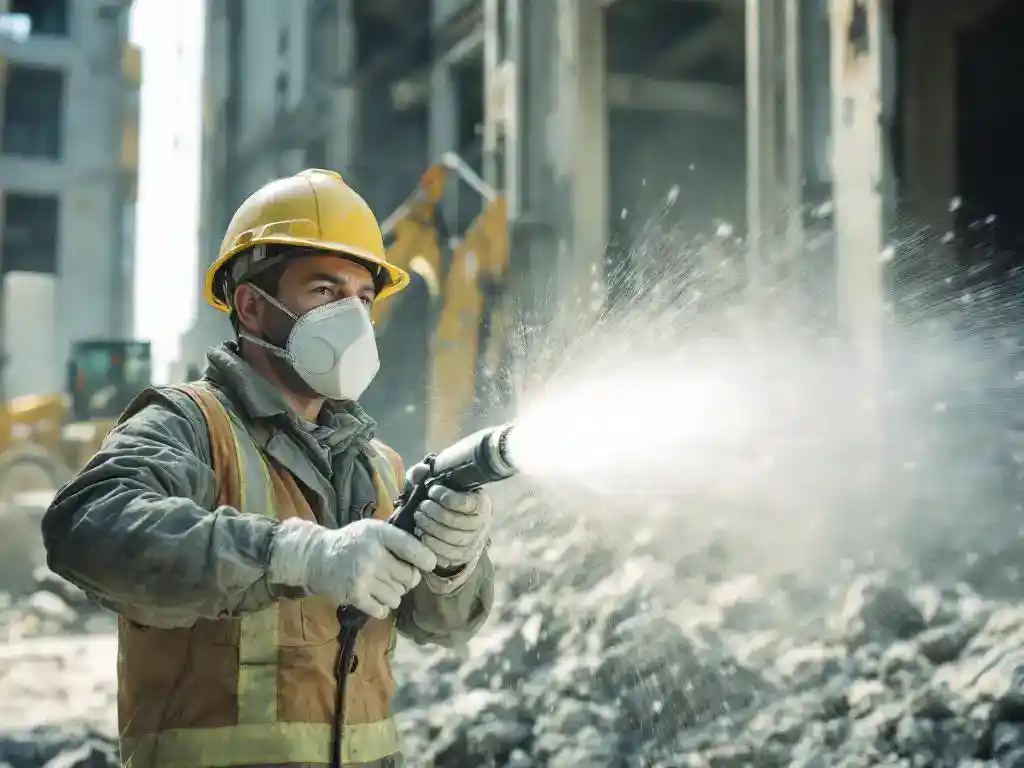
Foam is injected under high pressure via spray bars and nozzles, bringing the additive into direct contact with the dust-laden material. Water consumption is considerably lower than with traditional water mist systems, which also makes foam suppression attractive from a cost perspective.
What are the advantages and disadvantages of atomisation for dust control in mines?
Misting is effective at suppressing dust in open or semi-open environments because fine water droplets trap dust particles in the air and bring them down to the ground. The main advantage is its wide coverage; the main disadvantage is that misting is less targeted than foam or crust formation.
Advantages of misting in mining spill containment
- Wide coverage: a mist curtain protects a larger area around the dust source
- Flexible deployment: installations can be mobile or permanently fixed, depending on the location
- Effective for the loading and unloading of dry bulk materials in the open air
- With additives such as Freko-Humidifier, effectiveness is up to ten times higher than with plain water, as the surface tension of the water is reduced
Disadvantages of misting in mining overflows
- Wind-sensitive: in strong winds, the mist curtain spreads out and its effectiveness decreases
- Higher water consumption than foam suppression
- Less focused on point sources such as crushers or conveyor belt junctions
- The moisture content of the material may increase if the dosage is not correctly adjusted
Incidentally, effective dust control does not automatically mean using more water. By reducing surface tension, additives ensure better wetting and dust binding with less water, thereby limiting both water consumption and the risk of excessive moisture content.
Which method works best for particulate matter (PM2.5) at mining transhipment points?
For the reduction of particulate matter (PM2.5) at mining transhipment points, foam suppression combined with atomisation works best. Foam binds the finest particles directly at source, whilst atomisation captures the remaining airborne particles in the surrounding area. No single method offers the maximum PM2.5 reduction in all situations.
PM2.5 particles are so small that they are difficult to capture using water alone. The key lies in the use of additives that reduce the surface tension of water, causing water droplets to become smaller and adhere more effectively to the finest dust particles. Crust formation focuses on preventing PM2.5 from being released in the first place, and is therefore the most preventative approach for static sources.
At active transhipment points with continuous dust generation, a combined approach is the most reliable strategy for complying with current emission standards. Always validate the results with measurements: continuous particulate matter measurements at relevant points show whether PM2.5 concentrations are actually falling, and LiDAR can reveal whether any dust clouds are still escaping.
How do you choose the right dust control method for your transhipment point?
You select the appropriate dust control method for a transhipment point based on four factors: the type of material, the nature of the dust source (static or dynamic), the environmental conditions and the applicable emission standards. There is no one-size-fits-all solution; each transhipment point requires its own approach. Furthermore, the technology, dosage and equipment vary depending on the location, material and process, and therefore often require a bespoke solution.
Use this overview as a starting point:
- Static storage heaps and stockpiles → crust formation
- Conveyor belt junctions and crushers → foam suppression
- Loading and unloading in the open air → spraying with additives
- Multiple sources of particulate matter or high PM2.5 emissions → a combined approach
Furthermore, practical considerations play a role: the available water volume, the space available for installations, the wind conditions on site and the desired moisture content of the final material. An additive is not a stand-alone solution in this regard, but one component of a broader dust control strategy, alongside source-control measures such as limiting drop heights, shielding edge transitions and operational protocols in wind-sensitive conditions.
A laboratory test using your own materials provides insight into which method and which additive deliver the best results before a full installation is carried out. Once the system is up and running, you optimise the approach based on measurement data: adjust the dosage, nozzle configuration and settings according to what the measurements show, so that the results remain consistently at the required standard.
How we help with dust control at mining transhipment points
We work with mining companies worldwide on effective dust control at transhipment points. Our approach always begins with an analysis of the specific dust problem, followed by a laboratory test using the client’s own material. This ensures we know exactly which method and which additive work best before any investment is made in an installation.
What we offer:
- Crust formation using EcoCrust S or Freko-Crust for storage heaps and stockpiles
- Foam suppression with Freko-Foam for crushers, conveyor belts and transfer points
- Mist spraying with the Freko Humidifier for open transhipment sites and bulk transhipment
- Fully biodegradable additives, safe for people and the environment
- Bespoke installations, easy to automate and deliver on an ongoing basis
Looking for an effective solution for industrial dust control? We’d be happy to help you find a suitable approach. Take a look at our dust control solutions or get in touch for personalised advice.
Related Articles
- Which six dust control solutions are suitable for port transhipment?
- Which four factors determine how far dust pollution spreads?
- What is the difference between fine dust and coarse dust?
- What can be done to tackle dust clouds when unloading lorries?
- What is a substance management plan and when is it mandatory?