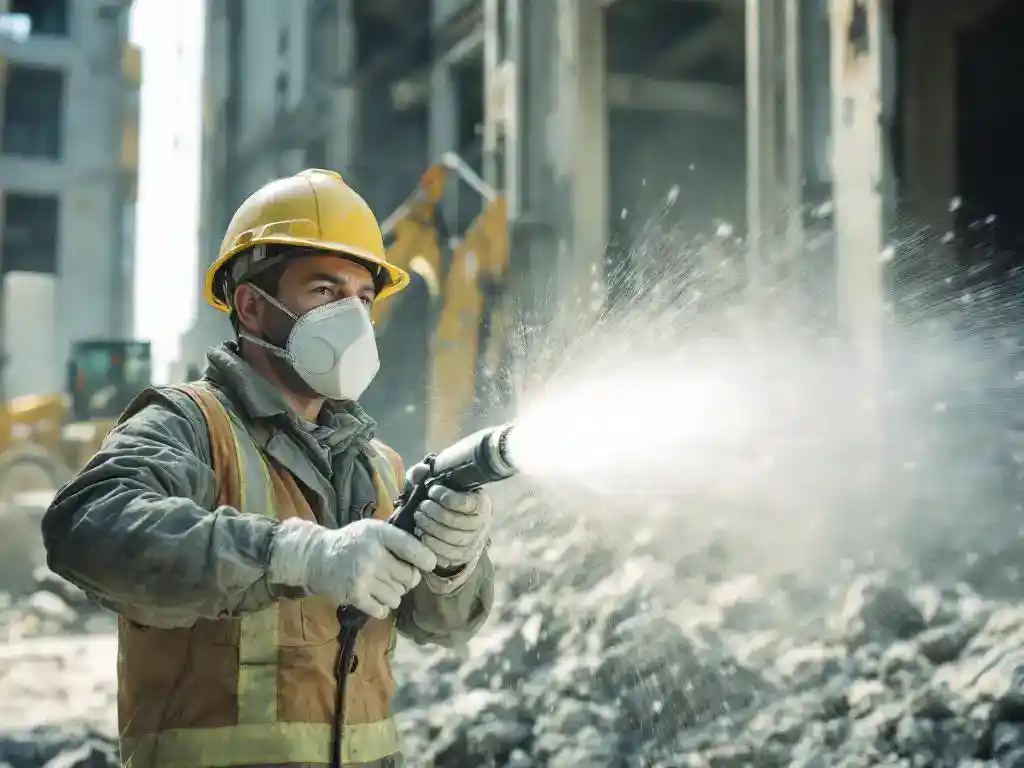
The four most effective methods for dust control in the mining industry are: crust formation, wetting (atomisation), foaming and road dust control. Which method works best depends on the type of material, the source of the dust and the on-site conditions. Dust control works best as part of a broader dust management strategy, in which you first identify the dust hotspots and then measure and validate the results. This article discusses each of these methods, explains when to use which one, and helps you make an informed choice for your situation.
What are the most common dust-related problems in the mining industry?
In the mining sector, the most common dust problems are: dust generation at crushers and conveyor belts, dust dispersion at stockpiles, dust clouds on the internal road network, and dust emissions during the loading and unloading of materials. These dust sources produce both coarse dust and fine particulate matter (PM10 and PM2.5), which is harmful to the health of employees and the environment.
Mining processes involve dry, fine-grained materials such as ores, coal, limestone and crushed stone. When these materials are moved, crushed or stored, they readily release particles into the air. Particularly in windy or dry conditions, dust can spread over long distances, leading to complaints from local residents, regulatory issues and health risks in the workplace. Dust therefore affects not only air quality but also business continuity: complaints, measurements exceeding the standard or production stoppages can have a direct impact on production.
In addition, there are specific high-risk moments: unloading lorries, dumping material onto stockpiles, operating crushers and driving heavy machinery on unpaved roads. Dust is generated at all these points and must be actively controlled.
First, identify the dust hotspots
Before choosing a method, it is important to know where, when and under what circumstances dust is generated. This prevents you from taking measures in the wrong place or at the wrong time. A practical approach:
- Where: trace the process from supply to disposal and mark all points where material falls, breaks, spills or is stored.
- When: be aware of peaks during loading and unloading, shift changes, dry and windy periods, and seasonal activities.
- Under what conditions: record wind direction and wind speed, the moisture content of the material, drop heights and vehicle movements.
- Who knows best: operators often know the problem areas best. Include their observations in the assessment.
What are the four most effective methods for dust control in the mining industry?
The four most effective methods for dust control in the mining industry are crust formation, wetting via atomisation, foam formation and road dust control. Each method targets a specific type of dust source and works best under certain conditions. In practice, a combination of methods yields the best results.
- Crust formation: suitable for storage areas and stockpiles; forms a protective layer on the surface of the material that prevents dust dispersion.
- Atomisation (humidification): works around the dust source; a mist curtain of fine water droplets binds dust particles in the air and causes them to settle.
- Foam formation: can be injected near active dust sources such as crushers and conveyor belts; binds dust directly at the point where it is released.
- Road dust control: keeps roads on the mine site moist using hygroscopic additives, thereby preventing dust clouds caused by moving traffic.
The choice of one or more of these methods depends on the location of the dust source, the type of material and the operational conditions. Also bear in mind water consumption: effective dust control does not automatically mean using more water. Additives improve dust binding and can help to use water more efficiently. Further on in this article, you will find an explanation of each method.
How does crust formation differ from wetting as a dust control method?
The key difference lies in where and for how long the method is effective. Crust formation creates a durable protective layer on the surface of the material, whilst humidification via atomisation temporarily binds dust particles in the air and causes them to settle. Crust formation is therefore more suitable for static situations; atomisation for active dust sources.
In crust formation, a water-based liquid is applied to a stockpile or storage site. Products such as EcoCrust S (containing natural fibres) or Freko-Crust (fibre-free and transparent) form a sturdy, flexible layer after drying that traps dust. Dust reduction at stockpiles can thus exceed 90 per cent. The crust remains effective as long as the material is not processed or moved.
Mist spraying works differently: a system disperses fine water droplets around the source of dust. These droplets bind dust particles and carry them to the ground. An additive such as Freko-Humidifier reduces the surface tension of the water, enabling the droplets to capture dust particles up to ten times more effectively. Mist suppression is ideally suited for transfer points, crushers and loading and unloading operations, but only works whilst the system is active. As the additive improves the binding action, water consumption can often be reduced without compromising the effectiveness of dust control.
When is foam the right choice for dust control?
Foam generation is the correct choice when dust needs to be controlled directly at the point of release, such as at crushers, sorting lines and conveyor belts. The foam envelops dust particles the moment they become detached from the material, preventing them from entering the air.
The operating principle is simple: Freko-Foam is injected onto the material or dust source via spray bars and nozzles under high pressure. The foam adheres to the dust particles and binds them to the larger material. This prevents airborne dispersion without significantly increasing the moisture content of the material itself. This makes foam formation particularly suitable for situations where a higher moisture content in the material is undesirable.
Foam works best with concentrated, active dust sources with a constant flow rate. In open, wind-exposed areas or where dust sources are scattered, atomisation or crust formation are generally more effective. Foam is also biodegradable and non-toxic to the aquatic environment, making it suitable for use near water extraction areas or ecologically sensitive sites.
What are the legal requirements for dust emissions in the mining industry?
The legal requirements for dust emissions in the mining sector are laid down in national and European environmental legislation, including the European Industrial Emissions Directive (IED) and national environmental permits. Companies are obliged to limit dust emissions to specified limit values and must take demonstrable measures to prevent dust nuisance.
In the Netherlands, mining-related activities fall under the Environmental Management Act and the Environmental Management Activities Decree. These contain standards for particulate matter (PM10 and PM2.5) in outdoor air and in the workplace. The Labour Inspectorate monitors employees’ exposure to dust; the environmental authorities assess emissions into the environment.
In 2026, enforcement regarding particulate matter emissions will become stricter, partly due to increasing social pressure and tighter European air quality standards. It is also expected that requirements will become even stricter as we approach 2030, for example through stricter limit values for particulate matter and higher expectations regarding best available techniques (BAT) and emission limit values. Companies that fail to take adequate measures risk fines, shutdowns or the revocation of their licences. Structural dust management is therefore also a prerequisite for retaining the licence to operate: without demonstrably controlled dust emissions, the permit – and with it the continuity of the business – is under threat. Demonstrating active dust management, preferably with measurable results, is therefore not only an operational choice but also a legal necessity.
Measuring and validating results
Demonstrating that measures are effective requires measurements. Particulate matter measurements (PM10 and PM2.5) at representative points on and around the site show whether emissions remain within the limit values. Techniques such as LiDAR allow you to map dust plumes and see where and when dust is released. By comparing measurements taken before and after a measure is implemented, you can validate its effect. The measurement data can also be used to optimise the method, dosage and equipment as the project progresses.
How do you choose the right dust control method for your mining process?
You select the appropriate dust control method based on four factors: the type of dust source, the material, the operational conditions and the desired sustainability of the solution. A combination of methods is often necessary in the mining industry, as multiple dust sources are active simultaneously.
Start by mapping out the dust sources at the site. Are they active sources (crushers, conveyor belts) or static sources (stockpiles, storage areas)? Is there heavy traffic on unpaved roads? Are there transhipment points where dust is released during loading and unloading? A different approach is required for each situation:
- Stockpiles and storage sites: crust formation using EcoCrust S or Freko-Crust
- Crushers, sorting lines and conveyor belts: foam formation with Freko-Foam
- Transfer points and loading/unloading points: atomisation using the Freko Humidifier
- Internal access roads and sites: road dust control with RDS100+
The material also plays a role: ores, coal and lime behave differently when exposed to moisture and wind. A laboratory test using your own material provides insight into which additive and what dosage are most effective. This prevents a method from working differently in practice than expected. Bear in mind that sites, materials and processes differ from one another: the correct technique, dosage and equipment therefore often require a bespoke approach. Additives work best as part of a broader dust control strategy, in combination with the right equipment and proper alignment with the process.
Furthermore, it is advisable to assess the available on-site infrastructure: are water pipes and sprinkler systems already in place, or does the installation need to be built from scratch? Fully automatable systems reduce the operational burden on the team and ensure continuous operation without manual intervention.
Once implementation is complete, the optimisation phase begins. Use the measurement data to adjust the dosage, spray pattern and equipment, and evaluate the approach as circumstances change, such as a different season or a different material.
How we help with dust control in the mining industry
We support mining companies in tackling dust problems, from the initial analysis through to the ongoing supply of additives. Our approach begins with a thorough assessment of the dust sources at your site and a laboratory test using your own material, ensuring the solution is tailored to the actual situation.
- Analysis of substance sources and material behaviour on site
- Laboratory test using our own materials to determine the correct method and dosage
- Bespoke systems for crust formation, foam generation, atomisation and road dust control
- All additives are biodegradable and safe for people and the environment
- Ongoing delivery and technical support following implementation
- A fully managed service: from advice and installation to management and monitoring
Looking for an effective solution for industrial dust control? We’d be happy to help you find a suitable approach. Take a look at our dust control solutions or get in touch for personalised advice.