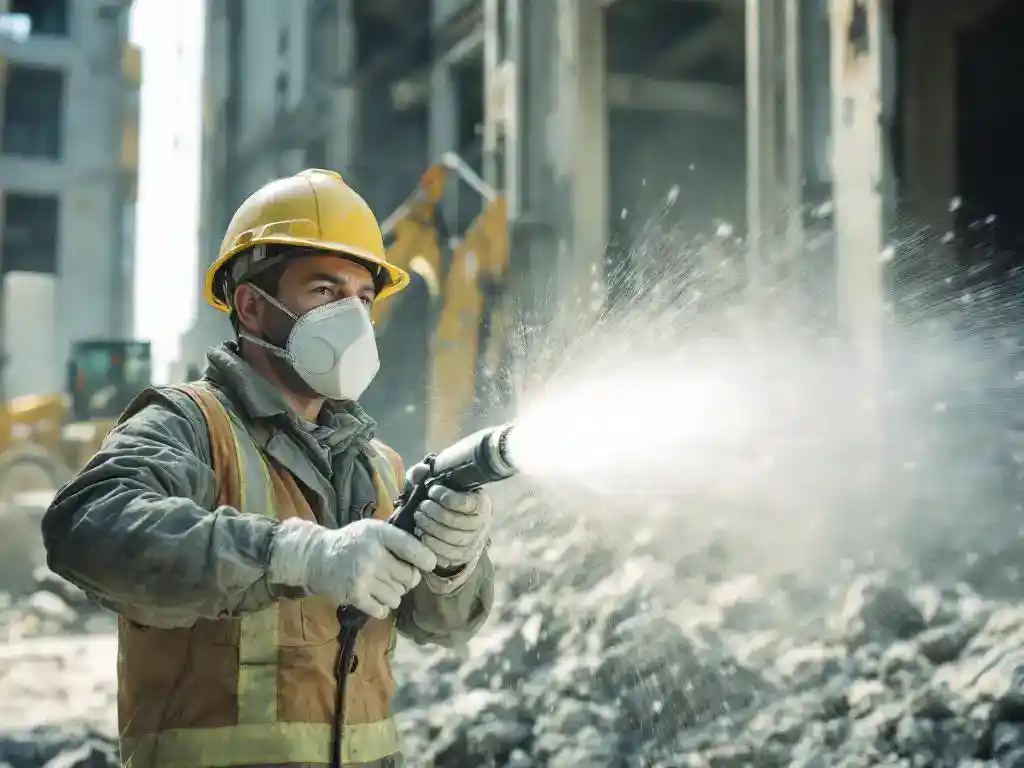
Dust clouds formed when lorries are unloaded arise from the physical properties of dry materials, which are carried into the air by the height of the drop, wind and movement. The most effective approach begins with mapping the dust hotspots: where, when and under what circumstances is the dust released? You then select a combination of measures, such as crust formation, foaming techniques, atomisation and biodegradable additives, which bind dust particles directly at the source. Water alone is often insufficient and requires large quantities. The correct method depends on the type of material, location, process and weather conditions, and often requires a bespoke solution.
Why do dust clouds form when lorries are being unloaded?
Dust clouds form when dry materials such as sand, gravel, biomass or recycled material are disturbed by mechanical movement and air currents. The drop height during unloading causes particles to break up and be carried away by the wind. Finer materials are more prone to forming dust clouds than coarser materials.
The physical processes that cause dust clouds from lorries are relatively straightforward to understand. When dry material falls from a height, turbulence is created in the air. This airflow carries small particles, which can then be dispersed further by the wind. The amount of dust depends on factors such as the moisture content of the material, wind speed, the height from which it falls and the method used to unload the material.
Weather conditions play a significant role in dust nuisance during transport. Dry, windy days exacerbate the problem considerably. When humidity is high, dust particles stick together more effectively and fewer dust clouds form. This explains why dust problems can be seasonal.
What health and environmental risks do dust clouds pose?
Dust clouds cause respiratory problems among employees, ranging from irritation to long-term lung conditions following repeated exposure. Fine dust particles can penetrate deep into the lungs and cause permanent damage. Furthermore, dust clouds lead to complaints from local residents and may result in fines for breaching environmental legislation.
The health risks to employees should not be underestimated. Prolonged exposure to problems with industrial dust control can lead to silicosis, asbestosis (in the case of materials containing asbestos) or other occupational diseases. Employees may suffer from coughing, shortness of breath and eye irritation, which reduces productivity and increases absenteeism.
The environmental impacts of dust emissions extend beyond mere local nuisance. Dust particles can spread over long distances and contribute to air pollution in urban areas. This has consequences for air quality and can affect ecosystems. Various industrial sectors are facing increasingly stringent regulations regarding particulate matter emissions.
Legal consequences can be significant. Companies that fail to comply with dust emission standards risk fines, temporary suspension of operations or even the revocation of licences. Dust control therefore directly affects your licence to operate and the continuity of your business operations. The costs of non-compliance often exceed the investment required for adequate dust control measures.
Please bear in mind the developments leading up to 2030. It is expected that regulations concerning particulate matter will become stricter, including through BAT (Best Available Techniques) requirements and tighter emission limit values for dust. Those who invest systematically in dust control now will avoid having to make adjustments under time pressure later on.
How do you identify the dust hotspots during unloading?
Effective dust control begins with insight. Without knowing where the dust originates, you will quickly choose a measure that does not suit the problem. Therefore, first map out the hotspots for each location and consider three questions: where does the dust originate, when does it occur, and under what circumstances?
- Where: the unloading area, the dump, the hopper, the transfer to conveyor belts, the transport routes and the stockpile itself.
- When: whilst tipping, at peak times in the supply, during dry periods or immediately after the surface has dried.
- Under what conditions: wind direction and wind speed, humidity, moisture content and particle size of the material, and the drop height.
Operators and drivers often know exactly where and when things go wrong. Therefore, involve them in the assessment: their observations complement measurements and lead more quickly to the actual sources of dust.
Record the results and validate them with measurements. Consider particulate matter measurements on-site and at the site boundary, or the use of LiDAR to visualise dust clouds and their dispersion. This will provide you with a baseline measurement against which you can later demonstrate whether a measure is effective.
What are the most effective methods for preventing dust clouds?
Dust clouds can be prevented using various methods: spraying water (inexpensive, but not very sustainable), covering (effective, but labour-intensive), crust formation (long-term effectiveness), foaming techniques (suitable for active processes) and biodegradable additives (sustainable and efficient). Crust formation and additives usually offer the best balance between effectiveness and cost. The best results are generally achieved through a combination of measures tailored to your specific hotspots.
Spraying water is the most commonly used, but also the least efficient, method for dust control during unloading. It requires large quantities of water, is only a temporary solution and can actually cause problems with certain materials. Furthermore, the water evaporates quickly, causing the dust problem to return.
| Method | Effectiveness | Sustainability | Costs |
|---|---|---|---|
| Water spraying | Low | In short | High water consumption |
| Coverage | High | Long | Labour-intensive |
| Crusting | Very high | Weeks/months | Cost-effective |
| Bio-additives | High | Long | Low water consumption |
Crust formation creates a protective layer over the material, which remains effective for weeks to months. This method reduces dust formation by more than 90 per cent and is suitable for stockpiles and storage areas. Dust suppression additives utilise special chemical compounds that bind dust particles without causing any harmful side effects.
Foam techniques are ideal for dynamic situations such as conveyor belts and unloading processes. The foam binds dust particles during the process and subsequently biodegrades. This method is particularly effective at reducing dust emissions during active operations.
Is more water the solution to dust control?
No. Effective dust control does not automatically mean using more water. Water evaporates quickly, especially on dry and windy days, meaning you have to keep spraying. That wastes water, makes the site waterlogged and still does not provide a lasting solution.
Additives can make a difference here. They improve the adhesion of water to dust particles and prolong the effect, enabling you to achieve better dust binding with less water. Do not view additives as a stand-alone solution, but as part of a broader strategy: first identify the hotspots, then select the appropriate technique, dosage and equipment, and finally measure the effectiveness.
How do you choose the right pest control method for your situation?
The correct method depends on your material type, location, budget and operational requirements. For static storage, crust formation is usually the most effective. For active processes such as unloading, it is better to use foam or atomisation. Dry, fine materials require a different approach to damp, coarse materials.
Start by analysing your specific situation. What type of material are you dealing with? How often does this occur? What are the weather conditions at your location? These factors determine which dust control solutions work best for your situation.
A proven four-step approach:
- Identify the hotspots and determine where, when and under what circumstances the substance is released.
- Test the solution using your own materials, so that you know which additive or technique really works.
- Adapt the technique, dosage and equipment to the location, the material and the process. What works at one location may not be optimal at another.
- Measure and optimise using particulate matter measurements or LiDAR, and use the results to further refine the approach and dosage.
For biodegradable pest control, one must consider the environmental impact of various methods. Traditional chemical agents can be harmful to groundwater and surrounding ecosystems. Biodegradable alternatives offer the same effectiveness without environmental risks.
Budget plays a key role in the decision. Although the initial investment in advanced systems may be higher, the operational costs are often lower. A crust-former that remains effective for months is ultimately cheaper than daily watering.
Operational requirements such as accessibility, safety and ease of maintenance also influence your choice. Some methods require specialised equipment or training, whilst others are easy to implement using existing resources.
How we help with dust clouds when unloading lorries
We offer dust control solutions that act directly at the source and reduce dust emissions by more than 90 per cent. Our biodegradable additives and crust-forming techniques are safe for people and the environment, whilst reducing water consumption by 70–80 per cent compared with traditional methods. We deploy them as part of a broader dust control strategy, tailored to your site, material and process.
Our approach always begins with a thorough analysis of your specific situation:
- Laboratory testing using your own materials to determine the most effective solution
- Bespoke crust formation with EcoCrust S for long-term protection of stockpiles
- Foam techniques using Freko-Foam for active loosening processes
- Mist systems with Freko-Humidifier for maximum efficiency
- Complete end-to-end service, from installation to the ongoing supply of additives
Our products have been developed in our own laboratory and consist of circular ingredients that are fully biodegradable. This means: no harmful side effects for aquatic ecosystems and no long-term damage to the environment.
Would you like to know which solution best suits your dust problem? Read more about our expertise or contact us directly for a no-obligation analysis of your situation.
Related Articles
- How does dust control work effectively in a port?
- How do you set up a substance management programme for a recycling site?
- How do you know if your dust control measures meet current standards?
- How can you prevent dust from spreading whilst loading ships?
- What are the six best methods for dust control in 2026?