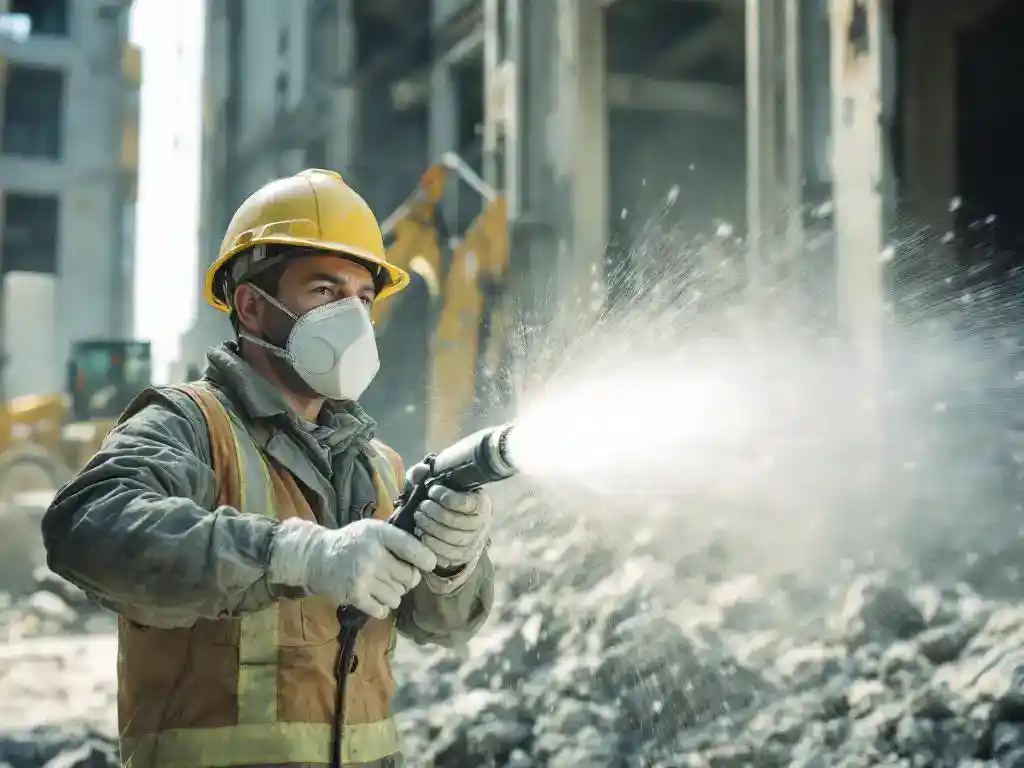
Dust pollution in industrial environments is becoming an increasingly urgent problem. Tighter environmental legislation, rising health risks for employees and growing pressure from local residents mean that companies are actively seeking effective dust control methods. The six best methods for 2026 are crust formation, foaming, atomisation, material-specific choices, biodegradable additives and combination techniques. This modern approach replaces traditional methods such as water spraying, which are often insufficiently effective and waste a great deal of water.
Why dust control will become more important in 2026
The pressure on industrial companies to tackle particulate emissions is increasing significantly. Stricter environmental legislation means that heavy fines are a real threat in the event of non-compliance, whilst health risks to employees are coming under ever closer scrutiny. Particulate matter causes respiratory complaints and irritation and can even lead to serious health problems in the long term.
In addition, companies are receiving more complaints from local residents about dust nuisance. This not only damages their reputation but can also cause production disruptions. Traditional methods such as water spraying often fall short because they have only a temporary effect and waste enormous quantities of water.
The problem is becoming more urgent because many companies lack sufficient in-house knowledge about which dust control method is best suited to their specific materials and processes. They are looking for solutions that are demonstrably effective, preferably tested on their own materials.
1: Crust formation – the most effective method
Crust formation tops the list of effective dust control methods for 2026. This technique creates a protective layer over stocks and storage areas, ensuring that dust particles remain bound and cannot be blown into the air.
The method works exceptionally well for heavy materials such as ores, coal and recycled materials. Adding natural fibres and additives to a water-based solution creates a flexible crust that reduces dust formation by more than 90 per cent. The major advantage is the long-lasting protection: a single treatment lasts for weeks or even months.
Crust formation also offers significant water savings. Whereas traditional methods require continuous spraying, crust formation requires only a single treatment. This reduces water consumption by 70 to 80 per cent, which is both cost-effective and environmentally friendly. You should opt for this method when you have long-term storage of dry bulk materials that are susceptible to being blown away.
2: Foaming for sensitive materials
Foam technology is the ideal solution for light materials that are easily blown away. Unlike crust formation, which creates a hard layer, dust control using foam creates a soft, protective covering that works perfectly with biomass, fine powders and other sensitive materials.
The foam is injected under high pressure via spray bars and nozzles, causing it to bind dust particles directly at the source. This method is particularly suitable for materials that must not get wet or that may lose their properties due to moisture. The foam dissolves slowly without leaving any residue.
The greatest advantages lie in flexibility and precision. You can apply the foam exactly where it is needed, for example on sorting lines, crushers and conveyor belts. For companies working with different types of materials at a single site, foam generation offers the perfect solution for dust control without compromising product quality.
3: Aerosolisation during transport and transhipment
Atomisation techniques are indispensable during the transport and transhipment of dry bulk materials. This method creates a mist curtain around dust sources, trapping dust particles before they can disperse.
Misting is primarily used during loading and unloading operations, where traditional methods often fail due to the dynamic nature of the process. When loading bulk carriers, unloading lorries or at waste treatment plants, misting ensures immediate dust suppression exactly when it is needed.
The major advantage is the ability to combine atomisation with other methods. Atomisation is used during transport, whilst for long-term storage, the system switches to crust formation. This integrated approach ensures optimal dust control throughout the entire process. Modern atomisation systems are up to ten times more effective than plain water due to the use of special additives that reduce surface tension.
4: Which method suits your material?
Choosing the right dust suppression method depends on various factors. The type of material is the most important: heavy materials such as iron ore respond well to crust formation, whilst light materials such as biomass are better suited to foam technology.
Particle size also plays an important role. Fine powders require a different approach to coarse materials. Sensitivity to moisture is another criterion: materials that must not get wet benefit from foaming or dry additives. The processing speed determines whether static methods are sufficient or whether dynamic solutions are required.
| Type of material | Best method | Why |
|---|---|---|
| Ores, coal | Crusting | Long-term storage, heavy materials |
| Biomass, fine powders | Foam formation | Moisture-sensitive, lightweight |
| Transport/transhipment | Misting | Dynamic processes |
Environmental factors such as wind, temperature and humidity also influence your choice. A specialist can help determine the optimal method for your specific situation through an analysis of materials and the environment.
5: Biodegradable additives vs. chemical alternatives
The choice between traditional chemical pest control and modern biodegradable additives is becoming increasingly important. Biodegradable solutions offer significant advantages in terms of environmental impact, worker safety and compliance with laws and regulations.
Chemical alternatives may be effective, but they entail risks. They can be harmful to employees, cause pollution in groundwater and surface water, and lead to compliance issues under stricter environmental legislation. Furthermore, they can cause corrosion to equipment and infrastructure.
Biodegradable additives are composed of circular ingredients and are non-toxic to humans, animals and the environment. They comply with all current environmental standards, cause no harmful side effects and are safe for aquatic ecosystems. In the long term, they are often more cost-effective as they do not entail any additional costs for waste disposal, remediation or compliance measures.
6: Combination techniques for complex substance-related problems
Complex industrial processes often require a combination of different pest control methods. This integrated approach delivers optimal results by deploying each method where it is most effective.
A typical example is a recycling company that uses misting whilst unloading lorries, applies foaming on sorting lines and utilises crust formation for the long-term storage of materials. These combined techniques ensure complete dust control throughout the entire process.
The advantage of combined solutions lies in their flexibility and effectiveness. You can respond to different sources of dust, varying weather conditions and fluctuating material flows. Modern control systems can automatically activate these methods based on environmental factors such as wind speed, humidity and activity levels.
Integrated solutions do require greater expertise in planning and implementation, but ultimately deliver better results at a lower total cost than stand-alone systems.
How Wuvio helps with dust control
We offer a comprehensive approach to industrial dust control, from analysis to ongoing support. Our expertise helps you choose the right method for your specific situation.
Our approach comprises:
- Laboratory tests using your own materials to deliver proven results
- Bespoke installations that can be fully automated
- Biodegradable additives developed in our own laboratory
- A fully managed service, from consultancy to ongoing delivery
- 24/7 availability and global expertise
Would you like to know which dust control method best suits your business? Discover our expertise and see how we solve industrial dust problems using sustainable, proven methods. Contact us for a no-obligation analysis of your dust problem.
Related Articles
- How does dust control in the steel industry differ from that in other heavy industries?
- How do you know if your dust control measures meet current standards?
- When does dust control at ore transhipment points fall short?
- How do you tackle dust when water is scarce?
- Can your company be held liable for dust nuisance affecting local residents?