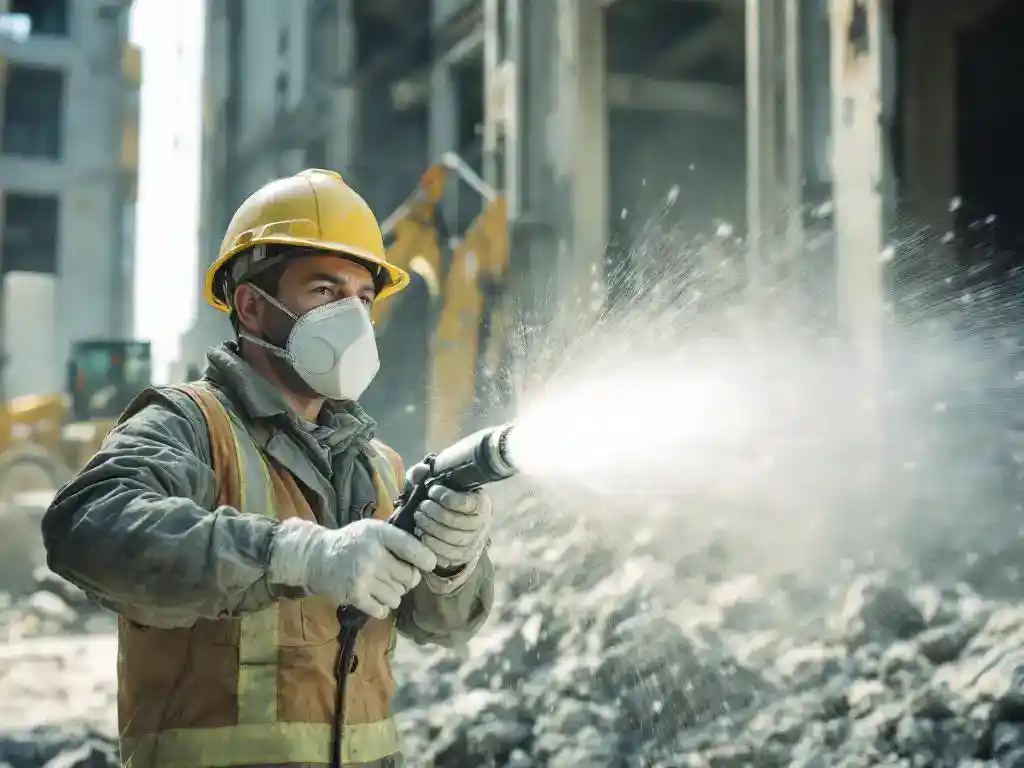
The three most effective sustainable solutions for dust control in the mining industry are crust formation, foam formation and atomisation. Each of these methods tackles dust generation at source, reduces the impact on people and the environment, and replaces traditional methods that often consume too much water or yield insufficient results. Which method is most suitable depends on the type of material, the location and the type of process, and begins with an understanding of where, when and under what conditions the dust is generated. Dust control is not an isolated measure, but part of broader operational management: it affects emissions, air quality, compliance and business continuity. This article answers the most frequently asked questions about dust control in the mining industry, ranging from health risks to regulations and choosing the right approach.
What health risks does dust in the mining industry cause?
Dust in the mining industry poses a serious health risk to workers, particularly due to prolonged exposure to fine particulate matter (PM2.5 and PM10). These particles are small enough to penetrate deep into the lungs and cause conditions such as pneumoconiosis (dust lung), silicosis and chronic bronchitis. The risk is greatest in open-cast mines and underground operations due to the combination of dry material, mechanical processing and limited ventilation.
In addition to respiratory diseases, there are also risks to the eyes, skin and respiratory tract following short-term exposure. Dust originating from ores, coal or minerals may also contain toxic substances that cause further harm to health. Organisations are legally obliged to minimise exposure, which makes dust control not merely a matter of comfort, but one of employment law and liability.
What are the most commonly used methods for dust control in the mining industry?
The most commonly used methods for dust control in mining are water spraying, crust formation, foaming and atomisation. Water spraying is the traditional approach, but it has limitations: it consumes large quantities of water, provides only a temporary effect and is quickly rendered ineffective in dry or windy weather. More modern techniques combine water with additives to increase effectiveness and reduce water consumption.
In addition to wet methods, tarpaulins and windbreaks are also used for stockpiles. These mechanical solutions are effective for static situations, but offer no protection during active operations such as drilling, crushing or transport. For dynamic processes in the mining industry, chemically-assisted techniques are generally more effective and more practical to implement.
The appropriate technique varies depending on the location, material and process. Dosage and equipment also often require a bespoke approach. An effective approach therefore begins with identifying the dust hotspots: where does the dust originate, at what time and under what conditions (dry weather, wind, airflow, drop height)? Operators often know the sources and problem areas better than anyone else, so their input is a valuable addition to measurements and inspections.
How does crust formation work as a sustainable dust control method?
Crust formation is a method whereby a binding agent is applied to the surface of stockpiles or earthworks, after which it hardens into a protective layer that traps dust particles. This crust prevents wind or mechanical disturbance from releasing loose particles into the air. Biodegradable crusting agents, such as water-based formulations containing natural fibres, reduce dust formation from stockpiles by more than 90 per cent.
Crust formation is ideally suited to situations where material is stored temporarily or long-term and is not continuously processed. In the mining sector, this involves stockpiles of ores, coal, fly ash or other dry bulk goods. The method requires little water and works even under dry conditions, making it more sustainable than conventional spraying. It is not a question of using more water, but of achieving better dust suppression with less water.
An additional advantage is that crust formers are available in transparent or coloured versions, depending on the application. Some products contain fibres for extra binding strength, whilst fibre-free variants are suitable for situations where a clean, uniform layer is required. Both variants are fully biodegradable and safe for the environment.
When is foam the best choice for dust control?
Foam formation is the most suitable method when dust is released at active processing points, such as crushers, conveyor belts, sorting lines and transhipment points. The foam binds dust particles directly at the source before they can disperse, without requiring large quantities of water. This makes foam generation effective in situations where water spraying would add too much liquid to the material or the surrounding area.
The technique works by injecting a foam-forming additive under high pressure via spray bars and nozzles, after which the foam envelops the dust particles and pulls them downwards. In the mining industry, this is relevant for breaking up rock, transporting fine-grained material, or loading and unloading dry raw materials. As the foam dissipates quickly, the amount of moisture added to the material remains minimal.
An additional advantage of foam generation is that the systems can be fully automated and operate continuously without manual intervention. This also makes the method practical for operations with limited staff. Further information on this approach can be found on the page about dust control solutions.
What laws and regulations apply to dust emissions in the mining sector?
Dust emissions in the mining sector are governed by a combination of national environmental legislation, health and safety legislation and European directives. In the Netherlands, the Environmental Management Act sets requirements for emissions into the air, whilst the Working Conditions Act establishes limit values for employees’ exposure to particulate matter in the workplace. Exceeding these limit values may lead to enforcement action, fines or the suspension of activities.
At European level, the Industrial Emissions Directive (IED) applies to larger mining operations, which are obliged to apply best available techniques (BAT) to limit dust emissions. In addition, environmental permits often impose site-specific requirements on dust levels, measured at the site boundary or in the immediate vicinity. Complaints from local residents may lead to stricter monitoring.
Looking towards 2030, it is expected that requirements will become even more stringent. Stricter standards for particulate matter, the further elaboration of BAT requirements and lower emission limit values mean that dust control is becoming an increasingly prominent part of the licensing process. For many mining companies, structural dust control is therefore a prerequisite for their licence to operate: those who can demonstrate that they remain below the limit values retain the trust of regulators and local residents and safeguard business continuity.
It is therefore advisable to view regulations not merely as a minimum obligation, but as a starting point for a structural approach. This also means that results must be measurable. Particulate matter measurements at the property boundary and at source, supplemented by, for example, LiDAR to map dust plumes, demonstrate whether measures are effective and provide the evidence required by the licensing authority. Companies that proactively invest in effective dust control run a lower risk of enforcement action and, at the same time, build a better relationship with the local community and the relevant authorities.
How do you choose the right sustainable dust control solution for your mining process?
The correct dust control solution for a mining process depends on three factors: the type of material, the nature of the dust-generating process and the site conditions. Crust formation is suitable for static storage situations, foam formation for active processing points, and atomisation for transhipment and transport. In practice, a combination of methods is often the most effective. Additives work best as part of a broader dust control strategy, alongside, for example, process modifications, encapsulation and proper maintenance, rather than as a stand-alone solution.
Water consumption also plays a role in the decision-making process. Effective dust control does not automatically have to involve using more water. In regions with water scarcity or strict discharge requirements, methods using additives are more attractive than pure water spraying, as they achieve better dust suppression with less water. Biodegradable additives offer the added benefit that they leave no hazardous residues in the soil or groundwater.
A practical approach consists of the following steps:
- Map out the hotspots: determine where, when and under what circumstances dust is generated, and involve operators in this assessment.
- Carry out a laboratory test on your own material: material properties such as particle size, moisture content and composition determine which additive and dosage will be effective.
- Conduct an on-site trial: test the chosen technique under actual process conditions, without immediately investing heavily in a system that may subsequently prove unsuitable.
- Measure and validate the results: use particulate matter measurements or LiDAR to demonstrate the effect.
- Optimise based on measurement data: adjust dosage, nozzles and equipment according to what the measurements show, and repeat this as seasons or materials change.
How we help with dust control in the mining industry
WUVIO develops and supplies biodegradable additives and systems for industrial dust control, specifically tailored to the challenges of the mining industry. Our approach begins with an analysis of the dust problem and a test using the client’s own material in our laboratory. Based on this, we recommend the most suitable solution, oversee the installation and supply the additives on an ongoing basis. As sites, materials and processes vary, the technology, dosage and equipment may require bespoke solutions.
- Crust formation (EcoCrust S / Freko-Crust): for stockpiles and long-term outdoor storage of ores, coal and other dry bulk goods
- Foam generation (Freko-Foam): for crushers, conveyor belts and transhipment points where dust is released during active operations
- Atomisation (Freko-Humidifier): for loading, unloading and transporting dry raw materials
- All products are fully biodegradable and safe for people and the environment
- Systems are easy to automate and integrate into existing processes
- Over 10 years’ experience in industrial dust control, operating in Europe and the Middle East
Looking for an effective solution for industrial dust control? We’d be happy to help you find a suitable approach. Take a look at our dust control solutions or get in touch for personalised advice.
Related Articles
- Why is dust nuisance caused by fine-grained material more difficult to control?
- How do you combine dust control with day-to-day port operations?
- What measurement techniques are associated with effective substance management?
- What regulations apply to dust emissions in the Netherlands?
- What environmental standards will apply to dust emissions in industry in 2026?