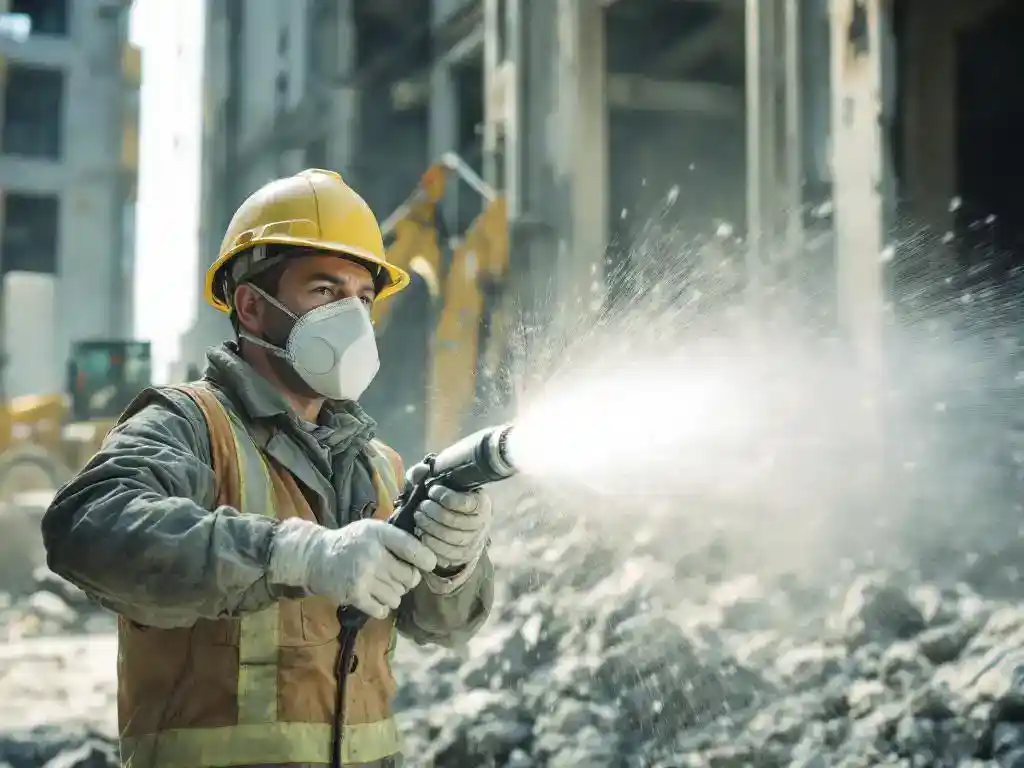
For dry bulk materials, several dust control methods are available: crust formation, foaming, atomisation and road dust control. Which approach works depends on the type of material, the source of the dust and the on-site conditions. There is no one-size-fits-all solution, but with the right analysis, an effective and sustainable approach can be found for every dust problem. This article answers the most frequently asked questions about dust control in dry bulk, ranging from technical aspects to legislation and regulations.
What dust control methods are used for dry bulk materials?
For dry bulk, four main methods are used: crust formation, foam formation, atomisation and road dust control. Each method targets a different type of dust source and operates via a different mechanism. The choice depends on where the dust is released, what material is being processed and what conditions prevail at the site.
Crust formation protects storage areas and stockpiles by forming a protective layer on the surface of the material. Foam formation binds dust particles directly at the source of the dust, such as conveyor belts, crushers and sorting lines. Atomisation creates a mist curtain around the dust source and captures dust particles released into the air. Road dust control keeps trackways and unsealed roads moist using hygroscopic additives, thereby preventing dust from being stirred up by passing traffic.
An overview of dust control solutions shows that these methods can also be combined when a site has multiple sources of dust.
Why is dust in dry bulk so difficult to control?
Dust in dry bulk is difficult to control because it is released at multiple points simultaneously and is highly dependent on material characteristics such as particle size, moisture content and dust sensitivity. Furthermore, conditions are constantly changing: wind, temperature, season and the intensity of the transhipment process all influence dust formation.
Short-lived but intense dust peaks occur during the loading and unloading of ships, the discharge onto conveyor belts or the processing of material in crushers. Storage yards, on the other hand, emit dust over a prolonged period, particularly in dry and windy weather. This means that a single solution is rarely sufficient. Materials such as coal, ores, fly ash and biomass each exhibit different dust behaviour, which calls for an approach specifically tailored to both the material and the process.
What is the difference between crust formation and foam formation in dust control?
The difference between crust formation and foam formation lies in the timing and location of application. Crust formation is applied to stationary materials, such as stockpiles and storage areas, to form a protective layer that prevents dust from being blown into the air. Foam application is used at active dust sources, such as conveyor belts and crushers, to capture dust particles immediately upon release.
In crust formation, water-based additives, with or without fibres, are applied to the surface of the material. This forms a hard or flexible layer that is resistant to wind and light precipitation. Dust reduction at stockpiles can thus exceed 90 per cent.
Foam formation works differently: the foam is injected under high pressure via spray bars and nozzles at the point where dust is released. The foam particles envelop the dust particles and ensure they adhere to the material rather than dispersing into the air. This method is particularly effective in enclosed or semi-enclosed environments such as hall or bunker installations.
When is atomisation the right choice for dust control?
Atomisation is the correct choice when dust needs to be intercepted in the vicinity of the dust source after it has already been released. It is particularly effective at transhipment points, during loading and unloading operations involving bulk carriers and lorries, and at waste treatment facilities where it is difficult to control dust directly at source.
A misting system creates a curtain of fine water droplets around the dust source. The droplets bind the dust particles and cause them to settle before they spread further. By using additives that reduce the surface tension of water, the effectiveness of atomisation is significantly increased. This makes it possible to bind more dust using less water, which also limits the moisture load on the material.
Spraying is less suitable if the primary source of dust is a large open storage area or if there is persistent wind that disrupts the dust suppression curtain. In such cases, crust formation offers a better solution.
How do you choose the right dust control approach for your material?
You select the appropriate dust control approach based on four factors: the type of material, the source of the dust, the site conditions and the operational requirements. There is no standard solution that works for every material and every process, which means that a thorough analysis is essential beforehand.
Relevant questions to consider when making a choice are:
- Where exactly does the dust originate: during transport, transhipment, storage or processing?
- What are the characteristics of the material: particle size, moisture content, dust sensitivity?
- Which environmental factors play a role: wind, temperature, space around the dust source?
- Are there any restrictions regarding water consumption or the addition of moisture to the material?
- What laws and regulations apply at the location?
A laboratory test using the client’s own materials provides insight into which additives and methods are best suited to the specific situation. This prevents the use of a method that appears logical on paper but fails to deliver satisfactory results in practice. Companies operating in a wide range of industrial sectors therefore include a test phase as a standard part of their selection process.
Which laws and regulations apply to dust emissions during bulk transhipment?
In the Netherlands and Europe, multiple legislative and regulatory frameworks apply to dust emissions from bulk transhipment. The most important of these are the Environmental Management Act, the Environment Act (in force since 2024), European directives on air quality, and sector-specific permit conditions, which may vary by location and activity.
Organisations that tranship or store dry bulk are obliged to limit dust emissions to the standards set out in their environmental permit. Exceeding these standards may lead to enforcement action, penalty payments or the revocation of the permit. By 2026, enforcement regarding dust emissions will become increasingly stringent, partly due to growing pressure from local residents and stricter European air quality standards.
In practical terms, this means that companies must be able to demonstrate that they are taking active measures to limit the spread of dust. Documentation of the methods employed, the products used and the measurement results plays an important role in this regard. The use of biodegradable and non-hazardous additives simplifies the licensing procedure, as no additional environmental assessment is required for the substances used.
How we help with dust control in dry bulk
Wuvio offers a comprehensive approach to dust control in dry bulk, from the initial analysis to the ongoing supply of additives. Our approach is practical and results-oriented:
- Lab testing with our own materials: we test the materials in our own laboratory to determine which method and which additive works best.
- Tailored advice: based on the test results and location analysis, we propose an approach that aligns with the process and operational requirements.
- Installation and implementation: we handle the installation of the dust control system, whether it involves crust formation, foaming or atomisation.
- Ongoing supply of biodegradable additives: all products are safe for people and the environment and comply with applicable laws and regulations.
- Start small, scale up when it works: a trial phase is always possible before scaling up to full implementation.
Would you like to know which approach suits your situation? Read more about our working methods and expertise, or contact us directly for a no-obligation consultation.
Related Articles
- What are the minimum requirements for dust control in infrastructure projects?
- How quickly does dust control work in the case of an acute outdoor dust problem?
- How do you adapt dust control measures to changing weather conditions?
- Crust formation or atomisation: which do you choose for dust control?
- What do you do if the local authority approaches you about dust nuisance?