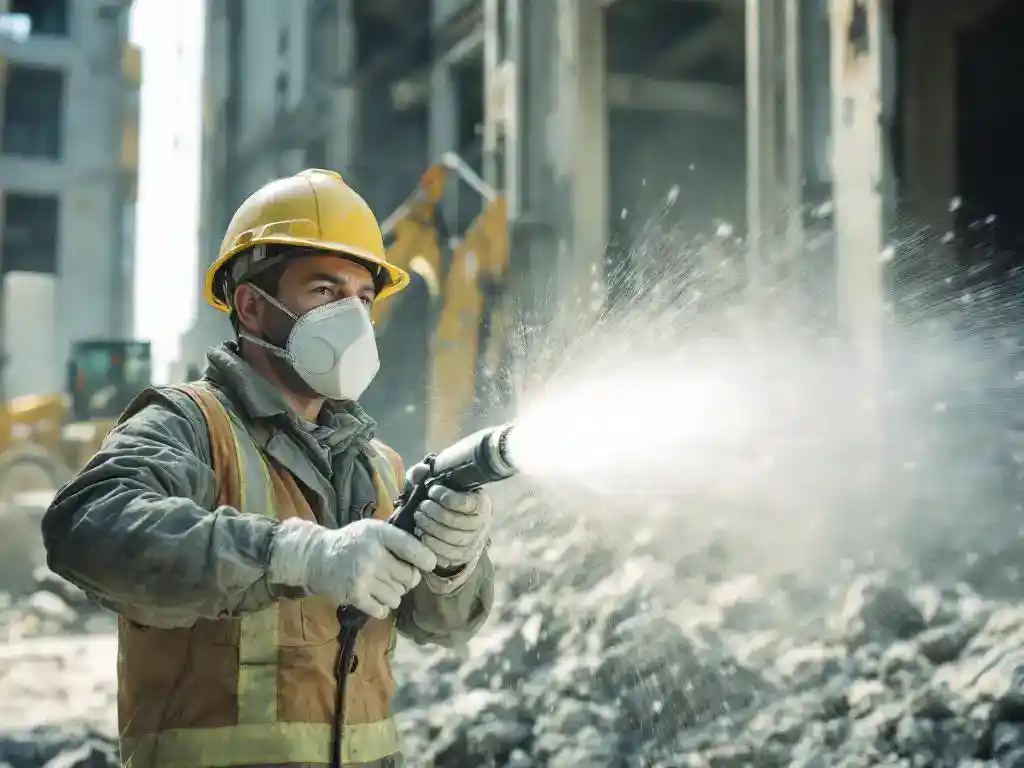
Dust at crushing plants in the mining industry is effectively controlled using a combination of foam additives and atomisation, tailored to the type of material, the location of the dust source and the conditions under which the dust is generated. Foam formation acts directly at the crusher itself, whilst misting protects the area surrounding the plant. Which method is most suitable depends on the material, water consumption and the applicable regulations. Dust control is not a stand-alone measure, but an integral part of operational management: it relates to emissions, air quality, compliance and business continuity. Below, we answer the most frequently asked questions about dust control at crushers.
Why do crushing plants produce so much dust?
Crushing plants produce large quantities of dust because the material is intensively fragmented with every crushing stroke. This process releases fine particles that enter the air directly. The drier and more brittle the material, the greater the dust generation. This applies to ores, coal, granite and other dry bulk raw materials processed in the mining industry.
The content creation focuses on a number of specific points in the process, the so-called ‘dust hotspots’:
- The breaking point itself, where material is crushed under high pressure
- Chutes and conveyor belts immediately after the crusher, where material falls and dust is stirred up
- Transfer points, where crushed material moves from one conveyor belt to another
- Screening decks, where fine dust is separated and released into the air
As crushers operate continuously and process large volumes, dust levels are structurally high. Without active dust control, concentrations of particulate matter quickly exceed legal standards and pose a health risk to staff on the shop floor.
First, map out the hotspots
Before choosing a method, it is worth determining where, when and under what circumstances the dust is generated. Dust generation is rarely constant: it varies depending on the type of material, moisture content, production peaks and weather conditions. Wind, dry conditions and a fluctuating feed rate to the crusher can cause emissions to fluctuate significantly. A thorough assessment involves a tour of the production line, recording dust peaks at each process location and linking these to production data and weather conditions. Operators often know the plant best and are aware of which points cause recurring problems. Their observations therefore provide a valuable supplement to measurements.
Which dust control methods are suitable for crushers?
In crushing plants, foam generation and atomisation are the two most suitable methods for active dust control. Both techniques use water, but in different ways and at different stages of the process. The choice depends on the dust source, the type of material and the available space around the plant.
Foam generation is ideally suited to the direct dust source. A foaming additive is injected under pressure at the point where the material breaks up. The foam particles bind the dust before it enters the air. This works well in enclosed or semi-open crushing plants where the dust source is easily accessible.
Atomisation creates a mist curtain around the installation. Fine water droplets capture dust particles already suspended in the air. This is effective in open configurations or as a supplementary measure alongside foam generation. Atomisation also protects the wider working environment around the crusher.
Traditional water spraying without additives is often insufficient for crushers. Water consumption is high, the material becomes too wet and dust suppression is limited. Modern additives significantly improve effectiveness whilst reducing water consumption. However, additives are not a stand-alone solution: they are most effective as part of a broader dust control strategy, alongside, for example, encapsulation, extraction and proper maintenance of the plant. Dosage, equipment and technology vary depending on the site, material and process, and therefore often require a bespoke approach.
What is the difference between atomisation and foam additives in crushing plants?
The difference between atomisation and foam additives in crushing plants lies in their mode of action and location. Foam additives act at the source: they bind dust at the moment of crushing. Atomisation acts around the source: fine droplets capture dust particles that have already been released into the air.
Foam additives: direct dust binding
Foam additives are injected under high pressure via spray bars and nozzles at the point of breakage. The foam envelops dust particles directly at the source, causing them to clump together and preventing them from entering the air. This significantly reduces water consumption compared with traditional spraying, and the material remains within the desired moisture limits.
Atomisation: protection of the environment
Atomisation uses atomisation systems that produce a cloud of extremely fine droplets around the dust source. These droplets are small enough to remain suspended in the air and capture dust particles. By adding an additive such as Freko-Humidifier, the surface tension of the water is reduced. This makes the droplets more effective at binding fine dust, without requiring additional water consumption.
In practice, both methods complement each other. Foam formation tackles the source, whilst atomisation protects the wider environment. For larger or open crushing plants, a combined approach is often the most effective.
How much water does dust suppression consume at a crushing plant?
Water consumption for dust suppression at a crushing plant varies greatly depending on the method used. Effective dust control does not automatically mean using more water: with modern additives, consumption is considerably lower than with traditional spraying, as the additives enhance the effectiveness of the water. Less water is needed to achieve the same dust-binding effect, resulting in better dust suppression.
With foam additives, water is injected under high pressure into a concentrated area. Because the foam binds dust directly at the source, no large quantity of water is required to spray the surrounding area. This also keeps the material drier, which is important for processes where excessive moisture content causes problems during further processing or transport.
With misting, water consumption depends on the size of the installation and the desired coverage. Additives such as Freko-Humidifier reduce the surface tension of the water, enabling the same amount of water to cover a larger surface area and bind dust more effectively. This makes misting, as a dust control technique, suitable even for locations with a limited water supply.
A precise indication of exact consumption depends on the crusher’s capacity, the type of material and local conditions. A laboratory test using your own material provides the most reliable basis for calculating water consumption. You can then further optimise dosing and water consumption using real-world measurement data.
What laws and regulations apply to dust emissions from mining installations?
In Europe and the Netherlands, legal standards apply to particulate matter emissions (PM10 and PM2.5) from mining installations, as well as to workplace exposure. The regulations stem from European directives, national environmental legislation and health and safety legislation. Exceeding these standards may result in fines, the shutdown of the facility or stricter permit conditions.
The key regulatory frameworks for mining companies are:
- European NEC Directive (National Emission Ceilings): sets national ceilings for particulate matter emissions
- Environmental Act (Netherlands): requires companies to control and report dust emissions
- Health and Safety Decree: sets limit values for exposure to dust in the workplace (including quartz dust, which is common in mining)
- Permit requirements: large crushing plants are subject to an environmental permit, with specific emission limit values
In practice, we have seen that the enforcement of dust standards has been tightened in recent years. Companies that cannot demonstrate that they are taking active measures run a greater risk of facing penalties. Documentation of the dust control methods used and measurement results is therefore not only useful but, in many cases, mandatory. You can find more information on the Wuvio website about how industrial dust control complies with current regulations.
Developments towards 2030 and the licence to operate
It is expected that requirements relating to particulate matter will be further tightened in the coming years. Stricter dust emission limits and the incorporation of BAT (Best Available Techniques) requirements into permits are making structural dust control increasingly important. Those who invest now in a demonstrably effective approach will be in a stronger position later on when it comes to permit granting and enforcement.
Dust control is therefore directly linked to the ‘licence to operate’: both the regulatory permit and the public support required to be allowed to produce. Dust nuisance for local residents, complaints about air quality and breaches of standards can lead to restrictions on business operations or even a complete shutdown. Structural dust control is therefore also a matter of business continuity, not just compliance.
How do you test which pest control solution works for your material?
The most reliable way to determine which dust control solution works is a laboratory test using the client’s own material, followed by a practical on-site trial. Every material behaves differently: the grain size, moisture content and mineralogical composition determine which technique and which additive work best.
A structured testing process consists of the following steps:
- Hotspot analysis: identify where, when and under what circumstances dust is generated, and involve the operators who know the installation best
- Material analysis: determine the properties of the material to be crushed, such as moisture content, dust sensitivity and particle size distribution
- Lab test: test various additives and concentrations on the client’s own materials in a laboratory setting
- Selection of the technique: based on the test results, choose the most effective method (foam, atomisation or a combination)
- On-site practical test: set up a test rig at the crushing plant and measure the dust concentrations before and after
- Evaluation and upscaling: assess the results, optimise dosage and equipment, and scale up the solution to the full-scale installation
This step-by-step plan prevents the installation of a solution that fails to deliver in practice. It also provides insight into the expected water consumption and the necessary equipment, so that the investment can be properly justified to senior management or other decision-makers.
Measuring and validating emissions
Measurement is essential to demonstrate the effect of a measure. Particulate matter measurements (PM10 and PM2.5) at and around the installation show whether concentrations are falling, and also provide the evidence required for regulatory authorities. Techniques such as LiDAR are suitable for obtaining a broader picture of dust plumes across a larger area. It is preferable to carry out measurements both before and after the introduction of a measure, and to repeat measurements under varying conditions, so that you know whether the approach remains effective even in dry and windy weather.
How we help with dust control at crushing plants
We support mining companies from the initial analysis right through to the ongoing supply of additives. Our approach is practical and tailored to the specific circumstances of the installation and the material, as the correct technique, dosage and equipment vary from site to site. What we offer:
- Lab testing using our own materials in our own laboratory, to ensure the correct solution is selected before any investment is made
- Freko-Foam for direct dust binding at the crusher using foam additives under high pressure
- Freko-Humidifier for effective atomisation around the installation, up to ten times more effective than water alone
- Bespoke installations, easy to automate and integrate into the existing process
- Biodegradable additives, completely safe for staff and the environment
- Ongoing delivery and technical support, ensuring that dust control remains structurally guaranteed
Looking for an effective solution for industrial dust control? We’d be happy to help you find a suitable approach. Take a look at our dust control solutions or get in touch for personalised advice.
Related Articles
- What are the seven key considerations for dust control in a seaport?
- How does dust control work structurally on large sites?
- Dust control in infrastructure projects: how do you go about it?
- How can you prevent dust from spreading whilst loading ships?
- What measuring equipment do you use to monitor dust?