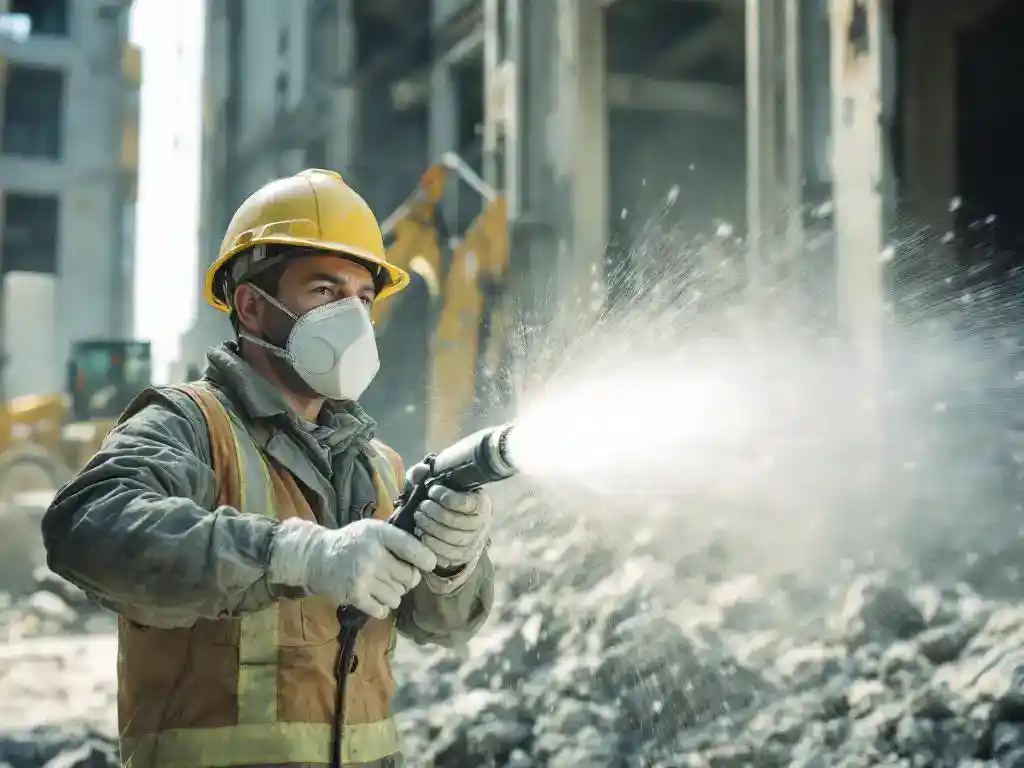
When it comes to dust control in a seaport, there are seven key considerations: legislation and regulations, the nature of the materials being handled, the specific environmental factors of a port, the choice of dust control techniques, the role of additives, methods for measuring effectiveness, and the involvement of local residents and competent authorities. Seaports combine intensive bulk handling, open areas and an immediate vicinity with residential areas and nature, making dust control here more complex than in most other industrial environments. The following questions provide a concrete and practical answer for each key consideration.
What laws and regulations apply to dust emissions in seaports?
In the Netherlands, seaports are governed by the Environmental Management Act, the Environment Act (in force since 2024) and the associated environmental permit. These set limit values for dust emissions, particulate matter (PM10 and PM2.5) and specific materials such as coal and ores. Breaches of these standards lead to enforcement action by the environmental agency and may result in fines or the suspension of activities.
In addition to national legislation, European directives apply, including the Industrial Emissions Directive (IED) and the NEC Directive on national emission ceilings. Port authorities and terminals are obliged to apply best available techniques (BAT) for dust control. What constitutes BAT is set out in so-called BREF documents, which are periodically revised and are becoming increasingly stringent.
In practice, this means that terminals must have an up-to-date dust control plan, carry out measurement programmes and demonstrably comply with the authorised emission limits. Monitoring takes place both on-site and via continuous emission monitoring.
Which materials cause the most dust nuisance during bulk transhipment?
The materials that cause the most dust nuisance during bulk transhipment in seaports are coal, iron ore, fly ash, biomass and cereals. These materials are dry, fine-grained or light in structure, meaning they quickly release dust particles when exposed to wind, when dropped from a height or during mechanical processing.
Coal and ores account for a large proportion of particulate matter emissions in dry bulk ports. Biomass, such as wood pellets and agricultural waste streams, is particularly light and generates a great deal of dust during loading and unloading. Fly ash is so fine that even the slightest air movement causes it to disperse.
Dust formation depends not only on the material itself, but also on the moisture content, the drop height during transhipment, the wind speed at the terminal and the condition of the material (fresh, weathered or broken). Wet material produces less dust, but if the moisture content is too high, other problems arise, such as loss of mass and transport issues.
How does dust control in a seaport differ from other industrial environments?
Dust control in a seaport differs from that in other industrial environments due to the combination of large open areas, variable weather conditions, high transhipment volumes and the proximity to open water and built-up areas. These factors place higher demands on the robustness, scalability and environmental safety of the methods employed.
In enclosed industrial environments such as factories or crushing plants, dust can be tackled at source, using extraction or enclosure. In a seaport, terminals operate largely in the open air, where wind plays a major role and enclosure is only possible to a limited extent. This makes atomisation around the dust source and crust formation on stockpiles more relevant than in indoor situations.
Furthermore, the scale is different: a seaport sometimes handles millions of tonnes per year across multiple terminals simultaneously. Dust control must therefore not only be effective but also operate reliably during continuous, large-scale operations without slowing down the turnaround time.
Which dust control techniques are most commonly used in seaports?
In seaports, four techniques are most commonly used: misting around transhipment points, crust formation on stockpiles, moistening of material via conveyor belts, and road dust control on access roads within the terminal.
- Atomisation: A mist curtain of fine water droplets around the dust source traps dust particles before they disperse. This works well during the loading and unloading of dry bulk carriers and at transfer points on conveyor belts.
- Crust formation: On stockpiles, a crust-forming agent forms a protective layer that significantly reduces dust dispersion caused by wind. This is a sustainable solution for the long-term outdoor storage of ores, coal or biomass.
- Foam formation: In crushers, sorting lines and conveyor belts, foam binds dust particles directly at the source, without using large quantities of water.
- Dust control: On unpaved roads within the terminal, wetting with hygroscopic additives prevents dust from being stirred up by freight traffic.
The choice of technique depends on the dust source, the material and the location. In most seaports, a combination of techniques is required to effectively control all dust sources.
When is the use of additives preferable to simply spraying water?
Additives are preferable to simply spraying water when water does not adhere sufficiently to the material, evaporates too quickly, or when the material’s moisture content must not be allowed to rise any further. In such situations, additives enhance the effectiveness of water without the drawbacks of excessive wetting.
Water alone has high surface tension, which means it penetrates poorly into hydrophobic materials such as coal or certain biomass streams. An additive such as Freko-Humidifier reduces this surface tension, enabling water to bind to dust particles up to ten times more effectively. This means lower water consumption whilst achieving the same or better results.
When forming a crust on stockpiles, water alone is never sufficient: without a binding agent, a stable crust will not form and the material will still be blown away by the next gust of wind. Crust formers such as EcoCrust S or Freko-Crust provide the structure that water cannot offer.
Additives are also relevant where strict requirements apply to the moisture content of the material to be supplied. By binding more effectively with less water, the moisture content remains within the customer’s contractual standards, whilst dust emissions are still limited. Find out more about how it works on the Wuvio website.
How do you measure the effectiveness of dust control in a seaport?
The effectiveness of dust control in a seaport is measured through a combination of continuous air quality monitoring, visual inspections, emission measurements at source, and a comparison of particulate matter concentrations before and after the implementation of dust control measures.
Continuous monitoring is carried out via measuring stations that record PM10 and PM2.5 at the terminal boundary or in the surrounding area. This measurement data shows whether emission standards are being met and whether peaks occur during specific activities, such as unloading a ship or moving a stockpile.
In addition, emission measurements at source are useful: these allow you to determine how much dust is released at a specific transfer point or conveyor belt, and what the effect of the technique used is. Visual inspection, whilst less objective, provides a quick insight into visible dust clouds and helps to identify uncovered dust sources.
A good monitoring programme combines environmental monitoring with source measurement and links the results back to the pest control techniques employed. This creates a cycle of measurement, evaluation and adjustment that supports demonstrable compliance with the licence.
How we help with dust control in seaports
We work with terminals and port operators that face dust nuisance issues during dry bulk transhipment, storage piles or internal transport. Our approach always begins with an analysis of the specific dust problem: what material, what source of dust, and what environmental factors. Based on this, we recommend the most effective combination of techniques and products.
- Crust formation on stockpiles using EcoCrust S or Freko-Crust: biodegradable, effective for ores, coal and biomass
- Mist generation at transfer points using the Freko-Humidifier: up to ten times more effective than water alone, with lower water consumption
- Foam generation at source with Freko-Foam: suitable for conveyor belts and transfer points
- Road dust control with RDS100+: hygroscopic action keeps road surfaces moist for longer
- All products are biodegradable and safe for the aquatic environment
- The systems can be fully automated and are easy to use
Looking for an effective solution for industrial dust control? We’d be happy to help you find a suitable approach. Take a look at our dust control solutions or get in touch for personalised advice.
Related Articles
- How do you identify hazardous substance contamination in recycling activities?
- How do you keep dust control measures effective in extreme wind conditions?
- What are the legal requirements for dust control in the mining industry?
- How harmful is dust in the workplace?
- How much dust are you legally allowed to breathe in at work?