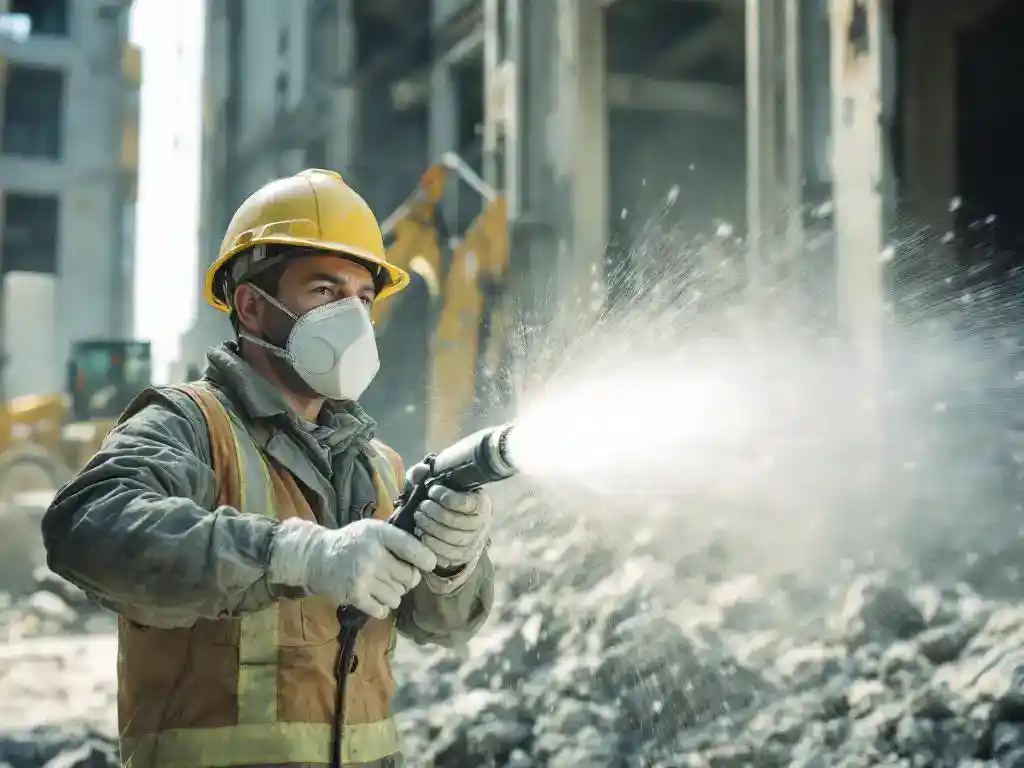
Dust suppression by misting works by dispersing tiny water droplets into the air, which bind dust particles and cause them to settle. This technique creates a mist curtain around dust sources and uses special additives to enhance its effectiveness. Mist suppression is particularly suitable for open spaces, loading and unloading operations, and situations where other dust control methods are impractical.
What is atomisation and how does it tackle dust problems?
Mist suppression for dust control works according to a simple yet effective principle: tiny water droplets capture dust particles from the air and bring them down before they can spread. The technique utilises misting systems that create a fine water mist around dust sources, such as conveyor belts, transhipment points and stockpiles.
The physical process behind atomisation is based on collision and adhesion. When dust particles come into contact with the tiny water droplets, they stick together due to surface tension. The combined mass becomes heavier and falls to the ground, effectively removing the dust particles from the air.
Modern atomisation techniques utilise special additives that reduce the surface tension of water. This ensures that the water droplets make better contact with dust particles, significantly increasing their effectiveness. This approach works well with various types of dust, from fine powder to coarser particles.
What different atomisation techniques are there?
There are three main types of industrial misting for dust control, each with specific characteristics and areas of application. The choice depends on the type of dust, the environment and your company’s operational requirements.
High-pressure atomisation operates at pressures between 20 and 100 bar and produces very fine droplets of 10–50 micrometres. This technique is ideal for fine particulate matter and offers excellent coverage, but requires more maintenance and entails higher energy costs.
Low-pressure atomisation uses pressures of 3–10 bar and creates droplets of 50–200 micrometres. This method is more cost-effective in terms of maintenance and energy consumption, but less effective with very fine dust. It works well with coarser dust particles and large surfaces.
Ultrasonic atomisation uses vibrations to create water droplets without high pressure. This technique produces uniformly shaped droplets and has low energy costs, but is more sensitive to water quality and has limited capacity for large spaces.
| Technology | Drop size | Energy consumption | Maintenance | Best use |
|---|---|---|---|---|
| High pressure | 10–50 μm | High | Intensive | Fine dust, precision work |
| Low pressure | 50–200 μm | Intermediate | Limited | Large surfaces, coarse particles |
| Ultrasonic | 1–10 μm | Low | Intermediate | Small spaces, sensitive environments |
When is atomisation the best choice for your dust problem?
Mist suppression for dust control is the best choice when you need flexibility and wide coverage for dynamic dust sources. This method works exceptionally well during the loading and unloading of ships and lorries, and at waste treatment plants, where dust sources regularly change location.
Opt for atomisation when other methods, such as crust formation or foaming techniques, are impractical. This applies particularly to open spaces, high piles of material and situations where you cannot make direct contact with the material. Atomisation also works well as a complement to other dust control methods.
The effectiveness of dust suppression using water mist depends on various factors. Wind speed plays an important role: in strong winds (over 5 m/s), the mist veil is blown away. The type of dust is also a determining factor: hydrophobic (water-repellent) materials are more difficult to bind than hydrophilic substances.
Atomisation is less suitable for permanently static situations where crust formation would be more effective. Other methods are also often preferable when dealing with very large volumes of dust or in processes that require a continuous supply of dry material. The various industrial sectors each have their own specific requirements for dust control.
What are the advantages and challenges of atomisation?
Mist spraying offers low water consumption compared to traditional water spraying, flexible deployment and relatively low installation costs. The system can be set up and moved quickly, making it ideal for temporary projects and changing operations.
The main advantages of dust suppression through atomisation are:
- Water-saving: up to 80% less water consumption than traditional methods
- Flexibly applicable to various sources of material
- Relatively low investment costs for installation
- Suitable for large areas and open spaces
- Can be automated and operated remotely
The challenges of misting are primarily practical in nature. Weather dependence is the greatest limitation: wind, rain and extreme temperatures affect its effectiveness. Nozzle maintenance is required to prevent blockages, particularly with hard or contaminated water.
Other points to note are:
- Regular cleaning and replacement of nozzles
- Limited effectiveness with water-repellent materials
- Dependence on weather conditions
- Potential formation of mud when used excessively
- Energy costs for pumps and compressors
How we help with misting to combat dust
We offer complete atomisation solutions tailored to your specific dust problem. Our approach begins with a thorough analysis of your situation, followed by a practical test using your material to determine the best configuration.
Our atomisation services include:
- Bespoke advice – analysis of dust type, environment and operational requirements
- Biodegradable additives – our Freko-Humidifier increases effectiveness up to 10 times
- Installation and configuration – complete setup of atomisation systems
- Ongoing support – maintenance, monitoring and optimisation
- A fully managed service – from lab testing to implementation and delivery of additives
We work with biodegradable and safe products that comply with all environmental legislation. Our solutions are developed in our own laboratory and tested in real-world situations. You can start small with a trial and scale up once the results are convincing.
Would you like to know whether misting is the right solution for your dust problem? Our team of experts would be happy to help you with a no-obligation analysis. Please get in touch to discuss your specific situation and options.