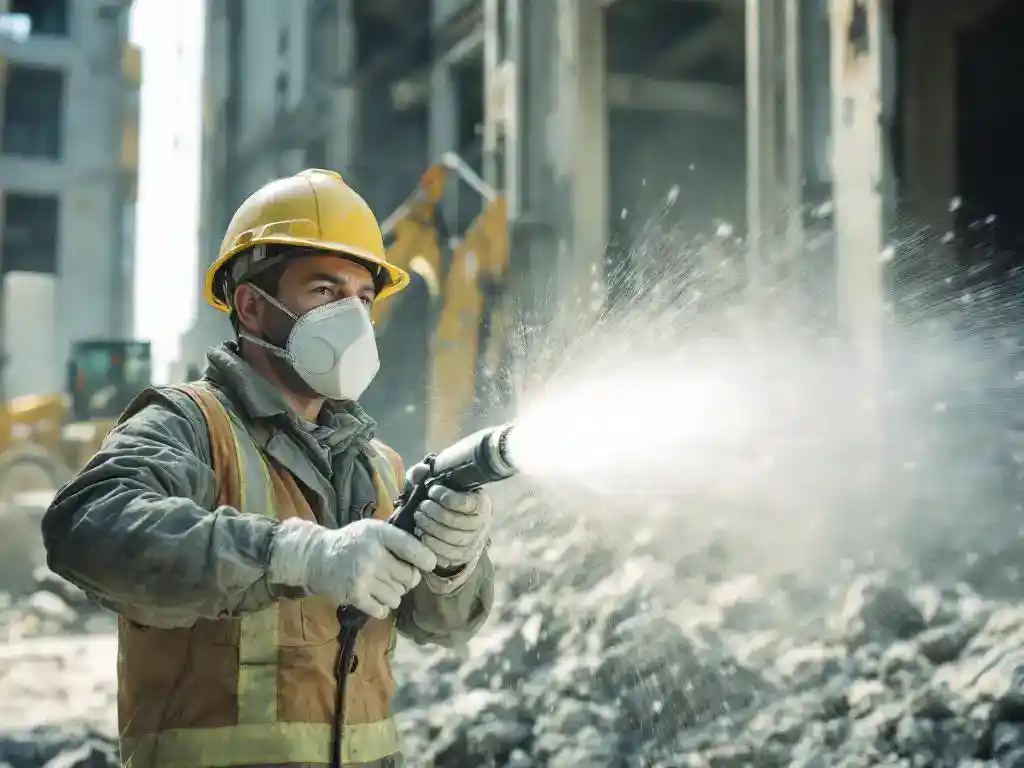
Atomisation and binders are both effective techniques for dust control in the mining industry, but they work in fundamentally different ways. Atomisation controls dust in the air around the dust source, whilst binders keep the dust at the source by binding material particles together. The best choice depends on the type of dust source, the type of material, the available water and the environmental conditions. That choice begins with a clear understanding of the dust hotspots on site. In many situations, both techniques together deliver the best results, as part of a broader dust control strategy.
Where to start: first, identify the key areas
Before choosing between atomisation and binders, it must be clear where the dust originates, when it arises and under what circumstances. Without that insight, the wrong technique will be deployed in the wrong place. A practical approach consists of the following steps:
- Map out the sources: consider crushers, transfer points, conveyor belts, stockpiles and transport routes.
- Determine the timing and circumstances: does the dust arise during loading or unloading, in dry weather, in strong winds, or continuously as a result of the process?
- Involve the operators: staff on the shop floor often know exactly where and when the dust is at its worst.
- Assess the baseline situation: particulate matter measurements and, for larger sites, LiDAR provide an objective picture of emissions before you take any measures.
This distinction between dynamic sources (loading, breaking, transport) and static sources (storage, stockpiles) largely determines which technique is most suitable.
What are the advantages and disadvantages of misting in the mining industry?
Atomisation works by creating a mist curtain of fine water droplets around the dust source, causing dust particles in the air to be bound and settle. This makes the technique particularly suitable for dynamic dust sources such as loading and unloading operations, crushers and conveyor belts in open-cast mining environments.
Advantages of atomisation in the mining industry:
- Direct action on particles already suspended in the air
- Suitable for large areas and open environments
- Easy to automate and deploy for variable sources of material
- Effective for high dust concentrations on a short-term basis
Disadvantages of atomisation:
- Relatively high water consumption in conventional installations
- Less effective for fine particulate matter (PM2.5 and smaller) without the addition of an additive that reduces surface tension
- Wind and weather conditions affect its operation
- Does not provide long-term protection at storage sites or stockpiles
Atomisation is therefore a strong choice for active, short-term sources of particulate matter, but less suitable as a long-term solution for the static storage of materials such as ores or coal.
How do binders work in combating mining dust?
Binders are additives applied to the surface of a material to bind dust particles together or form a protective crust. They prevent dust from becoming dislodged by wind, vibrations or mechanical stress. In the mining industry, they are widely used on stockpiles, transhipment points and conveyor belts.
There are two main types of binders used in mining environments:
Crust-forming binders
Crust-forming binders form a solid, protective layer on the surface of the material. They are ideally suited to the long-term outdoor storage of dry bulk materials such as ores, coal or fly ash. A well-formulated crusting agent can reduce dust emissions from stockpiles by more than 90 per cent and remains effective even in strong winds.
Moisture-binding and agglomerating binders
These binders increase the cohesion between dust particles without forming a visible crust. They are suitable for materials that remain in motion, such as on conveyor belts or at transhipment points. By reducing the surface tension of water, they achieve deeper and more effective wetting of the material using less water.
Which pest control technique uses less water?
Effective dust control does not automatically mean using more water. In most applications, binders consume considerably less water than conventional spraying. This is because binders reduce the surface tension of water, allowing a smaller amount of moisture to penetrate the material more effectively and remain active for longer. Spraying with water alone requires a continuous water supply to remain effective.
When using a spray additive – such as one that reduces surface tension – water consumption falls significantly compared with spraying with water alone, whilst dust suppression improves. In dry climates or regions with water scarcity, the choice between dust suppressants or optimised misting with additives is therefore not only a technical consideration, but also an operational and sustainability-related one.
When is atomisation better than binders, and vice versa?
Spraying is more suitable when dust is already present in the air and needs to be settled immediately. Binders are more effective when the aim is to prevent dust formation at source, particularly in the case of static storage or materials that are stored for long periods.
Opt for atomisation when:
- There are active dust sources such as crushers, loading points or conveyor belts
- Material must be assimilated quickly and directly within the immediate working environment
- The source of the material is variable or irregular
Opt for ‘binders’ when:
- Materials are stored outdoors for extended periods
- Wind is the main cause of dust emissions from stockpiles
- Water consumption must be reduced
- Long-term protection is required without the need for a continuously operating installation
Bear in mind that locations, materials and processes vary considerably. The correct technique, dosage and equipment therefore often require a bespoke approach, and a short trial using the client’s own materials provides greater certainty than general rules of thumb.
Can atomisation and binders be used together?
Spraying and binders can be effectively combined and complement each other in a multi-layered approach to industrial dust control. Binders prevent dust from being released at source, whilst atomisation captures the dust that is nevertheless released during dynamic processes. This combination is particularly effective in complex mining environments where both static storage and active transhipment take place.
A practical example: a stockpile of ores is treated with a crusting agent to minimise dust emissions in windy conditions. When loading the material onto a conveyor belt, atomisation is used to bind the dust released during mechanical handling. Together, these two techniques cover the entire dust risk without overburdening either one.
How do you measure and validate whether the approach works?
A dust control approach is only reliable if the results are measured. Compare the situation before and after the measure using particulate matter measurements (PM10 and PM2.5) at representative points, for example at the site perimeter, near residential buildings in the vicinity and at the workplace. For extensive sites, LiDAR can help to visualise dust plumes and identify hotspots.
You should then use the measurement data to further optimise dosage, spray times and equipment. This will prevent you from consistently using too much water or additive, or conversely, too little in the areas where it matters most.
Which dust control technique complies with environmental and safety standards?
Both atomisation and binding agents can comply with applicable environmental and safety standards, provided that the substances used are biodegradable and do not contain any hazardous substances. Dust control is more than just a technical measure: it directly impacts emissions, air quality, compliance and business continuity. Furthermore, the systematic control of dust emissions is a prerequisite for the ‘licence to operate’ – the social and regulatory scope to continue production.
Furthermore, the trend is moving in one direction. As we approach 2030, requirements regarding particulate matter, BAT (Best Available Techniques) requirements and emission limit values for particulate matter will be further tightened in many countries. Those who invest now in a demonstrably effective approach will avoid having to scale up measures later under time pressure.
When selecting a pest control technique, the following standards are relevant:
- Air quality standards: limit values for PM10 and PM2.5 in the workplace and the surrounding environment
- Environmental legislation: requirements concerning the use of chemical substances in soil and surface water
- Health and Safety Legislation: protection of employees against exposure to harmful substances
- Permit conditions and BAT conclusions: emission limit values and mandatory monitoring for the sector in question
Biodegradable additives that are safe for humans, animals and the environment meet the strictest standards in most cases. The use of water-based additives free from hazardous chemicals makes both spraying and crust formation suitable for use in sensitive mining environments.
How we help with dust control in the mining industry
At Wuvio, we develop and deliver dust control solutions specifically tailored to the challenges faced in the mining industry. Whether it involves atomisation, crust formation or a combination of both: we work with you to identify the dust hotspots, analyse the specific dust problem and recommend the most effective approach for the material and the process.
- Mist generation with the Freko Humidifier: up to 10 times more effective than water alone, due to a reduction in surface tension
- Crust formation using EcoCrust S or Freko-Crust: provides long-term protection for stockpiles against wind erosion and dust emissions
- All products are biodegradable and safe for people and the environment
- From lab testing with our own materials to installation and ongoing supply
- Bespoke solutions for each location, material and source of contamination
Looking for an effective solution for industrial dust control? We’d be happy to help you find a suitable approach. Take a look at our dust control solutions or get in touch for personalised advice.
Related Articles
- How does dust control reduce water consumption at a mining site?
- Which five indicators point to serious dust nuisance with dry bulk materials?
- Which four factors determine how far dust pollution spreads?
- How does dust control change when an industrial estate is expanded?
- What do you do if the local authority approaches you about dust nuisance?