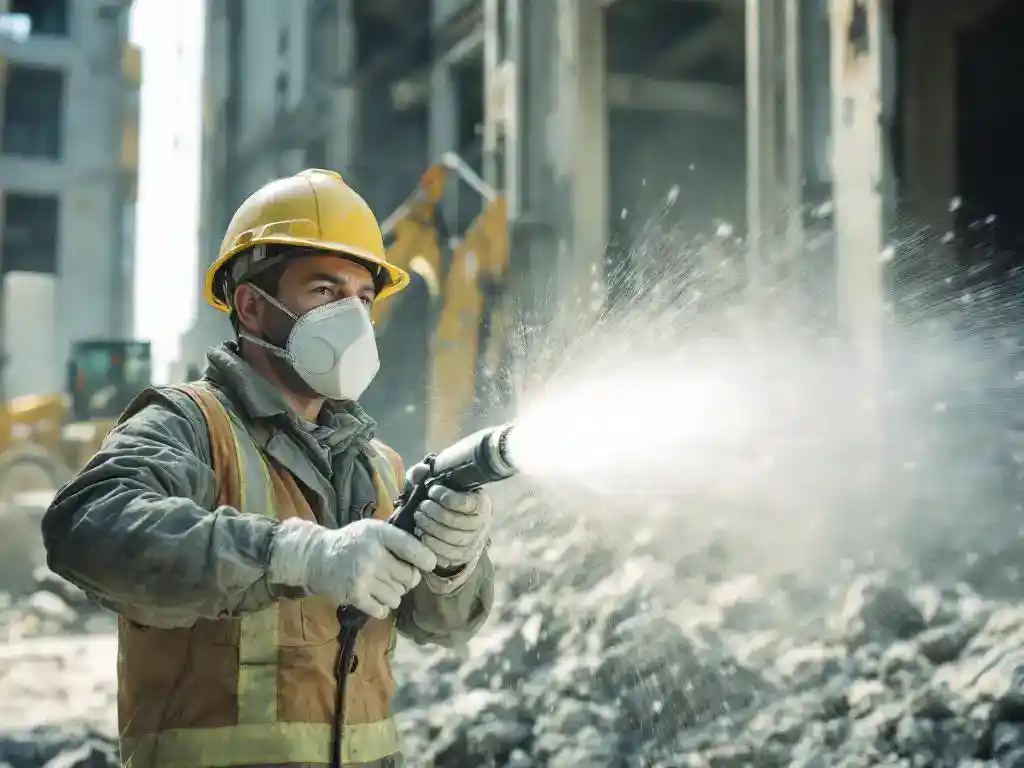
Dust control in mining encompasses all techniques and resources deployed to manage and reduce dust generation during mining operations. Examples include wetting materials, applying crust formers to stockpiles and using foam at crushers and on conveyor belts. Dust is generated in the mining industry at virtually every stage of the process: during the extraction, crushing, transport and storage of ore, coal and other minerals. Dust control is therefore not an isolated measure, but part of broader operational management: it affects emissions, air quality, compliance, the licence to operate and the continuity of the business. In this article, we answer the most frequently asked questions about dust problems, health risks, legislation and regulations, and effective solutions in the mining sector.
What are the most common dust-related problems in the mining industry?
In the mining industry, dust problems are virtually ubiquitous. The most common sources are crushing plants, conveyor belts, transhipment points and stockpiles of extracted material. In dry and windy weather, fine dust spreads rapidly over long distances, affecting both the working environment and the area outside the site.
Specific situations that cause dust nuisance:
- Crushers and grinding plants: the reduction of ore or coal releases large quantities of fine dust
- Conveyor belts: material is scattered at every overflow or transfer point
- Stockpiles: wind erodes the surface of uncovered piles, particularly when the material is dry
- Loading and unloading activities: when loading lorries or trains, dust is dispersed into the immediate surroundings
- Access roads on site: heavy traffic on unpaved roads causes significant dust clouds
Each of these sources requires a different approach. A generic solution rarely works; the dust control method must be suited to the material, the location and the process.
You should therefore always begin by identifying the dust hotspots: where does the dust originate, when does it occur, and under what circumstances? A practical approach consists of three steps:
- Identify the sources: go through the entire process, from extraction to loading, and mark all points where material falls, breaks, is overlooked or is exposed to the wind.
- Determine the pattern: consider the time of day, weather conditions, the moisture content of the material and the level of activity on site. A hotspot that only peaks when there is an easterly wind or during dry summer months requires a different approach to a continuous source.
- Involve the operators: staff who work daily with crushers, conveyor belts and access roads often know exactly where and when the dust is at its worst. Their knowledge makes the assessment quicker and more comprehensive.
What health risks do mining dust pose to employees?
Mining dust poses a serious health risk to anyone regularly exposed to it. Fine dust particles, and certainly respirable dust that penetrates deep into the lungs, can lead to serious and irreversible lung conditions. Silicosis, an occupational disease caused by quartz dust, is one of the best-known and most dangerous consequences of long-term exposure in the mining industry.
In addition to silicosis, there are other health effects that occur in mining practice:
- Pneumoconiosis (dust lung): accumulation of dust particles in the lung tissue due to prolonged inhalation
- COPD and chronic bronchitis: prolonged exposure causes structural damage to the airways
- Short-term symptoms: eye irritation, coughing, sore throat and headaches at high dust concentrations
- Increased risk of lung cancer: certain types of mineral dust are carcinogenic upon prolonged exposure
Staff working daily on crushers, conveyor belts or stockpiles are at the highest risk. Personal protective equipment is an emergency measure; structural dust control at source is the only sustainable way to limit exposure.
What laws and regulations apply to dust emissions in the mining sector?
In most countries, mining companies are subject to strict environmental and labour legislation concerning dust emissions. In Europe, the Industrial Emissions Directive (IED) sets requirements for dust emissions from industrial installations. In addition, national standards apply to maximum dust concentrations in the workplace, as laid down in health and safety legislation.
In the Netherlands, the Labour Inspectorate applies limit values for respirable quartz dust and other hazardous substances. Companies that exceed these limits risk fines, the suspension of operations and reputational damage. Environmental permits usually also contain specific emission requirements for dust, both for diffuse emissions (dispersion via wind) and for point sources.
Regulations are becoming stricter. Looking towards 2030, we expect stricter requirements regarding particulate matter, a tightening of BAT (Best Available Techniques) requirements and lower emission limit values for dust. At the same time, enforcement pressure is increasing, partly because local residents and environmental organisations are lodging objections to dust nuisance more frequently. Structural dust control is therefore also a prerequisite for the ‘licence to operate’: the social and regulatory scope to continue production. Those who invest now in effective dust control will avoid costly problems later on.
Demonstrability is just as important as the measure itself. Permit-issuing authorities and local residents want to see that the approach works. You should therefore measure emissions and results, for example through particulate matter measurements (PM10 and PM2.5) on site and at the site boundary, supplemented by, for instance, LiDAR to track dust plumes. This allows you to substantiate compliance and make step-by-step adjustments to the approach, dosage and equipment based on measurement data.
What are the most effective methods for dust control in the mining industry?
The most effective methods for dust control in the mining industry are crust formation on stockpiles, foam generation at crushers and conveyor belts, misting around transhipment points, and road dust control on access roads. Which method works best depends on the type of material, the source of the dust and the environmental conditions. This makes bespoke solutions the norm: the correct technique, dosage and equipment vary depending on the location, material and process.
An overview of the key techniques:
- Crust formation: a protective layer is applied to the surface of a stockpile. This prevents wind from dislodging dust particles. Suitable for long-term storage of ores, coal and other dry bulk goods
- Foam formation: foam binds dust particles directly at the source, for example at crushers or transfer points on conveyor belts. The foam envelops the particles so that they do not become airborne
- Atomisation: fine water droplets are sprayed around the dust source, creating a mist curtain that traps dust particles before they disperse
- Road dust control: additives keep the surface of unsealed roads moist for longer, thereby preventing dust clouds caused by heavy traffic
Effective dust control does not automatically involve using more water. Simply spraying water is often insufficient: it evaporates quickly, unnecessarily increases the moisture content of the material and requires large quantities of water. Dust suppression solutions containing additives can contribute to more efficient water use and better dust binding, as they reduce the surface tension of water or structurally stabilise the material. Additives form part of a broader dust control strategy, alongside source-control measures such as limiting drop heights, reducing spill points and adapting work activities to weather conditions.
How do biodegradable additives work with mining waste?
Biodegradable additives work by altering the physical properties of water or the dust material itself, so that dust particles are better bound or the surface of a material is stabilised. They contain no hazardous chemicals and break down completely in the environment after use, leaving no harmful residues behind.
In atomisation, additives such as a humidifier product reduce the surface tension of water. This makes the water droplets smaller and more effective at capturing fine dust particles. When crust formation occurs, additives bind the top layer of a stockpile together to form a solid crust that withstands wind loads. When foaming occurs, foaming additives encapsulate dust particles directly at the source.
The advantage of biodegradable additives is threefold: they are safe for staff, they have no negative impact on the environment surrounding the mine, and they comply with the increasingly stringent environmental requirements imposed on mining companies. Furthermore, they can reduce water consumption compared to traditional sprinkler systems, which is particularly relevant for sites where water availability is limited. However, the result does depend on the correct dosage and equipment for the specific material and process. By using measurement data, you can further optimise the dosage and setup as you go along.
When is an on-site dust test required in the mining industry?
An on-site dust test is required when the dust issue is complex, the material exhibits unknown behaviour, or when an existing approach yields insufficient results. Every mining site has a unique combination of material type, climate, process design and dust sources. What works for copper ore in a dry climate may not work for coal in a humid environment.
An on-site assessment provides insight into:
- The dust behaviour of the specific material under local conditions
- The most suitable additive or technique for that specific application
- The required dosage and installation setup for an effective result
- The expected water consumption and the cost-effectiveness of the solution
A test is most valuable if you have identified the hotspots in advance and carried out a baseline measurement. Compare the result afterwards with that baseline situation, for example using particulate matter measurements and a visual assessment of the dust plume. This reveals what the measure actually achieves and allows you to adjust the dosage and equipment before scaling up.
A trial also provides certainty for internal decision-making: when multiple stakeholders are involved in the investment, a proven result at the organisation’s own premises provides the confidence needed to proceed. Starting with a small-scale trial and then scaling up is an approach that limits both the risk and the initial investment. Further information on what such an approach entails can be found on the Wuvio website.
How Wuvio helps with dust control in the mining industry
We work with mining companies on a daily basis to achieve effective and sustainable dust control. Our approach always begins with a thorough analysis of the problem: which materials, which dust sources and which environmental factors play a role? Based on this, we devise a bespoke solution as part of a broader dust control strategy.
What we offer:
- Crust formation (EcoCrust S / Freko-Crust): for the stabilisation of stockpiles of ore, coal and other dry bulk goods
- Foam generation (Freko-Foam): for dust control at crushers, sorting lines and conveyor belts
- Mist generation (Freko-Humidifier): for transhipment points and loading and unloading operations
- Dust control (RDS100+): for unpaved roads on the mine site
- On-site trial: we test using our own materials at our own premises, so that the solution is proven to work before any large-scale investment is made
- Ongoing supply and service: from consultancy and installation to the continuous supply of biodegradable additives
Looking for an effective solution for industrial dust control? We’d be happy to help you find a suitable approach. Take a look at our dust control solutions or get in touch for personalised advice.
Related Articles
- How do mining companies tackle dust on unpaved transport routes?
- Which five indicators point to serious dust nuisance with dry bulk materials?
- How does dust pollution from coal differ from that caused by biomass?
- What can you do about dust blowing off conveyor belts?
- What can you do to tackle dust nuisance on a building site?