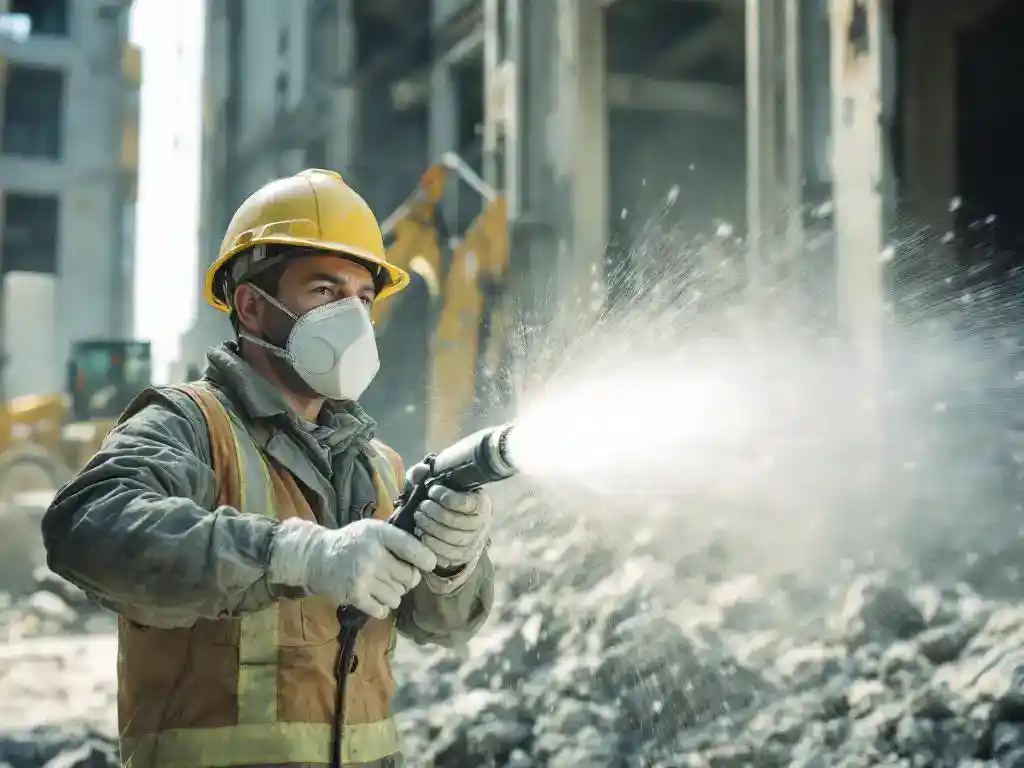
Effective dust control on a mining site reduces water consumption because additives enable the water to work more efficiently. Instead of spraying large quantities of water to settle dust, additives bind dust particles at source using a fraction of the water required. The result is reduced water consumption, less dust nuisance and lower operational costs. Effective dust control is therefore not automatically about using more water: it is about the right technique in the right place at the right time. The following questions provide a clear picture of how this works in practice.
How much water does a mining site use for dust suppression?
A mining site typically consumes thousands of litres of water per day for dust suppression, depending on the size of the site, the type of material and the weather conditions. At large open-cast mines with extensive road networks, transhipment points and stockpiles, this water consumption can quickly rise to tens of thousands of litres per day when water is used as the sole means of dust suppression.
This high consumption is a growing problem. Mining activities often take place in regions where water is scarce or where strict restrictions apply to water extraction. Furthermore, water consumption entails direct costs: transport, storage, pumping and sprinkler systems, and the staff required to operate these systems. Dust suppression using water alone is therefore not only environmentally harmful but also operationally costly.
The preconditions are also shifting. It is expected that requirements regarding particulate matter and the limit values for dust emissions will become stricter as we approach 2030, and expectations regarding the application of best available techniques (BAT) are increasing. Any company that is now systematically saving water without compromising on dust suppression will be better prepared for this than one that continues to rely on ever-increasing amounts of water.
Why is simply spraying water insufficient for mining dust?
Simply spraying water is insufficient for mining dust because water has a high surface tension, which means fine dust particles are not absorbed effectively. The smallest and most dangerous dust particles, which penetrate deepest into the respiratory tract, remain suspended in the air rather than settling.
Furthermore, water evaporates quickly, particularly in hot weather or when it is windy. On a mining site where temperatures soar and there is constant movement of vehicles and machinery, the effect of water spraying is often short-lived. Within a quarter of an hour of spraying, the road surface or stockpile may already be dry again and producing dust once more.
Another drawback is that too much water compromises the load-bearing capacity of unpaved roads. Excessively wet tracks become muddy and unsafe, leading to operational disruptions. Striking the right balance between effective dust suppression and a passable road surface is virtually impossible using water alone.
How do dust-control additives reduce water consumption?
Dust suppression additives reduce water consumption by enhancing the action of water, so that less volume is required to achieve the same or a better result. They lower the surface tension of water, enabling dust particles to be better encapsulated and bound. This makes it possible to achieve more effective dust suppression using considerably less water.
Depending on the type of additive, these resources work in different ways:
- Wetting additives reduce the surface tension of water so that it penetrates deeper into the material and binds finer dust particles.
- Crust formers create a protective layer on stockpiles and exposed surfaces, preventing the wind from stirring up dust. Once applied, continuous watering is no longer required.
- Foaming additives bind dust particles directly at source, such as in crushers or on conveyor belts, using a minimal amount of water.
- Hygroscopic additives attract moisture from the air, causing a treated road surface to remain damp for longer without the need for further watering.
The combined effect is that the frequency of watering decreases and the amount of water per treatment is significantly reduced. In practice, this means a reduction in water usage that can amount to a fraction of the original consumption when watering with pure water.
Additives are not a stand-alone solution in this context. They perform best as part of a broader dust control strategy, alongside source control measures, process adjustments, maintenance of traffic routes and proper planning of works. The correct choice of additive, the dosage and the equipment vary depending on the location, material and process, and therefore often require a bespoke approach.
Which dust control techniques save the most water in the mining industry?
The techniques that save the most water in the mining sector are crust formation for stockpiles and dust suppression on access roads using hygroscopic additives. Both techniques involve a one-off or periodic application rather than continuous spraying, which significantly reduces total water consumption.
Start by mapping out the substance hotspots
Which technique yields the best results depends on where, when and under what circumstances the dust is generated. Therefore, first identify the hotspots: which vehicle routes, transhipment points, crushers and stockpiles are the main sources; at what times of the day or season are emissions highest (dry, warm or windy weather, peak transport periods); and which materials play a role in this? Operators often know these locations from experience and can therefore provide valuable input. By applying water and additives specifically to the actual hotspots rather than across the entire site, consumption is reduced immediately.
Crust formation on stockpiles and exposed surfaces
In crust formation, an additive is applied to the surface of stockpiles or wasteland. The agent forms a solid, protective layer that prevents wind from carrying away dust particles. Products such as EcoCrust S can reduce dust formation at stockpiles by more than 90 per cent. Once applied, no further watering is required until the crust is mechanically disturbed, for example when the material is excavated.
Road dust control using hygroscopic action
On tracks and unpaved roads within the mining site, hygroscopic additives ensure that the road surface remains damp for longer. The additive draws moisture from the ambient air, thereby reducing the frequency of re-treatment. This is a significant improvement on spraying with plain water, where the surface dries out quickly in dry and warm weather.
Foaming at transfer points and crushers
For active dust sources such as crushers, sorting lines and conveyor belts, foam formation offers a water-saving solution. The foam encapsulates dust particles directly at source before they enter the air. As foam consists of a small amount of water and air, water consumption per volume of material treated is much lower than with direct spraying.
Measuring and optimising
Whether an approach genuinely saves water and sufficiently reduces dust can only be determined through measurements. Consider particulate matter measurements at the site boundary and near sensitive recipients, measurement of water consumption per treatment and, on larger sites, visual monitoring of plumes or LiDAR. Establish a baseline measurement in advance, compare this after the introduction of additives, and use the results to further adjust dosage, spraying frequency and equipment. In this way, the approach becomes a continuous improvement process rather than a one-off measure.
What are the cost and environmental benefits of reduced water consumption in dust control?
Reduced water consumption in dust control yields direct cost savings and reduces the environmental impact of mining operations. The costs of water supply, storage and distribution at a mining site are considerable. Every litre of water that does not need to be extracted, transported or pumped represents a direct saving on operational costs.
From an environmental perspective, water consumption in the mining sector is a growing area of concern. Stricter environmental legislation imposes restrictions on the amount of water that may be extracted from local sources. Companies that can demonstrate they are managing their water consumption and dust emissions not only comply better with these regulations but also strengthen their licence to operate: the confidence of local residents, clients and regulators that their activities are conducted responsibly and are systematically under control. Moreover, with stricter requirements on air quality and emissions, systematic dust control is a prerequisite for business continuity, as dust nuisance can lead to complaints, enforcement action or restrictions on business operations.
Additional benefits include:
- Reduced wear and tear on pumps and sprinkler systems due to fewer operating hours
- Less mud build-up on track surfaces, which limits vehicle damage and production losses
- Lower CO₂ emissions due to fewer water-powered vehicles and pumping stations in operation
- The use of biodegradable additives eliminates the risk of soil or groundwater contamination
The investment in effective dust control additives therefore pays for itself across multiple cost items simultaneously, not just through water consumption alone. Further information on available techniques can be found on the industrial dust control website.
When is an on-site dust control test appropriate for a mining company?
An on-site dust control test is advisable when the nature of the material, the environmental conditions or the specific dust sources require a bespoke solution. Mining materials vary greatly in composition, particle size and moisture content. An additive that works well with fine ore fines may perform differently with coarse rock material or carbon. Only a test using the client’s own material provides reliable information on its effectiveness.
A pilot test is also valuable when existing methods fail to deliver sufficient results or when operational conditions change, for example due to site expansion, a new type of material or stricter emission standards. By testing on a small scale first, a company can demonstrate that a solution works before scaling up the investment. Combine the test with measurements of dust concentrations and water consumption, so that the results can be objectively compared with the current situation and serve directly as the basis for the final dosage and choice of equipment.
How we help with dust control in the mining industry
We collaborate with mining companies on dust control solutions that structurally reduce water consumption without compromising on effectiveness. Our approach includes:
- Analysis of the dust problem on site, including the identification of hotspots, material types, dust sources and environmental factors
- Laboratory testing using our own materials to determine the most suitable additives and techniques
- Bespoke installations for crust formation, foam generation or road dust control, tailored to the site
- Continuous supply of biodegradable additives, safe for people, soil and groundwater
- Guidance and monitoring to ensure the solution continues to perform as the terrain or activities change, and that dosages and equipment are adjusted based on measurement data
Looking for an effective solution for industrial dust control? We’d be happy to help you find a suitable approach. Take a look at our dust control solutions or get in touch for personalised advice.
Related Articles
- How do you choose the right dust suppressant for dust control in mining?
- What are the three most underestimated sources of dust nuisance in a seaport?
- How do you continuously monitor dust control on a large outdoor site?
- When will dust control become a legal requirement in the Netherlands in 2026?
- How do you protect employees from dust in the workplace?