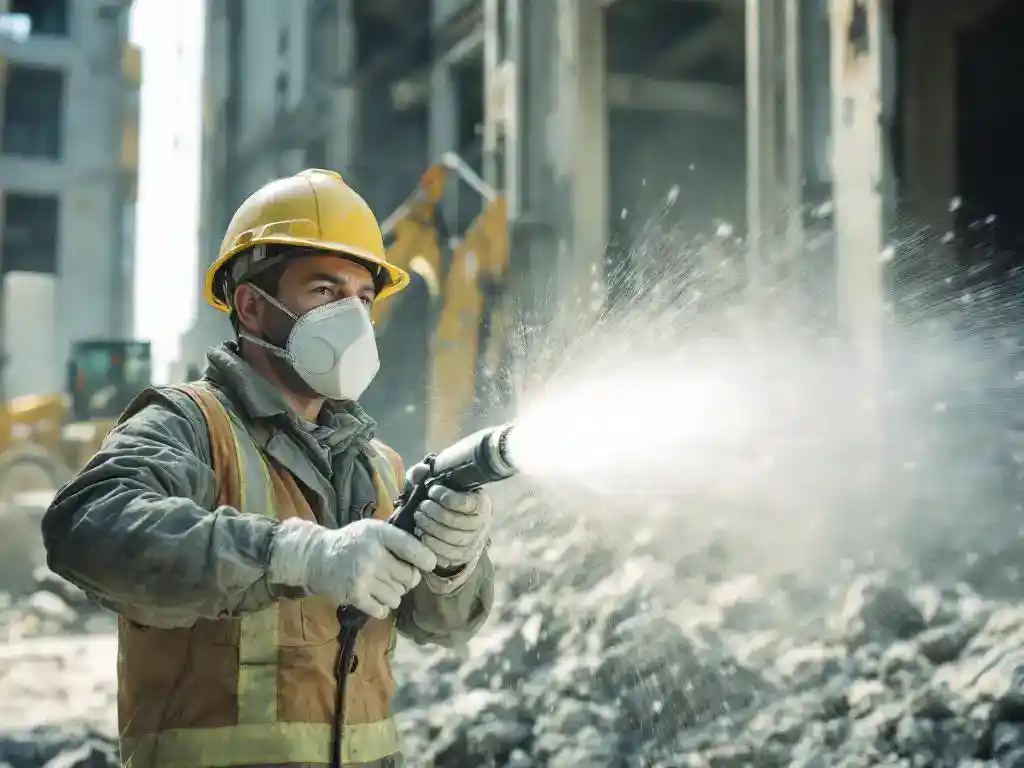
During dry summers, standard dust control without additional measures is insufficient in most industrial situations. Drought and heat accelerate the drying out of materials and significantly increase wind erosion, causing existing methods such as periodic water spraying to lose their effectiveness. In this article, we answer the most frequently asked questions about dust control during extreme drought and explain which approach actually works.
Why does dust pollution increase in dry and hot weather?
In dry and warm weather, dust nuisance increases because moisture in materials and the ground evaporates more quickly, making it easier for loose particles to be stirred up by wind and mechanical movement. The drier and finer the material, the greater the dust formation. This applies to storage areas, conveyor belts, transhipment points and unpaved roads.
Heat intensifies this effect in two ways. Firstly, added water evaporates much more quickly at high temperatures, meaning that the binding effect of moisture lasts for a shorter period. Secondly, air movement increases in warm weather, which enhances the dispersion of stirred-up dust. This effect is particularly noticeable at sites handling dry bulk materials such as ores, coal or biomass.
Stricter environmental legislation regarding dust emissions makes this problem particularly urgent. Organisations that do not take additional measures during the summer run a greater risk of complaints from local residents, breaches of emission limit values and associated fines.
Is simply sprinkling water still sufficient when it hasn’t rained for weeks?
Simply spraying water is not enough if it has not rained for weeks. During prolonged drought, the water from sprinklers evaporates so quickly that the effective moistening lasts only a few minutes. The amount of water that would be needed to achieve the same result as in normal weather is not feasible in practice and leads to unacceptably high water consumption.
Furthermore, excessive water spraying has drawbacks for the material itself. In the case of dry bulk materials, too much moisture can lead to a loss of quality or problems during further processing. On unpaved roads and construction sites, excessive water actually causes mud formation and instability.
Spraying water remains part of an effective approach, but only in combination with dust-control additives that reduce the surface tension of water and allow the wetting effect to last longer. In this way, less water is used more effectively.
Which pest control methods do work in conditions of extreme drought?
In cases of extreme drought, methods that bind dust at source or form a protective layer work best. Crust formation, foam formation and hygroscopic road dust control are the most effective techniques when spraying water alone is insufficient.
- Crust formation: a crust former binds the top layer of a stockpile or storage area into a solid crust, thereby preventing wind-induced drying and dust being blown away. This is particularly effective for materials left outdoors for long periods.
- Foam formation: foam envelops dust particles at active dust sources such as crushers, sorting lines and conveyor belts. It binds dust directly at the point of release, regardless of the outside temperature.
- Hygroscopic road dust control: products such as RDS100+ attract moisture from the air and keep the road surface damp for longer, even in hot and dry weather. This reduces dust formation on unpaved roads and construction sites without the need for constant spraying.
- Misting with additives: misting systems using surface-tension-reducing additives capture particulate matter more effectively than water alone, even at higher temperatures.
The best method depends on the type of material, the source of the substance and the location. In most cases, a combination of techniques yields the best results.
How do additives reduce water consumption in dust control?
Additives reduce water consumption in dust control by lowering the surface tension of water, enabling water droplets to adhere better to dust particles and penetrate deeper into the material. As a result, less water is required to achieve the same wetting effect, which can significantly reduce water consumption.
A product such as the Freko-Humidifier makes misting systems up to ten times more effective than water alone. This means that a greater dust-binding effect is achieved using a smaller amount of water. During dry summers, this is not only practical but also economically advantageous, particularly in locations where the water supply is limited.
Hygroscopic additives go one step further: they actively draw moisture from the ambient air. This ensures that a treated surface remains moist even after application, without the need for continuous re-spraying. For sectors such as mining, recycling and dry bulk handling, this offers a cost-effective solution during prolonged periods of drought.
When should companies take additional dust control measures?
Companies must implement additional dust control measures as soon as standard dust control measures no longer comply with the applicable emission limit values or cause visible dust outside their own site boundaries. In practice, this means that additional measures are necessary in the event of a prolonged drought lasting more than a week.
Specific indications that additional measures are required:
- Visible dust clouds caused by gusts of wind at storage sites or transhipment points
- Complaints from local residents or staff regarding dust nuisance
- Particulate matter readings that approach or exceed the statutory limit values
- Existing sprinkler systems that need to operate more frequently without achieving the desired result
- Dry spells lasting longer than seven days, combined with wind
Taking a proactive approach is wiser than reacting to complaints or enforcement action. Timely adjustment of the substance control strategy prevents operational standstill, fines and reputational damage.
Are biodegradable pest control products also effective in the summer?
Biodegradable pest control products are also effective in summer, provided they have been developed for use in high temperatures and dry conditions. Biodegradability does not adversely affect the product’s technical performance in hot conditions.
Water-based products containing natural fibres and binding additives, such as crust formers, retain their effectiveness even at high temperatures because they form a physical protective layer that does not depend on constant moistening. Foam-forming and hygroscopic products are also stable in hot weather.
An additional advantage of biodegradable products in summer is that higher temperatures accelerate biodegradation after use. This is beneficial for the soil and groundwater, without compromising effectiveness during use.
How we help with dust control during dry periods
Wuvio develops and supplies industrial dust control solutions that remain effective even in conditions of extreme drought and high temperatures. Our approach is practical and fully tailored to the organisation’s specific situation:
- Laboratory and field testing: we test our products using the client’s own materials, either in our laboratory or on-site, to ensure the solution is proven to work before implementation
- Tailored solutions for each dust source: from crust formation on stockpiles to foaming in active crushers and hygroscopic road dust control on construction sites
- Reducing water consumption: our additives enhance the effectiveness of water, meaning less water is required to achieve the same result
- 100% biodegradable: all products are safe for people and the environment, and contain no hazardous chemicals
- Ongoing supply and hassle-free service: from advice and installation to the continuous supply of additives
Would you like to find out more about our approach? Read about who we are or contact us directly for a no-obligation consultation.
Related Articles
- Which three causes of dust nuisance are most commonly overlooked?
- Dust control in mining during dry seasons: what works?
- How does dust control work on an unpaved port site?
- How can you prevent reputational damage caused by dust nuisance in the local area?
- What is the difference between chemical and biodegradable pest control?