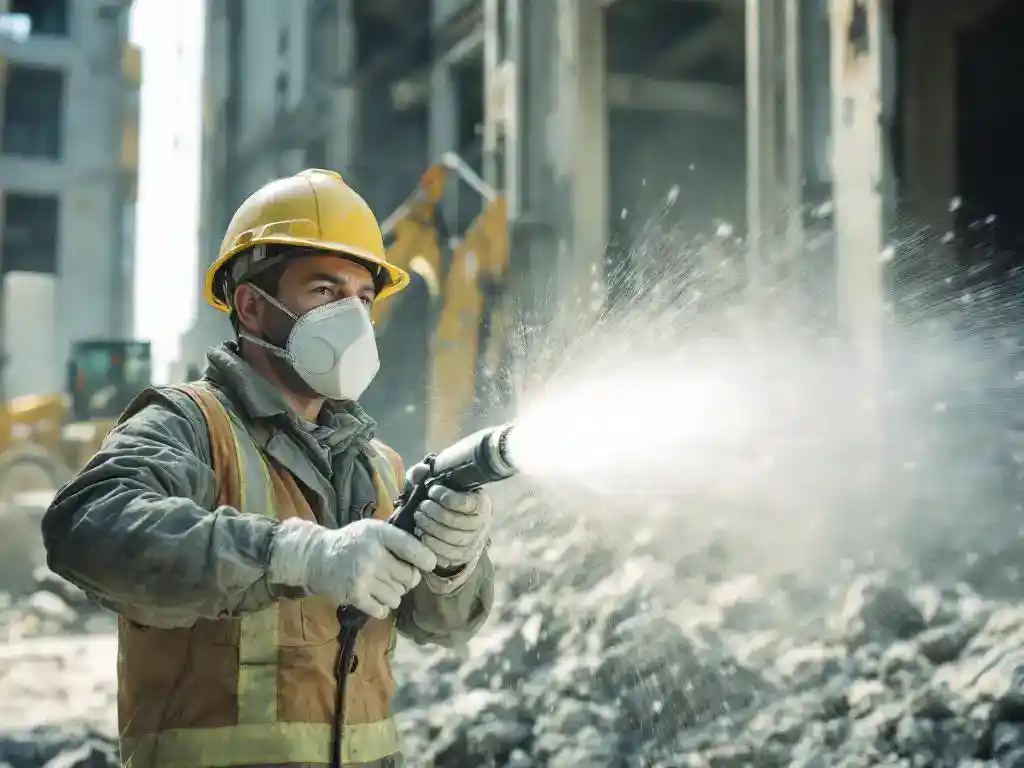
Dust control is more challenging with fine-grained material than with coarse material, as the particles are lighter and remain suspended in the air for longer. The correct approach depends on the type of material, the dust source and the on-site conditions. Below is a practical overview of the key considerations, ranging from health risks and methods to legal requirements and the choice of biodegradable additives.
Why is fine-grained material more difficult to manage than coarse material?
Fine-grained material is more difficult to control because the small particles have less mass and are therefore more easily carried along by air currents. Whilst coarse material settles quickly, fine dust remains suspended for a long time and spreads over greater distances. Standard spray water is often insufficient, as fine droplets are unable to bind the light particles effectively.
Furthermore, fine-grained material behaves differently depending on the situation. Dry and powdery materials, such as fly ash, fine sand or biomass residues, generate dust even at low wind speeds. At transhipment points, on conveyor belts and in storage areas where these types of materials are handled, dust clouds form that are almost impossible to control using conventional methods. The small particle size also makes it more difficult to form an effective crust or to moisten the material sufficiently without disrupting the moisture balance.
What health risks does fine-grained dust pose?
Dust consisting of fine-grained material poses serious health risks, particularly to the respiratory tract. Particles smaller than 10 micrometres (PM10) penetrate the respiratory tract, whilst particles smaller than 2.5 micrometres (PM2.5) even reach the alveoli. Long-term exposure can lead to chronic lung conditions, an increased risk of cardiovascular disease and, in some cases, occupational diseases.
For employees who work daily in environments containing particulate matter, such as in the processing of coal, ores, recycled materials or biomass, this poses a real risk. Occupational hygiene limit values have been set for various types of dust, but in practice these are difficult to meet without active dust control measures. In addition to direct health risks, exposure to fine dust also leads to increased absenteeism and loss of productivity.
Which dust control methods are effective for fine-grained material?
For fine-grained material, atomisation, foaming and crust formation are the most effective dust control methods. Each of these techniques works in a different way and is suitable for specific situations and types of material. The choice depends on the dust source, the material and the desired level of control.
Misting
Mist systems create a curtain of fine water droplets around the dust source. The droplets bind the dust particles and draw them downwards. By adding an additive such as Freko-Humidifier, the surface tension of the water is reduced, making it up to ten times more effective. This is a suitable method for loading and unloading dry bulk carriers and lorries, and at waste treatment plants.
Foam formation
Foam formation is effective for active dust sources such as sorting lines, crushers and conveyor belts. A foam-forming additive is injected under high pressure via spray bars and nozzles. The foam encapsulates the dust particles directly at source, before they have a chance to disperse. This makes foam formation one of the most direct ways of controlling dust at source.
Crusting
For storage sites and stockpiles, crust formation is a reliable method. A water-based crusting agent, reinforced with natural fibres and additives, forms a protective layer on the material. This prevents the wind from dislodging dust particles from the surface. Further information on the available dust control solutions helps in choosing the right technique for the specific situation.
How do you choose the right method for your specific material?
You select the correct dust control method based on the type of material, the source of dust, the site conditions and the desired moisture balance. There is no one-size-fits-all solution: every material and every process places different demands on dust control.
Relevant factors to consider when making a choice:
- Material type: Is the material hydrophilic or hydrophobic? Does it react sensitively to excess moisture?
- Source of material: Is it a static storage facility or an active transhipment point?
- Wind exposure: How exposed is the location to wind?
- Moisture content: Can the material absorb additional moisture, or are there process-related restrictions?
- Environmental requirements: Are there adjacent roads, residential areas or waterways that impose additional requirements?
A laboratory test using the organisation’s own materials provides the most reliable basis for making the right choice. This makes it clear which method actually works under the specific circumstances, without the need for major investment straight away. Organisations across various sectors, from mining to recycling, operate in this way. Take a look at the sectors where dust control is applied for an overview of relevant applications.
What are the legal requirements regarding dust emissions from fine-grained material?
The legal requirements regarding dust emissions from fine-grained material are laid down in European and national regulations, including the Environmental Management Act, the Working Conditions Act and European directives on air quality. Companies are obliged to limit dust emissions to specified limit values and must be able to demonstrate that they are taking active measures.
By 2026, the requirements in this area will become increasingly stringent. Regulatory bodies will enforce particulate matter emission limits more actively, and companies that fail to comply risk heavy fines and the suspension of operations. Specifically for fine particulate matter, limit values for PM10 and PM2.5 apply in the workplace and in the surrounding area. This makes a demonstrable and measurable dust control approach not only sensible, but also a legal necessity.
When are biodegradable additives the better choice?
Biodegradable additives are the better choice when dust control takes place in the vicinity of water, nature or residential areas, or when the material is subsequently processed in a supply chain where chemical residues are unacceptable. They combine effective dust control with minimal environmental impact.
Traditional chemical pest control agents can be harmful to the aquatic environment and the soil. Biodegradable alternatives break down naturally without leaving behind any harmful residues. This is relevant for sectors such as biomass, recycling and open-cast mining, where the material or the environment is sensitive to chemical contamination. Furthermore, biodegradable products are better aligned with the sustainability objectives increasingly being imposed by clients and public authorities.
How we help with dust control for fine-grained materials
Wuvio offers a comprehensive approach to dust control for fine-grained materials, from the initial analysis to the ongoing supply of additives. Our methodology:
- Lab test using your own materials: We test your specific materials in our own laboratory to determine which method works best.
- Tailored advice: Based on the test results and the on-site situation, we advise on the most effective and cost-efficient solution.
- Installation and implementation: We handle the installation of atomisation, foam or crust-forming systems, which are fully bespoke and easy to automate.
- Continuous supply: All additives are 100% biodegradable and safe for people and the environment, and are supplied on an ongoing basis to ensure continuity.
- Start small, scale up when it works: A trial is always the first step, without significant upfront investment.
Would you like to know how we tackle dust problems with fine-grained materials in practice? Read more about our approach or contact us directly for a no-obligation discussion.
Related Articles
- What are the three biggest misconceptions about dust pollution at mining sites?
- How can you systematically involve an HSE manager in substance management?
- What are the minimum requirements for dust control in infrastructure projects?
- What role does wind play in the failure of dust control in open areas?
- What happens when you work in a dusty environment for years on end?