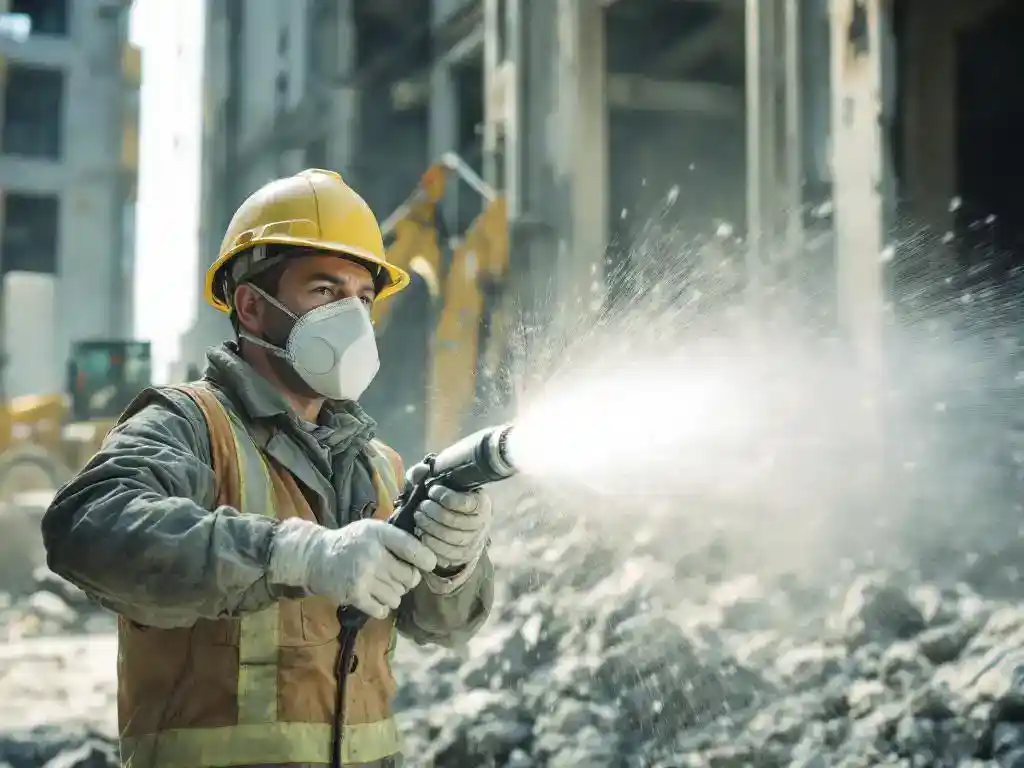
The three biggest misconceptions about dust nuisance at mining sites are: that spraying water is sufficient to control dust, that effective dust control is always expensive and disruptive, and that a single method works for all materials. In reality, dust control at mining sites requires an approach tailored to the specific material, conditions and process. The questions below provide a clear answer to each misconception.
Why is dust pollution on mining sites more difficult to control than anticipated?
Dust pollution at mining sites is more difficult to control than anticipated because conditions are constantly changing and the material itself varies greatly. Wind, temperature, humidity and the fineness of dust particles together determine how dust behaves. Anyone who fails to take this into account will quickly end up choosing a method that looks sound on paper but falls short in practice.
Mining sites are not controlled environments. Materials such as ores, coal and minerals are constantly being moved, crushed and transported. Every step in that process, from the crushers to the conveyor belts and stockpiles, creates new sources of dust. Furthermore, weather conditions vary by season, meaning that a solution which works in summer may fail in winter.
Furthermore, dust particles vary in size. Coarse dust is visible and a nuisance, but it is precisely the finer particles – so-called particulate matter – that travel the furthest and pose the greatest health risks. An approach that focuses solely on visible dust therefore misses a large part of the problem. This explains why standard solutions at mining sites so often fail to deliver satisfactory results.
Is spraying water sufficient to control dust on mining sites?
Simply spraying water is not sufficient to effectively control dust on mining sites. Water temporarily moistens the material, but evaporates quickly in the heat and wind. Furthermore, plain water does not reduce surface tension, meaning that finer dust particles are not effectively bound. The result is high water consumption with a limited and short-lived effect.
This is one of the most common misconceptions in the sector. Many companies invest in misting systems and assume that this solves the dust problem. In practice, they find that dust nuisance returns after a short time, particularly in dry and windy weather or with materials that dry out quickly.
A more effective approach combines water with additives that reduce the surface tension of water. As a result, the water droplets penetrate deeper into the material and it remains damp for longer. Products such as atomisation additives can make water up to ten times more effective, with significantly lower water consumption as an added benefit. This is not only better for dust control, but also for the sustainability of the process. Finding out more about these kinds of dust control solutions reveals which techniques make a real difference in practice.
Does dust control always entail high costs and significant disruption?
Effective dust control need not entail high costs or major operational disruptions. Modern methods are designed to integrate seamlessly into existing processes, without the need to halt production. Furthermore, the investment pays for itself through reduced material losses, less equipment maintenance and the avoidance of fines for non-compliance with environmental legislation.
The misconception that dust control is, by definition, expensive often stems from experiences with outdated or ill-conceived systems. Large installations, intensive maintenance and high water bills can indeed add up. However, this does not apply to well-tailored solutions based on the specific on-site situation.
Starting small with a pilot scheme is a proven way to minimise risk. By first testing on a small scale using your own resources, the results can be measured before a major investment is made. This makes it clear what works, what it costs and what it delivers, without disrupting day-to-day operations.
Are all dust control methods suitable for every type of mining material?
Not all dust control methods are suitable for every type of mining material. The choice of method depends on the properties of the material, such as grain size, moisture sensitivity and chemical composition. A method that works excellently with coal may, conversely, cause problems or have no effect whatsoever when used with ores or minerals.
This is the third major misconception: that dust control is a generic solution that can simply be applied. In reality, every material reacts differently to water, foam or crust formation. Some materials are hydrophobic, meaning that water penetrates them poorly. Other materials react chemically to certain additives, which can cause undesirable effects.
Below is an overview of common methods and their scope of application in mining environments:
- Crust formation: suitable for stockpiles and storage areas where the material remains undisturbed for extended periods
- Foam formation: effective for active dust sources such as crushers, conveyor belts and sorting lines
- Atomisation: applicable around transhipment points and loading and unloading activities
- Road dust control: focused on unpaved roads and transport routes on site
Choosing the right method begins with a thorough analysis of the material and the process. Laboratory tests using the client’s own material provide the most reliable basis for that choice. Companies operating in various industrial sectors each have their own specific substance-related issues that require a targeted approach.
Which dust control method works best in mining environments?
There is no single, universally best dust control method for mining environments. The most effective approach combines multiple techniques tailored to the specific dust sources, the material and the operational conditions on site. In practice, a combined approach involving the use of foam at active sources and the formation of a dust crust at storage areas often yields the best results.
In active processes, such as the crushing and transport of material, foam formation is a proven technique. Foam binds dust particles directly at the source, before they enter the air. It is applied under pressure via spray bars and nozzles, which ensures even distribution without weighing down the material.
For stockpiles and storage sites, crust formation is the recommended method. A crusting agent forms a protective layer over the material that traps dust particles, even in strong winds. Biodegradable crust formers are the most sustainable choice in this regard, as they leave no harmful substances in the soil or groundwater.
How do you know if a pest control solution really works for your situation?
A dust control solution is truly effective when it has been tested using the client’s own materials, under their own conditions, and demonstrates measurable results in terms of dust emissions, water consumption and material loss. Theoretical claims or general experiences reported by others serve as a starting point, but do not constitute proof that a solution is effective in a specific situation.
The most reliable way to assess this is through a laboratory test followed by a practical on-site trial. In a laboratory, the material is analysed and various additives and methods are tested for effectiveness. The most promising solution is then deployed in a controlled test setup at the site itself, so that the results are directly comparable with the existing situation.
Measurable indicators that demonstrate whether a solution works include:
- Reduction of dust concentration in the air around dust sources
- Reduction of material loss due to dust dispersion
- Lower water consumption compared with the existing method
- Fewer complaints from staff and local residents
- Compliance with applicable environmental and emissions standards
A solution that scores highly on all these points is not only effective but also sustainable and future-proof.
How we help tackle dust pollution on mining sites
We are Wuvio, specialists in industrial dust control with over ten years’ experience in mining environments and related sectors. Our approach always begins with an analysis of the material and the process, followed by a laboratory test and a practical on-site trial. This ensures you know exactly what works before a final decision is made.
- In-house laboratory for materials testing and bespoke product development
- Biodegradable additives for crust formation, foaming and atomisation, safe for people and the environment
- Bespoke installations that integrate seamlessly into existing processes
- Ongoing delivery and support, from initial testing to long-term contracts
- Active throughout Europe and the Middle East, with experience in mining, dry bulk handling, recycling and power stations
It is always possible to start small. Would you like to know whether our solution works for your situation? Read more about our approach and expertise, or contact us directly for a no-obligation consultation.
Related Articles
- How do you set KPIs for dust control on a large outdoor site?
- Is dust control sufficient during dry summers without additional measures?
- How do you combine dust control with day-to-day port operations?
- How can you prevent dust from settling on cars and buildings in the neighbourhood?
- How can you prevent reputational damage caused by dust nuisance in the local area?