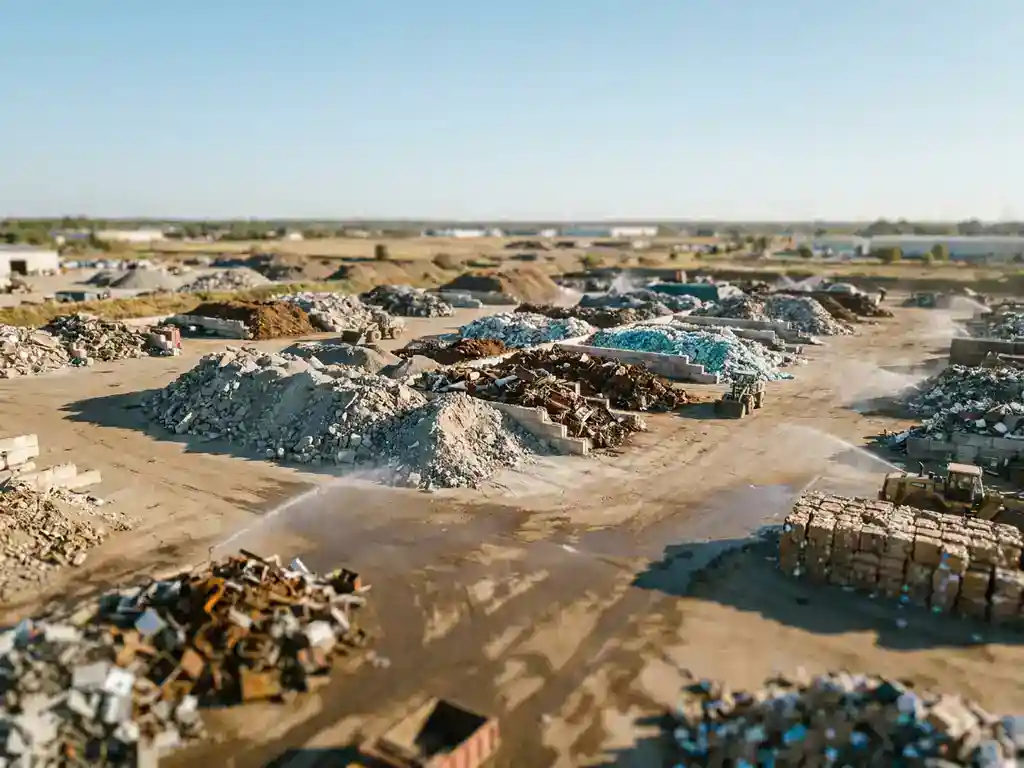
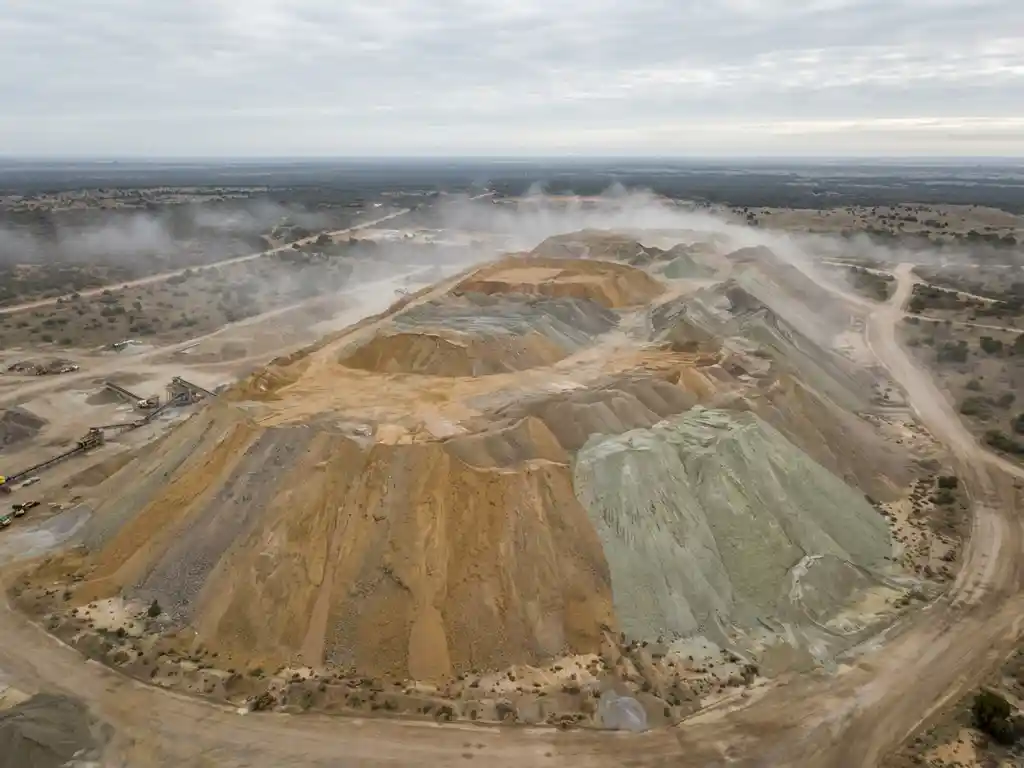
Crust-forming agents are the right choice for dust control in mining when materials are stored outdoors for long periods in stockpiles or on sites where wind and movement cause dust to become airborne. They form a protective layer on the surface of the material that traps dust particles at source. However, crust formation only works effectively as part of a broader dust control strategy: first, you determine where, when and under what conditions dust is generated; then, you select the appropriate technique for each location, material and process. The sections below answer the most frequently asked questions about crust formation in the mining industry.
What effect does a crust-forming agent have on the surface of the material?
A crust-forming agent penetrates the top layer of a material’s surface and binds the loose particles together to form a solid, cohesive crust. This crust acts as a physical barrier that prevents wind or vibrations from dislodging and dispersing dust particles. The material beneath remains unaffected and freely accessible for further processing.
The mechanism is comparable to stabilising a sandpit: the top layer is bound, whilst the structure underneath remains intact. With products such as EcoCrust S and Freko-Crust, this is achieved using water combined with natural fibres and additives which, once dry, form a flexible yet weather-resistant crust. This crust is resistant to rain and wind, but biodegrades as soon as the material is reprocessed or disposed of.
An important detail: the crust also reduces bulk loss. With dry bulk materials such as ores or coal, material is often lost during transport and storage due to dust emissions. An effective crust former holds that material together, which has a direct impact on yield.
Furthermore, a crust-former does not consume a continuous flow of water. Whereas water only binds dust temporarily and evaporates quickly, an additive ensures more sustainable dust binding with more efficient water use. More water therefore does not automatically mean more effective dust control.
On which materials does crust formation work best?
Crust formation works best with dry, fine-grained materials that are susceptible to wind dispersal and are stored in one location for an extended period. Examples include coal, ores, fly ash, sand and gravel. These materials have a surface structure that absorbs the binding additives effectively, ensuring that the crust adheres well and is durable.
For materials with a high moisture content or a greasy or sticky texture, crust formation is less effective, as the bond does not form as well. Materials that are frequently turned or moved are also less suitable for crust formation, as the crust is constantly being broken up.
In the mining sector, stockpiles of mining residues, finely ground ores and carbon-containing materials are the most common applications. It is precisely with these materials that dust control through crust formation is effective, as the particles are small and light and become airborne quickly in dry conditions.
Bear in mind that materials within a single mining site can vary significantly in grain size, moisture content and duration of storage. The correct formulation and dosage are therefore almost always tailored to each specific material and location.
What is the difference between crust formation and atomisation in dust control?
Crust formation and atomisation are both effective methods for dust control, but they work in fundamentally different ways. Crust formation traps dust at the source by forming a protective layer on the surface of the material. Atomisation captures dust particles in the air by creating a mist curtain of fine water droplets around the dust source.
Crust formation: recording at source
Crust formation is a passive, long-term solution. Once formed, the crust protects the material for weeks or months without requiring a continuous supply of energy or water. This makes it particularly suitable for static storage situations, such as stockpiles on mining sites.
Atomisation: actively intervening in the air
Mist spraying is an active method that operates continuously as long as dust is being generated. It is effective in dynamic processes such as loading, unloading, crushing or screening, where dust is released at the moment of processing. Mist suppression requires a system with spray nozzles and a constant water supply, and works best in combination with an additive such as Freko-Humidifier, which reduces the surface tension of water and increases its absorption capacity. This means less water is needed to achieve the same result.
The choice between the two methods depends on the type of dust source: static or dynamic. In the mining industry, both techniques are often combined: crust formation for the stockpiles, and atomisation at the processing sites.
How do you determine where crust formation is needed? Start with the dust hotspots
Before choosing a technique, you must map out the dust hotspots: where does the dust originate, when does it arise, and under what conditions? A pile of material that kicks up a lot of dust in a force 5 wind requires a different approach to a loading bay that only produces dust during operating hours.
A practical assessment consists of the following steps:
- Identifying sources: walk the site and note down all potential sources of material, from stockpiles and roads to crushing plants, transhipment points and conveyor belts.
- Identify the circumstances: consider wind direction and speed, drought, time of day, season and business activity. Dust peaks are often linked to a combination of these factors.
- Involve operators: staff on the ground know from experience which locations and times are problematic. That knowledge is often more valuable than a one-off inspection.
- Prioritisation: rank the hotspots according to their contribution to emissions and their impact on local residents and staff. This allows you to allocate resources where they will have the greatest effect.
Static sources, such as piles of stored material, lend themselves to crust formation; dynamic sources require atomisation or foam formation. Only after this analysis can a choice of agent and dosage be properly justified.
When is crust formation not the right choice?
Crust formation is not the right choice when materials are frequently converted, moved or processed. Any mechanical disturbance causes the crust to break open, causing it to lose its function. In such situations, an active method such as atomisation or foaming is more appropriate.
Furthermore, crust formation is less suitable for:
- Wet or damp materials: the bond does not form properly on a surface that is already saturated
- High-turnover materials: the crust is disrupted too quickly to be effective
- Dynamic dust sources: such as crushers, conveyor belts or loading and unloading points, where dust is released during movement and cannot be bound to a surface
- Situations where the crust affects material quality: in specific processing procedures, a crust can have undesirable effects on the composition
In such cases, industrial dust control via foaming or atomisation offers a better solution. A thorough analysis of the process and the material is always the first step in determining the correct approach.
How are crust-forming agents used in mining?
Crust-forming agents are applied in the mining industry via spraying systems that distribute the diluted agent over the surface of a stockpile or site. Once dry, the product forms a solid crust that protects the material from being blown away by the wind. The application is easy to automate and requires minimal operator intervention.
The practical application generally involves three steps:
- Preparation and dosage: the crust-forming agent is diluted with water in the correct ratio, depending on the type of material and the desired crust thickness.
- Application: the product is distributed evenly over the surface via mobile spraying systems or fixed spray nozzles. For large stockpiles, this is often carried out using a tanker lorry.
- Curing: after application, the crust dries within a few hours, depending on temperature and humidity. The crust is then immediately active.
The frequency of re-treatment depends on weather conditions, the type of material and the degree of exposure to wind and precipitation. During dry periods or in strong winds, a shorter treatment interval may be required.
The dosage, type of spraying equipment and application interval that work best vary depending on the location and material. You should therefore measure the results and adjust your approach based on the data, rather than continuing to follow a fixed procedure.
How do you measure and validate whether crust formation works?
A crust that looks good is not in itself proof of emission reduction. Measurement and validation make the difference between assuming and demonstrating. Common methods include:
- Particulate matter measurements: continuous measurements of PM10 and PM2.5 at the site boundary and near sensitive locations show whether concentrations are falling, and under which weather conditions peaks occur.
- LiDAR: LiDAR measurements make dust plumes visible across a larger area. This allows you to see which sources are actually contributing and whether the measure has an effect on plume formation.
- Visual inspection of the crust: check regularly for cracks, irregularities and thin spots, so that you can reapply treatment in good time.
- Baseline measurement and comparison: document the situation prior to intervention, so that the effect can be substantiated afterwards.
Use the measurement data to further optimise dosage, treatment intervals and equipment. This allows you to improve the results step by step and prevent unnecessary consumption of chemicals and water.
Which laws and regulations influence the choice of dust control measures in the mining industry?
In the mining sector, strict standards apply to dust emissions, both in terms of air quality and working conditions. The European Directive on Air Quality (2008/50/EC) sets limit values for particulate matter (PM10 and PM2.5) in ambient air. At national level, Member States translate these standards into specific emission requirements for industrial activities, including mining and bulk storage.
Factors relevant to the choice of a pest control method include, amongst others:
- Environmental permits: mining companies are obliged to limit dust emissions as part of their environmental permit. Exceeding the limits leads to enforcement action and fines.
- Health and Safety Legislation: employees’ exposure to respirable dust is subject to limit values. Particularly strict standards apply to quartz dust (found in many ores) due to the risk of silicosis.
- Environmental Act (Netherlands): regulates the impact of industrial activities on the environment, including dust nuisance for local residents.
- Requirements for dust control agents: the additives used must not contain any hazardous substances that pollute the environment or groundwater. Biodegradable agents meet these requirements and, in most cases, comply with regulatory requirements.
The choice of a crust-forming agent must demonstrably contribute to meeting these standards. Documentation of the treatment, the agents used and the measured results serves as a practical aid during inspections or when applying for permits.
Looking ahead to 2030: stricter requirements and a licence to operate
It is expected that requirements relating to particulate matter will become even stricter in the run-up to 2030. Stricter limit values for PM10 and PM2.5, a more prominent role for BAT (Best Available Techniques) requirements, and tighter emission limits for diffuse sources of particulate matter are the key developments in this regard. Anyone who currently merely responds to complaints or to the current minimum requirements runs the risk of falling behind later on.
Structural dust control is therefore more than just an environmental measure. It directly affects the licence to operate: both the regulatory permit and the public support required to continue production. Dust nuisance affecting local residents, regulatory breaches or suspended operations threaten business continuity. A well-founded, measured and documented approach makes the company more resilient when it comes to obtaining permits, compliance and dialogue with the local community.
How we help with crust formation in the control of mining dust
We assist mining companies in selecting and implementing the right dust control solution, from an initial analysis through to the ongoing supply of materials and on-site support. Our approach:
- Laboratory testing with our own materials: each material reacts differently to a crust-forming agent. We test the material in our own laboratory to determine the correct formulation and dosage.
- Tailored advice: based on the type of material, the storage situation and the applicable laws and regulations, we devise a suitable approach.
- EcoCrust S and Freko-Crust: our crust-forming agents are biodegradable, safe for people and the environment, and demonstrably effective at reducing dust emissions by more than 90 per cent.
- Installation and automation: we provide the installation of sprinkler systems that are easy to operate and can be fully automated.
- Ongoing delivery and support: even after implementation, we remain involved in the execution and optimisation.
Looking for an effective solution for industrial dust control? We’d be happy to help you find a suitable approach. Take a look at our dust control solutions or get in touch for personalised advice.
Related Articles
- What are the 5 ways to improve dust control on mining conveyor belts?
- Can dust nuisance in biomass storage cause spontaneous combustion?
- What is the difference between reactive and preventive dust control?
- How does dust control in the steel industry differ from that in other heavy industries?
- When will dust control become a legal requirement in the Netherlands in 2026?