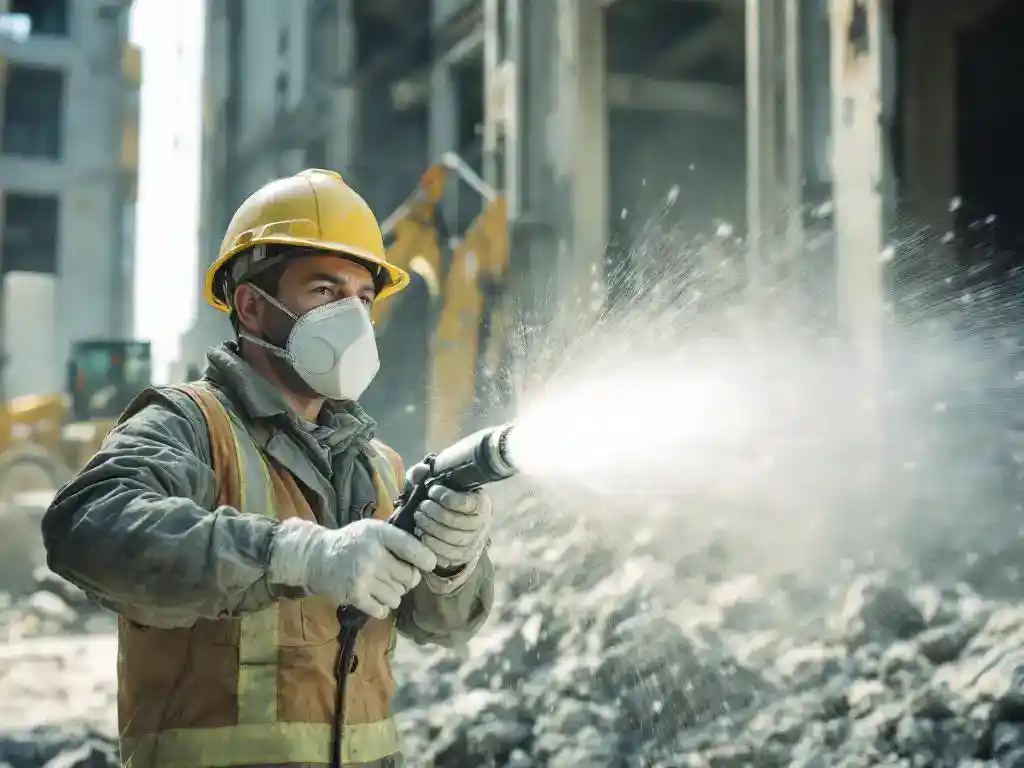
Reactive dust control involves intervening after dust has already been released or is causing problems. Preventive dust control focuses on preventing dust formation before the problem arises. The difference, therefore, lies in the timing of intervention: after the event versus beforehand. For industrial environments, this choice determines costs, health risks and compliance with environmental legislation. This article answers the most frequently asked questions about both approaches and helps you determine which strategy best suits your situation.
When is dust control reactive and when is it preventive?
Dust control is reactive when action is only taken after dust has become visible, complaints have been received or measurements show that limits have been exceeded. Preventive dust control is implemented before dust is released, by tackling the source or treating materials in advance, so that dust formation occurs not at all or only to a very limited extent.
In practice, reactive behaviour is often seen in situations where dust nuisance is regarded as a given. Water is sprayed as soon as a dust cloud becomes visible, or complaints from local residents are awaited before any changes are made. Preventive approaches are proactive in nature: they form part of the process, not a reaction to a problem.
Which methods fall under preventive substance management?
Preventive dust control encompasses all techniques that prevent dust formation at source. Examples include crust formation on storage sites, moistening materials prior to transport or transhipment, and the application of foam-forming additives on conveyor belts or crushers. The aim is always the same: to bind dust particles before they are released.
The most commonly used preventative methods in the industry are:
- Crusting: a protective layer on stockpiles or storage surfaces that prevents wind or movement from stirring up dust
- Foam formation: additives that bind dust particles at dust sources such as sorting lines, crushers and transhipment points
- Atomisation: a mist curtain around the dust source that uses fine water droplets to settle dust particles before they disperse
- Road dust control: treating unpaved roads with hygroscopic additives so that the road surface remains damp for longer
- Pre-wetting: bringing the material to the correct moisture balance before processing or transhipment
What preventive methods have in common is that they are structurally embedded within the process. They do not rely on human intervention the moment dust becomes visible.
What are some examples of reactive dust control in industry?
Reactive dust control can be recognised by interventions that take place after dust has already become a problem. Common examples include manually spraying water onto a dust cloud, deploying a street-sweeper following complaints from local residents, or covering a stockpile after measurements show that limits have been exceeded.
Other reactive measures that frequently occur in the industry:
- Temporarily increasing the watering frequency during dry spells
- Erecting emergency screens or tarpaulins around dust sources following a complaint
- Deployment of additional cleaning teams following an incident
- Adjusting working methods following an enforcement inspection
These interventions resolve the immediate problem but do not address the root cause in a structural way. Consequently, the same problems recur.
What are the drawbacks of purely reactive dust management?
Reactive dust management alone structurally leads to higher costs, greater health risks and a higher likelihood of fines or enforcement action. Because action is only taken after dust has already been released, the exposure of staff and the surrounding environment is already a fact. This makes reactive management more expensive and riskier in the long term than preventive action.
The main drawbacks at a glance:
- Health risks: staff are exposed to particulate matter before any action is taken
- Higher operational costs: frequent, unplanned interventions are more expensive than a structural approach
- Compliance risk: environmental legislation prescribes emission standards; reactive management more often leads to breaches and associated penalties
- Production losses: dust nuisance can slow down or temporarily halt processes
- Reputational damage: complaints from local residents or negative media coverage are difficult to reverse
Organisations that operate exclusively on a reactive basis also run the risk of having to reinvest in temporary solutions every time regulations are tightened, without having laid a sustainable foundation.
Which approach is best suited to which substance-related problem?
The choice between a preventative and a reactive approach depends on the type of dust source, the frequency of the problem and the risk classification of the material. For structural dust sources such as storage areas, conveyor belts or unpaved roads, a preventative approach is almost always more effective. In the case of occasional or unforeseen situations, reactive intervention may be a necessary supplement.
| Situation | Recommended approach | Example |
|---|---|---|
| Structural source of dust in the production process | Preventive | Crust formation on stockpiles, foam on conveyor belts |
| Unpaved roads on a building site or grounds | Preventive | Road dust control using hygroscopic additives |
| Temporary work or one-off projects | Reactive as a supplement | Using a mobile misting system whilst carrying out work |
| Unexpected surge in dust levels due to weather conditions | Reactive as an emergency measure | Extra watering in the event of drought or strong winds |
Most industrial environments benefit from a combination: a preventative approach that tackles structural sources of dust, supplemented by reactive measures for exceptional situations. Examine the sectors where dust control plays a role to see which approach is most common in a specific industry.
How do you start with preventative dust control if you are currently working reactively?
The transition from reactive to preventive dust management begins with identifying the sources of dust within the process. Which points cause structural dust generation? What is the nature of the material? And under what circumstances does dust generation increase? Based on this analysis, it is possible to select targeted preventive measures that are suited to the material and the process.
A practical, step-by-step approach:
- Map out dust sources: identify the points in the process where dust is systematically released
- Analyse the material: the properties of the material determine which technique is most effective
- Start with a test: have a representative sample analysed in a laboratory to determine the correct additives or technique
- Implement at a single location: start small, measure the impact and scale up once the results demonstrate that the approach works
- Integrate into the process: ensure that the preventative measure becomes part of the standard working method, rather than a one-off intervention
Starting small with a lab test or an on-site pilot lowers the barrier to entry and makes it possible to justify the investment before scaling up.
How we assist with the transition to preventive substance management
Wuvio supports organisations at every stage of the transition from reactive to preventive dust management. This begins with an analysis of the dust source and the material, followed by a laboratory test to determine the most effective approach. This is followed by a bespoke installation that can be fully automated, supplemented by a continuous supply of biodegradable additives.
- In-house laboratory for material testing and product development
- Solutions for crust formation, foaming, atomisation and road dust control
- All products are biodegradable and safe for people and the environment
- Operating in Europe and the Middle East, with experience in dry bulk, recycling, mining and energy production
- Pest control as a service: from advice to ongoing provision
Would you like to know which approach suits your dust problem? Find out more about our working method or contact us directly for a no-obligation consultation.
Related Articles
- Dust control in infrastructure projects: how do you go about it?
- How do you adapt dust control measures to changing weather conditions?
- Which method is suitable for dust control on a stockpile?
- How do you protect employees from dust in the workplace?
- What can you do about dust that blows off a rubbish tip onto the road?