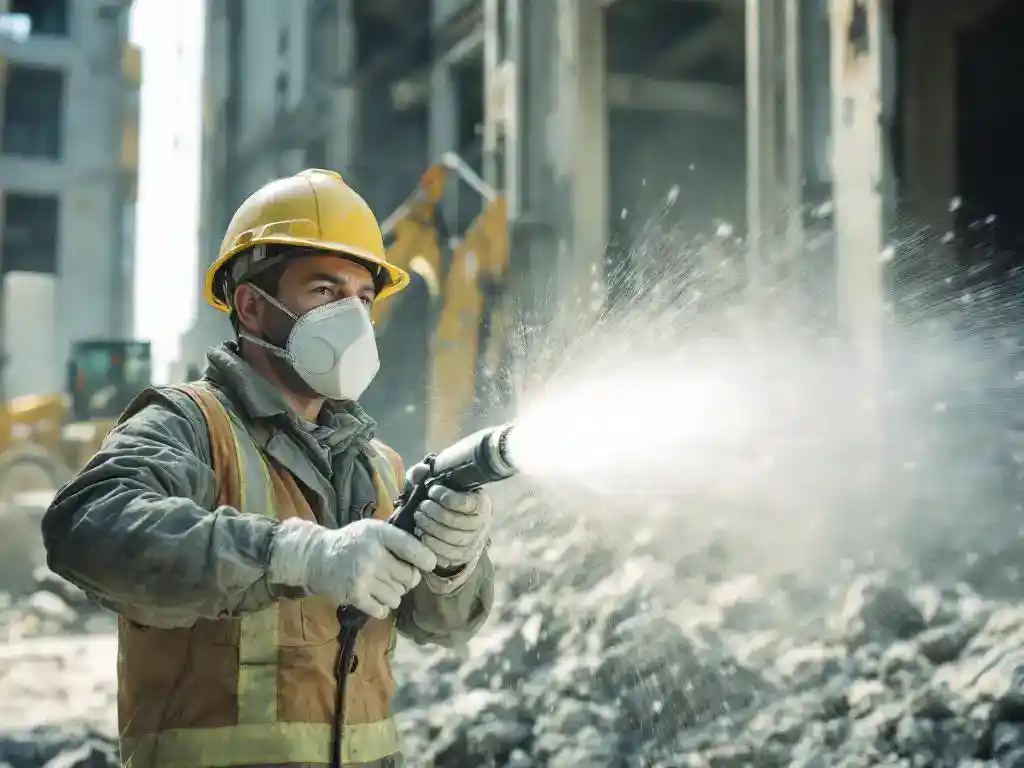
Choosing the right dust suppressant for mining dust control depends on three factors: the type of material, the source of the dust and the on-site conditions. You should therefore always start by identifying the dust hotspots: where does the dust originate, when and under what conditions? Crust formation works well for storage heaps and stockpiles, whilst foam formation is better suited to active crushers and conveyor belts. Biodegradable additives are now just as effective as traditional chemical agents and also comply with modern environmental legislation. The questions below will help you make the right choice, step by step.
What types of dust suppressants are used in mining?
In the mining industry, three main types of dust suppressants are used: crust formation, foaming and wetting. Crust formation creates a protective layer on the material, foam formation binds dust particles at active dust sources, and wetting reduces the surface tension of water so that fine dust is bound more effectively. Which type works best varies depending on the situation.
Mining sites have multiple sources of dust simultaneously: stockpiles of ore or coal, conveyor belts, crushers, and loading and unloading points. Each of these sources requires a different approach. With stockpiles, the focus is on preventing dust from being stirred up by wind and movement. With crushers and conveyor belts, however, dust is generated by mechanical stress on the material. An effective dust control strategy therefore often combines several techniques, tailored to the hotspots at your site.
A dust suppressant is not a stand-alone solution, but part of a broader dust control strategy. This strategy directly addresses emissions, air quality and compliance with permit requirements, and thus the business continuity and the site’s licence to operate. Structural dust control prevents complaints from local residents, operational stoppages due to enforcement actions and disputes during the permit application process.
In addition to the technology, the composition of the additive also plays a role. Water-based additives with hygroscopic properties keep material moist for longer, even in dry conditions. This makes them particularly useful in open-cast mines where wind and high temperatures accelerate dust formation.
What is the difference between crust formation and foam formation in dust control?
Crust formation and foam formation are both effective methods for dust control, but they work in fundamentally different ways. Crust formation creates a solid, protective layer on the surface of a stockpile or bulk material. Foaming binds dust particles the moment they are released, directly at the source of the dust.
In crust formation, an additive is applied to the material which, once dry, forms a solid layer. This layer prevents wind or rain from carrying away loose particles. This is particularly useful for the long-term outdoor storage of ores, coal or other dry bulk materials. The crust remains intact as long as the material is not disturbed.
Foam formation works differently: the additive is injected under pressure as foam into areas where dust is released, such as at crushers, sorting lines and overflow points. The foam envelops the dust particles and makes them heavier, causing them to settle rather than remain suspended in the air. This is an active method that operates continuously for as long as the process is running.
The choice between the two methods therefore depends on the situation: crust formation for storage, foam formation for active processes. At many sites, a combination is most effective, as storage, processing and transport each have their own dust profile.
How do you know which dust binder is suitable for your material?
You can find the right dust suppressant by first identifying the dust sources and then analysing the material for properties such as particle size, moisture content, specific gravity and chemical composition. A dust suppressant that works well with fine coal dust may not work with coarse ore. Material-specific testing is the most reliable way to make the right choice.
A practical four-step approach:
- Map out the hotspots: determine where dust is generated, at what times (for example, in dry weather, strong winds or during peak process loads) and under what conditions. Operators often know the dust sources best and can provide valuable information in this regard.
- Analyse the material: examine the grain size, moisture content and composition.
- Test using your own material: assess in the laboratory how the material reacts to various additives.
- Validate in practice: measure the effect on site and adjust dosage and equipment as necessary.
Some guidelines for each type of material:
- Fine-grained material (fly ash, fine ore): reacts well to crust formation due to its high susceptibility to dust dispersion in windy conditions
- Coal and biomass: requests for additives that keep the moisture content stable without affecting the calorific value
- Coarsely crushed stone: benefits more from wetting or foaming during the crushing process
- Recycled and mixed materials: require an additive that is versatile and does not cause hazardous reactions
A laboratory test using the client’s own materials provides the most reliable outcome. This test assesses how the materials react to various additives, under conditions comparable to those encountered on site. As sites, materials and processes vary, the correct technique, dosage and equipment may require a bespoke approach for each situation. Only then is it possible to make an informed choice.
When does a dust suppressant not work well enough in the mining industry?
A dust binder performs poorly if it is not tailored to the specific material, the environmental conditions or the application. The most common causes are incorrect dosage, an unsuitable application method or the use of a generic product that has not been tested on the material in question.
Specific situations in which dust binders fall short:
- The material has too low a moisture content to absorb the additive properly
- The ambient temperature is too high, causing the additive to evaporate too quickly
- The source material is too dynamic (constant change, high volume) for a static crust-former
- The additive is not compatible with the chemical composition of the material
- The application is not uniform enough, meaning that parts of the material remain unaddressed
- The hotspots have not been properly mapped out, meaning the additive is being deployed in the wrong place or at the wrong time
In such cases, it helps to reassess the application method and, if necessary, switch to a combination of techniques. Measure the effect, for example using particulate matter measurements or LiDAR, and use the measurement data to further optimise the dosage and equipment. Simply spraying water is rarely sufficient to tackle serious dust problems in the mining industry.
Are biodegradable dust binders just as effective as chemical alternatives?
Yes, biodegradable soil binders are just as effective as traditional chemical agents in most mining applications, provided they have been developed for the specific material and conditions. The difference lies not in their effectiveness, but in their composition: biodegradable additives contain no hazardous substances and leave no harmful residues in the soil or groundwater.
Traditional chemical binders sometimes contain petroleum products or other persistent substances that end up in the environment over time. This poses risks to the surrounding natural environment, groundwater and the health of staff. Furthermore, stricter environmental legislation coming into force in 2026 will make it increasingly difficult to justify the use of such substances.
This trend is set to continue towards 2030. Expect stricter requirements regarding particulate matter, tighter BAT (Best Available Techniques) requirements and lower emission limit values for dust. Those who invest now in well-founded, measurable and environmentally friendly dust control will be in a stronger position when it comes to permit granting and enforcement.
Biodegradable alternatives such as the crust-forming agent EcoCrust S demonstrate that sustainability and effectiveness go hand in hand. They comply with environmental standards, are safe for humans and animals, and perform comparably to chemical variants in practice, even under harsh conditions.
How is a dust suppressant applied at mining sites?
The application of a dust suppressant at mining sites is carried out via spray systems, spray bars or nozzles, depending on the dust source and the type of additive. Dust-binding agents are applied via a spray truck or a fixed installation on the stockpile. Foam is injected via automated spray bars directly at the source of the dust.
The application can be set up manually, semi-automatically or fully automatically. Fully automated systems are useful for continuous processes such as crushers and conveyor belts, where manual operation is impractical. Sensors and timers then ensure that the additive is dispensed at the right time and in the correct dosage.
A different approach applies to road dust control on mining sites: the additive is applied to the carriageway via a spray vehicle, after which its hygroscopic effect keeps the surface slightly damp for a prolonged period. This significantly reduces dust kicked up by moving traffic.
Incidentally, effective dust control does not automatically mean using more water. Where water evaporates quickly, additives keep the surface and the carriageway moist for longer and bind the dust more effectively. This can actually reduce overall water consumption, for example because fewer watering sessions are required. The exact dosage and equipment required depend on the location and the material, and are best determined on the basis of practical measurement data.
Monitor the results systematically. Particulate matter measurements and LiDAR measurements show whether dust emissions are actually falling and whether the approach complies with the applicable limit values. This data also serves as supporting evidence for the licensing authority and regulatory body, and helps to fine-tune dosage, nozzles and spray times.
A good installation is easy to use, requires little maintenance and integrates with the site’s existing infrastructure.
How we help with dust control in the mining industry
At Wuvio, we always begin with an analysis of the material and the situation on site. Every dust problem is different, and a generic solution rarely leads to the desired result. That is why we test the material in our own laboratory before making a recommendation.
What we offer:
- Lab tests using our own materials: this way, we can be certain which additive works best
- Bespoke installations: tailored to the dust sources and the process at your site
- Biodegradable additives: safe for people, animals and the environment, without hazardous chemicals
- Ongoing delivery and support: from initial testing to long-term collaboration
- Expertise in mining, dry bulk, recycling and more: with experience across Europe and the Middle East
Looking for an effective solution for industrial dust control? We’d be happy to help you find a suitable approach. Take a look at our dust control solutions or get in touch for personalised advice.
Related Articles
- What are the seven key considerations for dust control in a seaport?
- Dust control in dry bulk: which approach works?
- How do you tackle dust control during a drought?
- What should a company measure and report regarding dust emissions?
- What changes are coming to European environmental legislation on dust emissions in 2026?